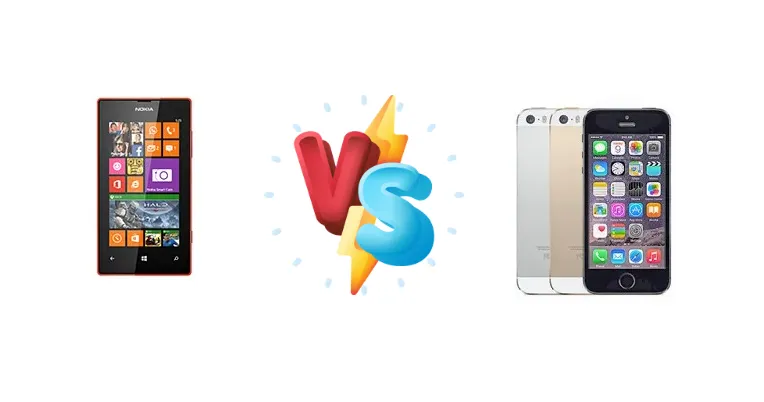
The Nokia Lumia 525 and Apple iPhone 5s represent different eras of smartphone design and philosophy. The Lumia 525 aimed for affordability and Windows Phone charm, while the iPhone 5s brought significant advancements to Apple's lineup. Let's dive into a detailed comparison to see which phone holds up best today.
🏆 Quick Verdict
The iPhone 5s, despite its age, edges out the Lumia 525 thanks to its superior processor, more polished iOS experience, and generally better camera. While the Lumia 525 offers a budget-friendly entry point, the iPhone 5s provides a more robust and enduring user experience.
| Network |
|---|
| 2G bands | GSM 850 / 900 / 1800 / 1900 - RM-998 | GSM 850 / 900 / 1800 / 1900 - all models |
| 3G bands | HSDPA 900 / 2100 - RM-998 | HSDPA 850 / 900 / 1700 / 1900 / 2100 - A1533 (GSM), A1453 |
| 4G bands | 1, 3, 7, 8, 20, 28, 38, 40 | 1, 2, 3, 4, 5, 8, 13, 17, 19, 20, 25 - A1533 GSM, A1533 CDMA |
| Speed | HSPA 21.1/5.76 Mbps | HSPA 42.2/5.76 Mbps, LTE Cat3 100/50 Mbps, EV-DO Rev.A 3.1 Mbps |
| Technology | GSM / HSPA | GSM / CDMA / HSPA / EVDO / LTE |
| | - | 1, 2, 3, 5, 7, 8, 20, 38, 39, 40 - A1530 |
| Launch |
|---|
| Announced | 2013, November. Released 2014, January | 2013, September 10. Released 2013, September 20 |
| Status | Discontinued | Discontinued |
| Body |
|---|
| Build | Glass front, glass back, aluminum frame | Glass front (Corning-made glass), aluminum back, aluminum frame |
| Dimensions | 119.9 x 64 x 9.9 mm, 75.7 cc (4.72 x 2.52 x 0.39 in) | 123.8 x 58.6 x 7.6 mm (4.87 x 2.31 x 0.30 in) |
| SIM | Micro-SIM | Nano-SIM |
| Weight | 124 g (4.37 oz) | 112 g (3.95 oz) |
| Display |
|---|
| Protection | Scratch-resistant glass | Corning Gorilla Glass, oleophobic coating |
| Resolution | 480 x 800 pixels, 5:3 ratio (~233 ppi density) | 640 x 1136 pixels, 16:9 ratio (~326 ppi density) |
| Size | 4.0 inches, 45.5 cm2 (~59.3% screen-to-body ratio) | 4.0 inches, 44.1 cm2 (~60.8% screen-to-body ratio) |
| Type | IPS LCD | IPS LCD |
| Platform |
|---|
| CPU | Dual-core 1.0 GHz | Dual-core 1.3 GHz Cyclone (ARM v8-based) |
| Chipset | Qualcomm MSM8227 | Apple A7 (28 nm) |
| GPU | Adreno 305 | PowerVR G6430 (quad-core graphics) |
| OS | Microsoft Windows Phone 8, upgradable to 8.1 | iOS 7, upgradable to iOS 12.5.7 |
| Memory |
|---|
| Card slot | microSDXC (dedicated slot) | No |
| Internal | 8GB 1GB RAM | 16GB 1GB RAM, 32GB 1GB RAM, 64GB 1GB RAM |
| Main Camera |
|---|
| Features | LED flash, panorama, HDR | Dual-LED dual-tone flash, HDR |
| Single | 5 MP, 1/4.0", AF | 8 MP, f/2.2, 29mm (standard), 1/3.0", 1.5µm, AF |
| Triple | 48 MP, f/1.8, 26mm (wide), 1/2.0", 0.8µm, PDAF
8 MP, f/2.2, 120˚, 15mm (ultrawide), 1/4.0", 1.12µm
5 MP, f/2.4, (depth) | - |
| Video | 720p@30fps | 1080p@30fps, 720p@120fps |
| Selfie camera |
|---|
| Features | HDR | face detection, HDR, FaceTime over Wi-Fi or Cellular |
| Single | 16 MP, f/1.9, 29mm (standard), 1/3.06, 1.0µm | 1.2 MP, f/2.4, 31mm (standard) |
| Video | 4K@30fps, 1080p@30fps | 720p@30fps |
| | No | - |
| Sound |
|---|
| 3.5mm jack | Yes | Yes |
| 35mm jack | Yes | Yes |
| Loudspeaker | Yes | Yes |
| | - | 16-bit/44.1kHz audio
|
| Comms |
|---|
| Bluetooth | 4.0, A2DP, LE/ aptX after WP8 Denim update | 4.0, A2DP |
| NFC | No | No |
| Positioning | GPS, GLONASS | GPS, GLONASS |
| Radio | FM Radio | No |
| USB | microUSB 2.0 | Lightning, USB 2.0 |
| WLAN | Wi-Fi 802.11 b/g/n, hotspot | Wi-Fi 802.11 a/b/g/n, dual-band, hotspot |
| Features |
|---|
| Sensors | Accelerometer, proximity | Fingerprint (front-mounted), accelerometer, gyro, proximity, compass |
| Battery |
|---|
| Charging | 15W wired, QC3
9W wireless | - |
| Music play | Up to 48 h | - |
| Stand-by | Up to 336 h (2G) / Up to 336 h (3G) | Up to 250 h (3G) |
| Talk time | Up to 17 h (2G) / Up to 10 h 40 min (3G) | Up to 10 h (3G) |
| Type | Li-Ion 1430 mAh, removable (BL-5J) | Li-Po 1560 mAh, non-removable (5.92 Wh) |
| Misc |
|---|
| Colors | Black, White, Yellow, Red | Space Gray, White/Silver, Gold |
| Models | LMG910EMW, LM-G910EMW | A1453, A1457, A1518, A1528, A1530, A1533, iPhone6,1, iPhone6,2 |
| Price | About 120 EUR | About 330 EUR |
| SAR | - | 1.12 W/kg (head) 1.18 W/kg (body) |
| SAR EU | 0.72 W/kg (head) 0.79 W/kg (body) | 1.00 W/kg (head) 0.80 W/kg (body) |
| Tests |
|---|
| Audio quality | - |
Noise -93.6dB / Crosstalk -90.3dB |
| Battery life | - |
Endurance rating 54h
|
| Camera | - |
Photo / Video |
| Display | - |
Contrast ratio: 1219:1 (nominal) / 3.565:1 (sunlight) |
| Loudspeaker | - |
Voice 68dB / Noise 66dB / Ring 69dB
|
| Performance | - |
Basemark X: 14341 |
Nokia Lumia 525
- Extremely affordable
- Clean Windows Phone interface (at the time)
- Decent call quality
- Wireless charging (9W)
- Outdated processor
- Low-resolution display
- Limited app availability (Windows Phone)
- Plastic build quality
Apple iPhone 5s
- Faster processor and smoother performance
- Better camera quality
- More robust app ecosystem (iOS)
- Premium build quality (aluminum)
- Generally longer software support (historically)
- Older design
- Small screen by modern standards
- Battery life is aging
- Limited storage options (original models)
Display Comparison
Both phones feature 4-inch displays, but the iPhone 5s boasts a higher resolution (1136 x 640 vs. 854 x 480 on the Lumia 525). The iPhone 5s's display also generally offers better color accuracy and viewing angles. While both have impressive contrast ratios (1219:1 nominal, 3.565:1 sunlight), the iPhone 5s's higher resolution gives it a noticeable edge in sharpness.
Camera Comparison
The iPhone 5s's camera (8MP) consistently delivers better image quality than the Lumia 525's (5MP). The iPhone 5s captures more detail, has better dynamic range, and produces more accurate colors. While both can record video, the iPhone 5s offers superior stabilization and overall video quality.
Performance
The iPhone 5s's Apple A7 chip (1.3 GHz dual-core Cyclone) significantly outperforms the Lumia 525's Qualcomm MSM8227 (1.0 GHz dual-core). iOS is also generally more optimized for Apple's hardware, resulting in a smoother and more responsive user experience. The Lumia 525 can feel sluggish at times, especially when multitasking.
Battery Life
Both phones are reported to have endurance ratings of 54 hours, however, real-world usage often differs. The iPhone 5s's more efficient processor and iOS optimization likely contribute to slightly better battery life in practical scenarios, despite the Lumia 525 having a slightly larger battery capacity.
Buying Guide
The Nokia Lumia 525 is ideal for users on a very tight budget who are comfortable with the Windows Phone operating system and prioritize affordability over premium features. The Apple iPhone 5s is a better choice for those seeking a more refined smartphone experience, a stronger app ecosystem, and a device that will likely receive longer-term software support (though limited now).
Frequently Asked Questions
❓ Is the Nokia Lumia 525 still worth buying?
Only if you're on an extremely tight budget and are comfortable with the limitations of Windows Phone. Otherwise, there are better options available.
❓ Can I still update the iPhone 5s?
Apple has stopped providing iOS updates for the iPhone 5s. It will no longer receive security patches or new features.
❓ Which phone has a better user interface?
The iPhone 5s with iOS generally offers a more polished and intuitive user experience compared to the Lumia 525's Windows Phone.