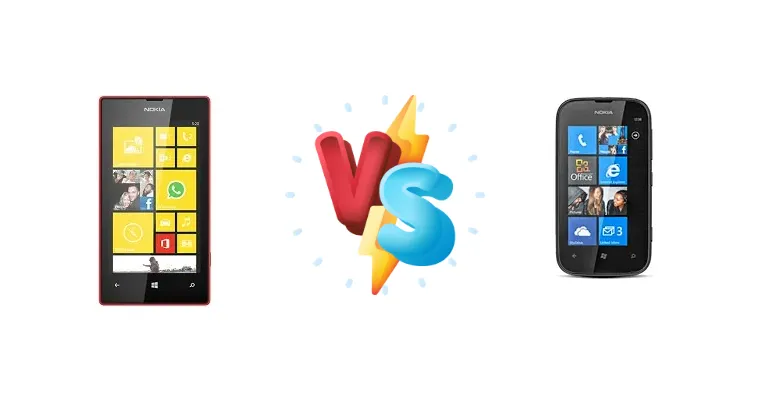
The Nokia Lumia 520 and 510 were popular budget Windows Phone options, offering a taste of Microsoft's mobile OS without breaking the bank. But which one was the better choice? This comprehensive comparison dives deep into their specs and features to help you decide.
🏆 Quick Verdict
The Nokia Lumia 520 edges out the 510 thanks to its slightly faster processor, improved chipset, and comparable battery life. While both offer excellent value, the 520's minor performance boost makes it the preferable pick for most users seeking a reliable budget Windows Phone.
| Network |
|---|
| 2G bands | GSM 850 / 900 / 1800 / 1900 - all versions | GSM 850 / 900 / 1800 / 1900 |
| 3G bands | HSDPA 900 / 2100 - RM-914 | HSDPA 850 / 900 / 1900 / 2100 |
| EDGE | - | Up to 236.8 kbps |
| GPRS | - | Up to 85.6 kbps |
| Speed | HSPA 21.1/5.76 Mbps | HSPA 7.2/0.384 Mbps |
| Technology | GSM / HSPA | GSM / HSPA |
| | HSDPA 850 / 1700 / 1900 / 2100 - RM-917 | HSDPA 850 / 1900 - RM-898 |
| Launch |
|---|
| Announced | 2013, February. Released 2013, April | 2012, October. Released 2012, November |
| Status | Discontinued | Discontinued |
| Body |
|---|
| Build | Glass front, plastic back, plastic frame | - |
| Dimensions | 119.9 x 64 x 9.9 mm, 75.7 cc (4.72 x 2.52 x 0.39 in) | 120.7 x 64.9 x 11.5 mm, 81 cc (4.75 x 2.56 x 0.45 in) |
| SIM | Micro-SIM | Micro-SIM |
| Weight | 124 g (4.37 oz) | 129 g (4.55 oz) |
| Display |
|---|
| Protection | Scratch-resistant glass | - |
| Resolution | 480 x 800 pixels, 5:3 ratio (~233 ppi density) | 480 x 800 pixels, 5:3 ratio (~233 ppi density) |
| Size | 4.0 inches, 45.5 cm2 (~59.3% screen-to-body ratio) | 4.0 inches, 45.5 cm2 (~58.1% screen-to-body ratio) |
| Type | IPS LCD | TFT, 65K colors |
| Platform |
|---|
| CPU | Dual-core 1.0 GHz | 800 MHz Cortex-A5 |
| Chipset | Qualcomm MSM8227 | Qualcomm MSM7227A Snapdragon S1 |
| GPU | Adreno 305 | Adreno 200 |
| OS | Microsoft Windows Phone 8, upgradable to 8.1 | Microsoft Windows Phone 7.8 |
| Memory |
|---|
| Call records | - | Yes |
| Card slot | microSDXC (dedicated slot) | No |
| Internal | 8GB 512MB RAM | 4GB 256MB RAM |
| Phonebook | - | 1000 entries |
| Main Camera |
|---|
| Features | - | LED flash |
| Single | 5 MP, f/2.4, 28mm (wide), 1/4.0", AF | 5 MP, AF |
| Video | 720p@30fps | 480p@30fps |
| Selfie camera |
|---|
| Features | - | LED flash |
| Single | - | 2 MP |
| Video | - | 480p |
| | No | No |
| Sound |
|---|
| 3.5mm jack | Yes | Yes |
| 35mm jack | Yes | Yes |
| Loudspeaker | Yes | Yes |
| Comms |
|---|
| Bluetooth | 4.0, A2DP, LE/ aptX after WP8 Denim update | 2.1, A2DP, EDR |
| NFC | No | No |
| Positioning | GPS, GLONASS | GPS |
| Radio | FM Radio | Stereo FM radio |
| USB | microUSB 2.0 | microUSB 2.0 |
| WLAN | Wi-Fi 802.11 b/g/n, hotspot | Wi-Fi 802.11 b/g/n |
| Features |
|---|
| Games | - | Yes |
| Java | - | No |
| Messaging | - | SMS(threaded view), MMS, IM |
| Sensors | Accelerometer, proximity | Accelerometer, proximity |
| | - | SkyDrive (7 GB cloud storage)
MP3/WAV/eAAC+/WMA player
MP4/H.264/WMV player
Document viewer
Video/photo editor |
| Battery |
|---|
| Music play | Up to 61 h | Up to 38 h |
| Stand-by | Up to 360 h (3G) | Up to 739 h (2G) / Up to 653 h (3G) |
| Talk time | Up to 14 h 40 min (2G) / Up to 9 h 40 min (3G) | Up to 6 h 15 min (2G) / Up to 8 h 25 min (3G) |
| Type | Li-Ion 1430 mAh, removable (BL-5J) | Li-Ion 1300 mAh, removable (BP-3L) |
| Misc |
|---|
| Colors | Yellow, red, cyan, white/black | White, Cyan, Black, Red, Yellow |
| Price | About 70 EUR | About 110 EUR |
| SAR | 0.77 W/kg (head) | 0.85 W/kg (head) 0.96 W/kg (body) |
| SAR EU | 1.09 W/kg (head) | 0.65 W/kg (head) |
| Tests |
|---|
| Audio quality |
Noise -82.3dB / Crosstalk -81.8dB |
Noise -79.4dB / Crosstalk -75.2dB |
| Battery life |
Endurance rating 49h
|
Endurance rating 44h
|
| Camera |
Photo / Video |
Photo |
| Display |
Contrast ratio: 834:1 (nominal) / 1.161:1 (sunlight) |
Contrast ratio: 904:1 (nominal) / 1.268:1 (sunlight) |
| Loudspeaker |
Voice 68dB / Noise 69dB / Ring 66dB
|
Voice 67dB / Noise 66dB / Ring 76dB
|
Nokia Lumia 520
- Slightly faster processor
- Newer chipset
- Video recording capability
- Comparable battery life
- Display contrast slightly lower than 510
- Mediocre camera quality
Nokia Lumia 510
- Slightly better display contrast (in sunlight)
- Lower price point (potentially)
- Slower processor
- Older chipset
- No video recording
- Slightly shorter battery life
Display Comparison
Both phones feature similar display technology and resolution (likely WVGA). The Lumia 510 boasts a marginally better contrast ratio (904:1 nominal, 1.268:1 sunlight) compared to the 520 (834:1 nominal, 1.161:1 sunlight). This suggests slightly better visibility in bright conditions on the 510, but the difference is likely minimal in real-world use. Both displays are adequate for their price range but lack the sharpness and vibrancy of more modern panels.
Camera Comparison
The Lumia 520 includes both photo and video capabilities, while the 510 is limited to photo capture only. Both phones feature a 5MP camera, but image quality is generally mediocre on both devices. Expect decent shots in good lighting conditions, but struggles in low light. The 520's video recording capability is a significant advantage.
Performance
The Lumia 520 holds a clear advantage here. It's powered by a Qualcomm MSM8227 dual-core 1.0 GHz CPU, while the 510 uses a Qualcomm MSM7227A Snapdragon S1 800 MHz Cortex-A5. The 520's faster processor and newer chipset translate to snappier app loading times and a generally more responsive user experience. While neither phone is a powerhouse, the 520 offers a noticeable improvement.
Battery Life
Battery life is comparable between the two. The Lumia 520 boasts an endurance rating of 49 hours, while the 510 clocks in at 44 hours. Both phones offer respectable battery performance for their age and usage profiles, easily lasting a full day with moderate use.
Buying Guide
The Nokia Lumia 520 is ideal for users prioritizing a slightly smoother experience and a more modern chipset. The Nokia Lumia 510 is a good option for those seeking the absolute lowest price point and are comfortable with slightly reduced performance. Both are best suited for basic tasks like calling, texting, and light web browsing.
Frequently Asked Questions
❓ Are these phones still worth buying?
Given their age, finding these phones in good condition can be challenging. While they still function, modern smartphones offer significantly better performance and features. They might be suitable for very basic use or as a backup device.
❓ What operating system do these phones use?
Both the Nokia Lumia 520 and 510 run on Windows Phone 8.1. Microsoft no longer supports this operating system, so you won't receive security updates.