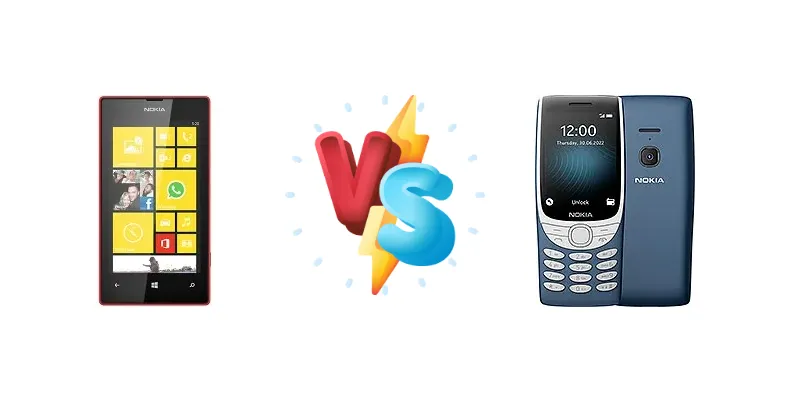
Nokia's legacy continues with these two budget-friendly options: the Lumia 520, a Windows Phone classic, and the 8210 4G, a modern feature phone. Both offer affordability, but cater to different needs. This comparison dives deep to help you decide which is right for you.
🏆 Quick Verdict
The Nokia 8210 4G wins overall, offering 4G connectivity, a more modern chipset, and improved features. While the Lumia 520 boasts impressive battery life and a surprisingly good display contrast, the 8210 4G's modern capabilities make it the better choice for most users.
| Network |
|---|
| 2G bands | GSM 850 / 900 / 1800 / 1900 - all versions | GSM 850 / 900 / 1800 / 1900 |
| 3G bands | HSDPA 900 / 2100 - RM-914 | HSDPA 850 / 900 / 2100 - International |
| 4G bands | - | 1, 3, 5, 7, 8, 20 - APAC, EU, RUCIS |
| Speed | HSPA 21.1/5.76 Mbps | HSPA, LTE |
| Technology | GSM / HSPA | GSM / HSPA / LTE |
| | HSDPA 850 / 1700 / 1900 / 2100 - RM-917 | 1, 2, 3, 4, 5, 7, 8, 28, 40 - LATAM |
| Launch |
|---|
| Announced | 2013, February. Released 2013, April | 2022, July 12 |
| Status | Discontinued | Available. Released 2022, July 28 |
| Body |
|---|
| Build | Glass front, plastic back, plastic frame | - |
| Dimensions | 119.9 x 64 x 9.9 mm, 75.7 cc (4.72 x 2.52 x 0.39 in) | 131.3 x 56.2 x 13.8 mm (5.17 x 2.21 x 0.54 in) |
| SIM | Micro-SIM | · Nano-SIM· Nano-SIM + Nano-SIM |
| Weight | 124 g (4.37 oz) | 107 g (3.77 oz) |
| Display |
|---|
| Protection | Scratch-resistant glass | - |
| Resolution | 480 x 800 pixels, 5:3 ratio (~233 ppi density) | 240 x 320 pixels, 4:3 ratio (~143 ppi density) |
| Size | 4.0 inches, 45.5 cm2 (~59.3% screen-to-body ratio) | 2.8 inches, 24.3 cm2 (~32.9% screen-to-body ratio) |
| Type | IPS LCD | TFT LCD |
| Platform |
|---|
| CPU | Dual-core 1.0 GHz | 1.0 GHz Cortex-A7 |
| Chipset | Qualcomm MSM8227 | Unisoc T107 (22 nm) |
| GPU | Adreno 305 | - |
| OS | Microsoft Windows Phone 8, upgradable to 8.1 | - |
| Memory |
|---|
| Call records | - | Yes |
| Card slot | microSDXC (dedicated slot) | microSDHC |
| Internal | 8GB 512MB RAM | 128MB 48MB RAM |
| Phonebook | - | Yes |
| Main Camera |
|---|
| Features | - | LED flash |
| Single | 5 MP, f/2.4, 28mm (wide), 1/4.0", AF | 0.3 MP |
| Video | 720p@30fps | Unspecified |
| Sound |
|---|
| 3.5mm jack | Yes | Yes |
| 35mm jack | Yes | Yes |
| Loudspeaker | Yes | Yes |
| Comms |
|---|
| Bluetooth | 4.0, A2DP, LE/ aptX after WP8 Denim update | 5.0, A2DP, LE |
| NFC | No | No |
| Positioning | GPS, GLONASS | No |
| Radio | FM Radio | Wireless FM radio |
| USB | microUSB 2.0 | microUSB 2.0 |
| WLAN | Wi-Fi 802.11 b/g/n, hotspot | No |
| Features |
|---|
| Games | - | Yes |
| Java | - | No |
| Messaging | - | SMS, MMS |
| Sensors | Accelerometer, proximity | - |
| Battery |
|---|
| Music play | Up to 61 h | - |
| Stand-by | Up to 360 h (3G) | - |
| Talk time | Up to 14 h 40 min (2G) / Up to 9 h 40 min (3G) | - |
| Type | Li-Ion 1430 mAh, removable (BL-5J) | Li-Ion 1450 mAh, removable |
| Misc |
|---|
| Colors | Yellow, red, cyan, white/black | Sand, Blue, Red |
| Models | - | TA-1507, TA-1494, TA-1489, TA-1485, TA-1483 |
| Price | About 70 EUR | About 170 EUR |
| SAR | 0.77 W/kg (head) | 0.98 W/kg (head) 1.34 W/kg (body) |
| SAR EU | 1.09 W/kg (head) | 0.98 W/kg (head) 1.43 W/kg (body) |
| Tests |
|---|
| Audio quality |
Noise -82.3dB / Crosstalk -81.8dB | - |
| Battery life |
Endurance rating 49h
| - |
| Camera |
Photo / Video | - |
| Display |
Contrast ratio: 834:1 (nominal) / 1.161:1 (sunlight) | - |
| Loudspeaker |
Voice 68dB / Noise 69dB / Ring 66dB
| - |
Nokia Lumia 520
- Exceptional battery life (49h endurance)
- Excellent display contrast (834:1 nominal, 1.161:1 sunlight)
- Simple and reliable Windows Phone OS
- Affordable
- Outdated Windows Phone OS
- Limited app availability
- Basic camera
- Slow performance
Nokia 8210 4G
- 4G connectivity
- Modern design
- FM Radio
- More recent chipset (Unisoc T107)
- Affordable
- Basic display quality
- Limited performance
- Basic camera
- Feature phone functionality (limited smartphone features)
Display Comparison
The Lumia 520's display shines with an impressive 834:1 contrast ratio (and even better 1.161:1 in sunlight), offering vibrant colors and good visibility. The 8210 4G's display is a standard QVGA screen, adequate for its feature phone purpose but noticeably less impressive in terms of contrast and clarity. The Lumia 520 takes the display crown.
Camera Comparison
The Lumia 520 had a basic camera, capable of taking decent photos in good lighting. The 8210 4G also features a basic camera, likely with similar image quality. Neither phone excels in photography, but the Lumia 520's camera might offer slightly better results due to potentially better software optimization. It's a close call.
Performance
Here, the 8210 4G pulls ahead. While both phones have 1.0 GHz CPUs, the 8210 4G's Unisoc T107 chipset (22nm) is more efficient and modern than the Lumia 520's Qualcomm MSM8227. Expect smoother navigation and app loading on the 8210 4G, though neither phone is a powerhouse.
Battery Life
The Lumia 520's endurance rating of 49h is remarkable, showcasing its exceptional battery efficiency. The 8210 4G's battery life is respectable for a feature phone, but it doesn't match the Lumia 520's longevity. The Lumia 520 is the clear winner in battery performance.
Buying Guide
The Nokia Lumia 520 is ideal for users seeking a simple, reliable phone with exceptional battery life and a nostalgic Windows Phone experience. The Nokia 8210 4G is better suited for those needing 4G connectivity, basic smartphone features, and a more contemporary design.
Frequently Asked Questions
❓ Is the Nokia Lumia 520 still worth buying?
If you prioritize battery life and a simple, nostalgic experience, the Lumia 520 can still be a viable option. However, the lack of updates and limited app availability are significant drawbacks.
❓ What are the key differences between the Nokia 8210 4G and a smartphone?
The 8210 4G is a feature phone, meaning it offers basic functionalities like calling, texting, and FM radio. It lacks the advanced features and app ecosystem of a smartphone.