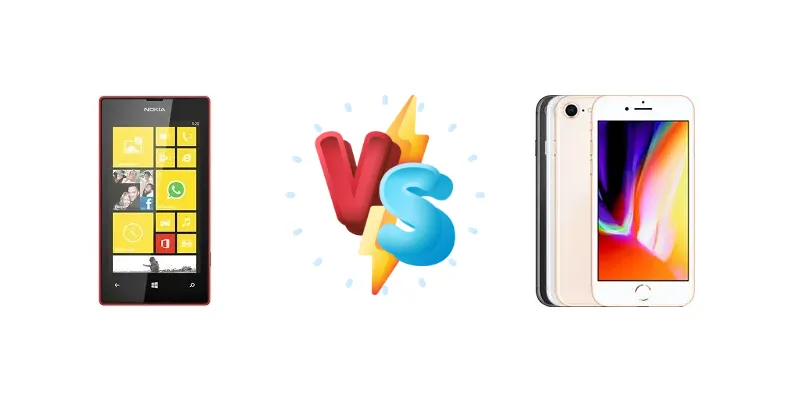
The Nokia Lumia 520 represents a bygone era of affordable Windows Phone devices, while the Apple iPhone 8 embodies modern smartphone technology. This comparison dives deep into their strengths and weaknesses, helping you decide which phone best suits your needs and budget.
🏆 Quick Verdict
The iPhone 8 decisively wins in almost every category – performance, camera quality, and display technology. However, the Lumia 520 remains a compelling option for those seeking an incredibly budget-friendly device with surprisingly good battery life, though severely limited functionality.
| Network |
|---|
| 2G bands | GSM 850 / 900 / 1800 / 1900 - all versions | GSM 850 / 900 / 1800 / 1900 |
| 3G bands | HSDPA 900 / 2100 - RM-914 | HSDPA 850 / 900 / 1700(AWS) / 1900 / 2100 |
| 4G bands | - | 1, 2, 3, 4, 5, 7, 8, 12, 13, 17, 18, 19, 20, 25, 26, 28, 29, 30, 34, 38, 39, 40, 41, 66 |
| Speed | HSPA 21.1/5.76 Mbps | HSPA 42.2/5.76 Mbps, LTE (3CA) Cat12 600/150 Mbps, EV-DO Rev.A 3.1 Mbps |
| Technology | GSM / HSPA | GSM / HSPA / LTE |
| | HSDPA 850 / 1700 / 1900 / 2100 - RM-917 | - |
| Launch |
|---|
| Announced | 2013, February. Released 2013, April | 2017, September 12. Released 2017, September 22 |
| Status | Discontinued | Discontinued |
| Body |
|---|
| Build | Glass front, plastic back, plastic frame | Glass front (Corning-made glass), glass back (Corning-made glass), aluminum frame |
| Dimensions | 119.9 x 64 x 9.9 mm, 75.7 cc (4.72 x 2.52 x 0.39 in) | 138.4 x 67.3 x 7.3 mm (5.45 x 2.65 x 0.29 in) |
| SIM | Micro-SIM | Nano-SIM |
| Weight | 124 g (4.37 oz) | 148 g (5.22 oz) |
| | - | IP67 dust/water resistant (up to 1m for 30 mins)
Apple Pay (Visa, MasterCard, AMEX certified) |
| Display |
|---|
| Protection | Scratch-resistant glass | Ion-strengthened glass |
| Resolution | 480 x 800 pixels, 5:3 ratio (~233 ppi density) | 750 x 1334 pixels, 16:9 ratio (~326 ppi density) |
| Size | 4.0 inches, 45.5 cm2 (~59.3% screen-to-body ratio) | 4.7 inches, 60.9 cm2 (~65.4% screen-to-body ratio) |
| Type | IPS LCD | Retina IPS LCD, 625 nits (typ) |
| | - | 3D Touch display & home button |
| Platform |
|---|
| CPU | Dual-core 1.0 GHz | Hexa-core (2x Monsoon + 4x Mistral) |
| Chipset | Qualcomm MSM8227 | Apple A11 Bionic (10 nm) |
| GPU | Adreno 305 | Apple GPU (three-core graphics) |
| OS | Microsoft Windows Phone 8, upgradable to 8.1 | iOS 11, up to iOS 16.7.12 |
| Memory |
|---|
| Card slot | microSDXC (dedicated slot) | No |
| Internal | 8GB 512MB RAM | 64GB 2GB RAM, 128GB 2GB RAM, 256GB 2GB RAM |
| | - | NVMe |
| Main Camera |
|---|
| Features | - | Quad-LED dual-tone flash, HDR |
| Single | 5 MP, f/2.4, 28mm (wide), 1/4.0", AF | 12 MP, f/1.8, 28mm (wide), PDAF, OIS |
| Video | 720p@30fps | 4K@24/30/60fps, 1080p@30/60/120/240fps |
| Selfie camera |
|---|
| Features | - | Face detection, HDR, panorama |
| Single | - | 7 MP, f/2.2 |
| Video | - | 1080p@30fps |
| | No | - |
| Sound |
|---|
| 3.5mm jack | Yes | No |
| 35mm jack | Yes | No |
| Loudspeaker | Yes | Yes, with stereo speakers |
| Comms |
|---|
| Bluetooth | 4.0, A2DP, LE/ aptX after WP8 Denim update | 5.0, A2DP, LE |
| NFC | No | Yes |
| Positioning | GPS, GLONASS | GPS, GLONASS, GALILEO, QZSS |
| Radio | FM Radio | No |
| USB | microUSB 2.0 | Lightning, USB 2.0 |
| WLAN | Wi-Fi 802.11 b/g/n, hotspot | Wi-Fi 802.11 a/b/g/n/ac, dual-band, hotspot |
| Features |
|---|
| Sensors | Accelerometer, proximity | Fingerprint (front-mounted), accelerometer, gyro, proximity, compass, barometer |
| Battery |
|---|
| Charging | - | 15W wired, PD2.0, 50% in 30 min
Wireless (Qi) |
| Music play | Up to 61 h | - |
| Stand-by | Up to 360 h (3G) | - |
| Talk time | Up to 14 h 40 min (2G) / Up to 9 h 40 min (3G) | Up to 14 h (3G) |
| Type | Li-Ion 1430 mAh, removable (BL-5J) | Li-Ion 1821 mAh, non-removable (6.96 Wh) |
| Misc |
|---|
| Colors | Yellow, red, cyan, white/black | Silver, Space Gray, Gold, Red |
| Models | - | A1863, A1905, A1906, A1907, iPhone10,1, iPhone10,4 |
| Price | About 70 EUR | About 210 EUR |
| SAR | 0.77 W/kg (head) | 1.32 W/kg (head) 1.36 W/kg (body) |
| SAR EU | 1.09 W/kg (head) | 1.19 W/kg (head) 1.17 W/kg (body) |
| Tests |
|---|
| Audio quality |
Noise -82.3dB / Crosstalk -81.8dB |
Noise -93.5dB / Crosstalk -80.4dB |
| Battery life |
Endurance rating 49h
| Endurance rating 66h |
| Camera |
Photo / Video |
Photo / Video |
| Display |
Contrast ratio: 834:1 (nominal) / 1.161:1 (sunlight) |
Contrast ratio: 1395:1 (nominal), 3.957 (sunlight) |
| Loudspeaker |
Voice 68dB / Noise 69dB / Ring 66dB
|
Voice 71dB / Noise 77dB / Ring 80dB |
| Performance | - |
AnTuTu: 237594 (v7)
GeekBench: 10214 (v4.4)
GFXBench: 20fps (ES 3.1 onscreen) |
Nokia Lumia 520
- Extremely affordable
- Long battery life
- Durable build
- Simple and easy to use
- Outdated hardware
- Slow performance
- Low-resolution display
- Limited app selection
- Basic camera
Apple iPhone 8
- Powerful performance
- Excellent camera
- High-quality display
- Seamless iOS experience
- Wireless charging
- Regular software updates
- Expensive
- Limited customization options
- Non-expandable storage
- Lightning connector
Display Comparison
The iPhone 8 boasts a significantly superior display with a much higher contrast ratio (1395:1 nominal, 3957:1 sunlight) compared to the Lumia 520 (834:1 nominal, 1161:1 sunlight). The iPhone 8's display is brighter, sharper, and offers better color accuracy, making it a much more enjoyable experience for media consumption and general use. The Lumia 520's display is adequate but noticeably less vibrant.
Camera Comparison
The iPhone 8's camera is a clear winner, offering superior image quality, better low-light performance, and advanced features like Portrait Mode. While the Lumia 520's camera is functional, it struggles in challenging lighting conditions and produces noticeably lower-quality images. Video recording capabilities are also significantly better on the iPhone 8.
Performance
The iPhone 8's A11 Bionic chip is in a different league compared to the Lumia 520's Qualcomm MSM8227. The iPhone 8's hexa-core processor delivers significantly faster performance for multitasking, gaming, and demanding applications. The Lumia 520 can feel sluggish at times, especially when running multiple apps or navigating complex interfaces.
Battery Life
Both phones offer a similar endurance rating (66h vs 49h), suggesting comparable real-world battery life. However, the iPhone 8's more efficient hardware and iOS optimization likely contribute to its slightly better longevity despite the Lumia 520's larger battery capacity.
Buying Guide
The Nokia Lumia 520 is ideal for users on a very tight budget who prioritize long battery life and basic functionality. The Apple iPhone 8 is perfect for those who want a powerful, feature-rich smartphone with a great camera and seamless iOS experience, and are willing to pay a premium.
Frequently Asked Questions
❓ Is the Nokia Lumia 520 still worth buying in 2024?
Only if you're on an extremely tight budget and need a basic phone for calls and texts. Its outdated hardware limits its functionality.
❓ What operating system does the Nokia Lumia 520 use?
It runs Windows Phone 8.1, which is no longer supported with updates.
❓ Can I expand the storage on the iPhone 8?
No, the iPhone 8 has non-expandable storage. You'll need to choose the storage capacity you need at the time of purchase.
❓ Does the iPhone 8 support 5G?
No, the iPhone 8 does not support 5G connectivity.