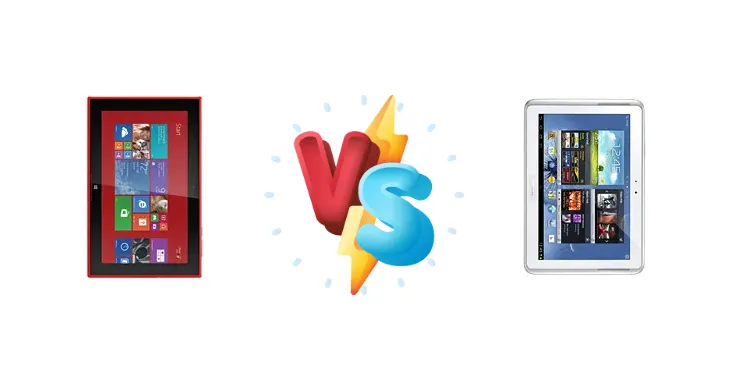
The Nokia Lumia 2520 and Samsung Galaxy Note 10.1 were flagship tablets of their time, offering distinct experiences. The Lumia championed Windows, while the Note brought Android's versatility. But which one holds up best today? Let's dive into a comprehensive comparison.
🏆 Quick Verdict
The Lumia 2520 boasts a significantly faster processor and generally smoother performance, especially for demanding tasks. However, the Note 10.1's Android ecosystem and potentially better software support (depending on updates) give it an edge for some users. Ultimately, the Lumia wins on raw power.
| Network |
|---|
| 2G bands | GSM 850 / 900 / 1800 / 1900 - all versions | GSM 850 / 900 / 1800 / 1900 |
| 3G bands | HSDPA 850 / 900 / 1800 / 1900 / 2100 - RX-113 | HSDPA 850 / 900 / 1900 / 2100 |
| 4G bands | 3, 7, 20 - RX-113 | - |
| Speed | HSPA 42.2/11.5 Mbps, LTE Cat4 150/50 Mbps | HSPA 21.1/5.76 Mbps |
| Technology | GSM / HSPA / LTE | GSM / HSPA |
| | 4, 13 - RX-114v | - |
| Launch |
|---|
| Announced | 2013, October. Released 2013, December | 2012, August. Released 2012, August |
| Status | Discontinued | Discontinued |
| Body |
|---|
| Dimensions | 267 x 168 x 8.9 mm (10.51 x 6.61 x 0.35 in) | 262 x 180 x 8.9 mm (10.31 x 7.09 x 0.35 in) |
| SIM | Micro-SIM | Mini-SIM |
| Weight | 615 g (1.36 lb) | 600 g (1.32 lb) |
| | - | Stylus |
| Display |
|---|
| Protection | Corning Gorilla Glass 2 | - |
| Resolution | 1080 x 1920 pixels, 16:9 ratio (~218 ppi density) | 800 x 1280 pixels, 16:10 ratio (~149 ppi density) |
| Size | 10.1 inches, 281.2 cm2 (~62.7% screen-to-body ratio) | 10.1 inches, 295.8 cm2 (~62.7% screen-to-body ratio) |
| Type | IPS LCD | PLS |
| | ClearBlack display | - |
| Platform |
|---|
| CPU | Quad-core 2.2 GHz Krait 400 | Quad-core 1.4 GHz Cortex-A9 |
| Chipset | Qualcomm MSM8974 Snapdragon 800 (28 nm) | Exynos 4412 Quad (32 nm) |
| GPU | Adreno 330 | Mali-400MP4 |
| OS | Microsoft Windows RT | Android 4.0.3 (Ice Cream Sandwich), upgradable to 4.4.2 (KitKat), TouchWiz UI |
| Memory |
|---|
| Card slot | microSDXC (dedicated slot) | microSDXC (dedicated slot) |
| Internal | 32GB 2GB RAM | 16GB 2GB RAM, 32GB 2GB RAM, 64GB 2GB RAM |
| | eMMC 4.5 | - |
| Main Camera |
|---|
| Features | Carl Zeiss optics | LED flash |
| Single | 6.7 MP, 1/3.4", AF | 5 MP, AF |
| Video | 1080p@30fps | 720p@30fps |
| Selfie camera |
|---|
| Single | 2 MP | 1.9 MP |
| Video | 720p@30fps | - |
| Sound |
|---|
| 3.5mm jack | Yes | Yes |
| 35mm jack | Yes | Yes |
| Loudspeaker | Yes, with stereo speakers | Yes, with stereo speakers |
| Comms |
|---|
| Bluetooth | 4.0, A2DP | 4.0, A2DP |
| Infrared port | - | Yes |
| NFC | Yes | - |
| Positioning | GPS, GLONASS | GPS, A-GPS; GLONASS |
| Radio | No | No |
| USB | USB 3.0, OTG | Proprietary |
| WLAN | Wi-Fi 802.11 a/b/g/n, dual-band, hotspot | Wi-Fi 802.11 a/b/g/n, dual-band, Wi-Fi Direct, hotspot |
| Features |
|---|
| Sensors | Accelerometer, gyro, proximity, compass | Accelerometer, gyro, compass |
| | HDMI port
MP4/DivX/Xvid/H.264 player
MP3/WAV/eAAC+ player
Photo viewer/editor
Document editor/viewer | - |
| Battery |
|---|
| Stand-by | Up to 600 h | Up to 1500 h |
| Talk time | Up to 10 h | Up to 33 h 20 min |
| Type | Li-Ion 8120 mAh, non-removable | Non-removable Li-Ion 7000 mAh battery |
| Misc |
|---|
| Colors | Cyan , Red, Black, White | Black, White/Silver |
| Models | - | GT-N8000 |
| Price | About 360 EUR | About 320 EUR |
| SAR | - | 1.10 W/kg (body) |
| SAR EU | 1.77 W/kg (body) | - |
| Tests |
|---|
| Audio quality |
Noise -93.5dB / Crosstalk -94.2dB |
Noise -90.2dB / Crosstalk -91.3dB |
| Camera | - |
Photo / Video |
| Display | - |
Contrast ratio: 821:1 (nominal) |
| Loudspeaker | - |
Voice 71dB / Noise 69dB / Ring 79dB |
Nokia Lumia 2520
- Significantly faster processor
- Better performance for demanding tasks
- Potentially better color accuracy on display
- Larger battery capacity
- Windows operating system (may not appeal to all)
- Limited app selection compared to Android
- Older device, potential for hardware issues
- Software support may be limited
Samsung Galaxy Note 10.1 N8000
- Android operating system (wider app selection)
- More mature tablet software experience (potentially)
- S Pen stylus for note-taking and drawing
- Generally better software support (historically)
- Slower processor compared to Lumia 2520
- Less powerful performance
- Display not as vibrant as Lumia 2520
- Software updates may be discontinued
Display Comparison
Both tablets feature 10.1-inch displays with a nominal contrast ratio of 821:1. The Lumia 2520's display is generally considered to have slightly better color accuracy and brightness. The Note 10.1's display is good, but not exceptional. Resolution is similar, offering a decent viewing experience for both.
Camera Comparison
Camera quality on both devices is adequate for their time, but not a strong point. Both offer photo and video capabilities, but image quality is generally mediocre by modern standards. The Lumia 2520 might have a slight edge in low-light conditions, but the difference is minimal.
Performance
This is where the Lumia 2520 shines. Its Qualcomm Snapdragon 800 chipset with a 2.2 GHz quad-core Krait processor significantly outperforms the Note 10.1's Exynos 4412 Quad (1.4 GHz). Expect noticeably faster app loading, smoother multitasking, and better gaming performance on the Lumia.
Battery Life
Battery life is a tricky comparison. While the Lumia 2520 has a larger battery capacity (around 8000 mAh), Windows can be more resource-intensive than Android. Real-world battery life is likely comparable, offering around 8-10 hours of moderate usage for both devices.
Buying Guide
The Nokia Lumia 2520 is ideal for users deeply invested in the Microsoft ecosystem, those needing strong performance for productivity, and those comfortable with Windows. The Samsung Galaxy Note 10.1 is a better choice for Android enthusiasts, those seeking a wider app selection, and those prioritizing a more mature tablet software experience (though updates are a concern).
Frequently Asked Questions
❓ Is the Nokia Lumia 2520 still worth buying?
If you need a powerful Windows tablet and can find one in good condition, it can still be a viable option. However, be aware of its age and potential hardware limitations.
❓ Which tablet has a better app ecosystem?
The Samsung Galaxy Note 10.1 has a better app ecosystem due to the vast Android app store. The Windows Store has improved, but still lags behind.