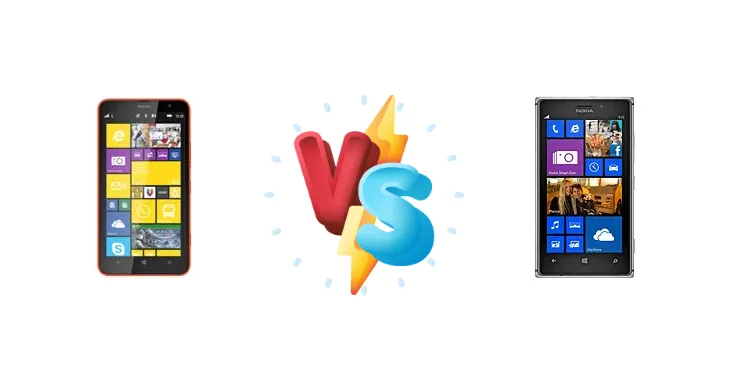
Nokia's Lumia series offered a unique blend of Windows Phone software and distinctive hardware. Today, we pit two popular models against each other: the budget-friendly Lumia 1320 and the more premium Lumia 925. Which phone delivers the best experience?
🏆 Quick Verdict
The Lumia 925 wins overall, boasting a superior display, more powerful chipset, and a refined design. However, the 1320 offers incredible battery life and a larger screen at a significantly lower price point, making it a compelling choice for budget-conscious users.
| Network |
|---|
| 2G bands | GSM 850 / 900 / 1800 / 1900 - all versions | GSM 850 / 900 / 1800 / 1900 - all versions |
| 3G bands | HSDPA 850 / 900 / 2100 - RM-994 | HSDPA 850 / 900 / 1900 / 2100 - RM-892 |
| 4G bands | 3, 7, 20 - RM-994 | 1, 3, 7, 8, 20 - RM-892 |
| Speed | HSPA 42.2/5.76 Mbps, LTE Cat3 100/50 Mbps | HSPA 42.2/5.76 Mbps, LTE Cat3 100/50 Mbps |
| Technology | GSM / HSPA / LTE | GSM / HSPA / LTE |
| | 2, 4, 5, 17 - RM-995 | 2, 4, 5, 17 - RM-893 |
| Launch |
|---|
| Announced | 2013, October. Released 2014, January | 2013, May. Released 2013, June |
| Status | Discontinued | Discontinued |
| Body |
|---|
| Dimensions | 164.2 x 85.9 x 9.8 mm, 125 cc (6.46 x 3.38 x 0.39 in) | 129 x 70.6 x 8.5 mm, 78 cc (5.08 x 2.78 x 0.33 in) |
| SIM | Micro-SIM | Micro-SIM |
| Weight | 220 g (7.76 oz) | 139 g (4.90 oz) |
| Display |
|---|
| Protection | Corning Gorilla Glass 3 | Corning Gorilla Glass 2 |
| Resolution | 720 x 1280 pixels, 16:9 ratio (~245 ppi density) | 768 x 1280 pixels, 5:3 ratio (~332 ppi density) |
| Size | 6.0 inches, 99.2 cm2 (~70.4% screen-to-body ratio) | 4.5 inches, 57.6 cm2 (~63.3% screen-to-body ratio) |
| Type | IPS LCD | AMOLED |
| | ClearBlack display | PureMotion HD+ ClearBlack display |
| Platform |
|---|
| CPU | Dual-core 1.7 GHz Krait 300 | Dual-core 1.5 GHz Krait |
| Chipset | Qualcomm MSM8230AB Snapdragon 400 (28 nm) (3G model)/ MSM8930AB Snapdragon 400 (28 nm) (LTE model) | Qualcomm MSM8960 Snapdragon S4 Plus |
| GPU | Adreno 305 | Adreno 225 |
| OS | Microsoft Windows Phone 8, upgradable to 8.1 | Microsoft Windows Phone 8, upgradable to 8.1 |
| Memory |
|---|
| Card slot | microSDXC (dedicated slot) | No |
| Internal | 8GB 1GB RAM | 16GB 1GB RAM, 32GB 1GB RAM |
| | eMMC 4.5 | - |
| Main Camera |
|---|
| Features | LED flash | Carl Zeiss optics, dual-LED flash |
| Single | 5 MP, f/2.4, 28mm (wide), 1/4.0", AF | 8 MP, 1/3.0", AF, OIS |
| Video | 1080p@30fps | 1080p@30fps |
| Selfie camera |
|---|
| Single | VGA | 1.3 MP |
| Video | - | 720p@30fps |
| Sound |
|---|
| 3.5mm jack | Yes | Yes |
| 35mm jack | Yes | Yes |
| Loudspeaker | Yes | Yes |
| Comms |
|---|
| Bluetooth | 4.0, A2DP, EDR, LE/ aptX after WP8 Denim update | 4.0, A2DP, EDR, LE/ aptX after WP8 Denim update |
| NFC | No | Yes |
| Positioning | GPS, GLONASS | GPS, GLONASS |
| Radio | FM radio | FM radio |
| USB | microUSB 2.0 | microUSB 2.0 |
| WLAN | Wi-Fi 802.11 b/g/n, hotspot | Wi-Fi 802.11 a/b/g/n, dual-band, DLNA, hotspot |
| Features |
|---|
| Sensors | Accelerometer, proximity, compass | Accelerometer, gyro, proximity, compass |
| Battery |
|---|
| Music play | Up to 98 h | Up to 55 h |
| Stand-by | Up to 672 h (2G) / Up to 672 h (3G) | Up to 440 h (3G) |
| Talk time | Up to 25 h (2G) / Up to 21 h (3G) | Up to 18 h 20 min (2G) / Up to 12 h 40 min (3G) |
| Type | Li-Ion 3400 mAh, non-removable (BV-4BW) | Li-Ion 2000 mAh, non-removable (BL-4YW) |
| Misc |
|---|
| Colors | Yellow, white, black, red | Black, White, Gray |
| Price | About 210 EUR | About 260 EUR |
| SAR | 0.47 W/kg (head) 0.29 W/kg (body) | 1.42 W/kg (head) 1.00 W/kg (body) |
| SAR EU | 0.46 W/kg (head) 0.44 W/kg (body) | 0.81 W/kg (head) |
| Tests |
|---|
| Audio quality |
Noise -89.1dB / Crosstalk -88.6dB |
Noise -82.5dB / Crosstalk -81.2dB |
| Battery life |
Endurance rating 75h
| - |
| Camera |
Photo / Video |
Photo / Video |
| Display |
Contrast ratio: 1089:1 (nominal), 1.941 (sunlight) |
Contrast ratio: Infinite (nominal) / 3.402:1 (sunlight) |
| Loudspeaker |
Voice 61dB / Noise 60dB / Ring 66dB
|
Voice 63dB / Noise 72dB / Ring 66dB
|
Nokia Lumia 1320
- Exceptional battery life
- Large 6-inch display
- Affordable price
- Durable build
- Lower performance compared to 925
- Less impressive camera
- Bulkier design
- Older software updates
Nokia Lumia 925
- Superior display quality (AMOLED, higher resolution)
- Better performance
- Premium design and build
- Excellent camera with OIS
- More refined user experience
- Shorter battery life
- Higher price
- Older chipset (less future-proof)
- Limited software update support
Display Comparison
The Lumia 925's display is the clear winner. Its 'Infinite' contrast ratio (though a marketing term, it indicates exceptional contrast) and 3.402:1 sunlight readability far surpass the 1320's 1089:1 nominal and 1.941:1 sunlight performance. The 925 also features a higher resolution (1280 x 768) compared to the 1320's (1280 x 768), resulting in sharper images. The 925's AMOLED technology provides vibrant colors and deeper blacks.
Camera Comparison
Both phones feature Photo/Video capabilities, but the Lumia 925's camera is generally considered superior. It boasts a 20MP PureView camera with optical image stabilization (OIS), resulting in sharper and more detailed photos, especially in low light. The 1320's camera is decent, but lacks OIS and produces less impressive results. The 925 also has better video recording capabilities.
Performance
The Lumia 925's Qualcomm MSM8960 Snapdragon S4 Plus chipset, while older, generally offers slightly better performance than the 1320's Snapdragon 400. The 925's dual-core 1.5 GHz Krait CPU often handles multitasking and demanding apps more smoothly. The 1320's dual-core 1.7 GHz Krait 300 provides adequate performance for everyday tasks, but struggles more with heavier workloads.
Battery Life
The Lumia 1320's battery life is its standout feature. With an endurance rating of 75h, it significantly outlasts the Lumia 925. The 925's battery life is respectable, but falls short of the 1320's endurance, especially with more demanding usage.
Buying Guide
The Nokia Lumia 1320 is ideal for users prioritizing battery life and a large screen on a tight budget. The Lumia 925 is better suited for those who value a premium design, better performance, and a superior display, even if it means spending more.
Frequently Asked Questions
❓ Is the Lumia 1320 still worth buying?
If you prioritize battery life and a large screen on a very tight budget, the 1320 can still be a viable option. However, be aware of its limitations in performance and camera quality.
❓ Which Lumia is better for photography?
The Lumia 925 is significantly better for photography thanks to its 20MP PureView camera with optical image stabilization.