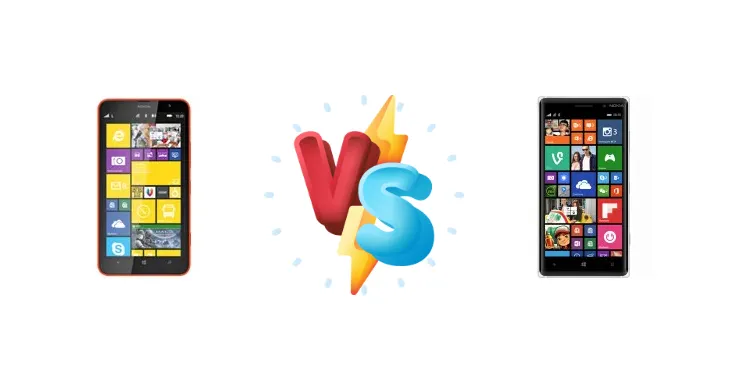
Nokia's Lumia series offered a unique Windows Phone experience. The Lumia 1320 and 830 were popular choices, but cater to different needs. This comparison dives deep into their features to help you decide which one was the better pick.
🏆 Quick Verdict
The Lumia 830 edges out the 1320 thanks to its superior processor, better display sunlight readability, and wireless charging. While the 1320 boasts incredible battery life, the 830's overall refinement and performance make it the more compelling choice for most users.
| Network |
|---|
| 2G bands | GSM 850 / 900 / 1800 / 1900 - all versions | GSM 850 / 900 / 1800 / 1900 |
| 3G bands | HSDPA 850 / 900 / 2100 - RM-994 | HSDPA 850 / 900 / 1900 / 2100 |
| 4G bands | 3, 7, 20 - RM-994 | 1, 3, 7, 8, 20 |
| Speed | HSPA 42.2/5.76 Mbps, LTE Cat3 100/50 Mbps | HSPA 42.2/5.76 Mbps, LTE Cat4 150/50 Mbps |
| Technology | GSM / HSPA / LTE | GSM / HSPA / LTE |
| | 2, 4, 5, 17 - RM-995 | 2, 4, 5, 17 - AT&T |
| Launch |
|---|
| Announced | 2013, October. Released 2014, January | 2014, September. Released 2014, September |
| Status | Discontinued | Discontinued |
| Body |
|---|
| Dimensions | 164.2 x 85.9 x 9.8 mm, 125 cc (6.46 x 3.38 x 0.39 in) | 139.4 x 70.7 x 8.5 mm (5.49 x 2.78 x 0.33 in) |
| SIM | Micro-SIM | Nano-SIM |
| Weight | 220 g (7.76 oz) | 150 g (5.29 oz) |
| Display |
|---|
| Protection | Corning Gorilla Glass 3 | Corning Gorilla Glass 3 |
| Resolution | 720 x 1280 pixels, 16:9 ratio (~245 ppi density) | 720 x 1280 pixels, 16:9 ratio (~294 ppi density) |
| Size | 6.0 inches, 99.2 cm2 (~70.4% screen-to-body ratio) | 5.0 inches, 68.9 cm2 (~69.9% screen-to-body ratio) |
| Type | IPS LCD | IPS LCD |
| | ClearBlack display | ClearBlack display |
| Platform |
|---|
| CPU | Dual-core 1.7 GHz Krait 300 | Quad-core 1.2 GHz Cortex-A7 |
| Chipset | Qualcomm MSM8230AB Snapdragon 400 (28 nm) (3G model)/ MSM8930AB Snapdragon 400 (28 nm) (LTE model) | Qualcomm Snapdragon 400 (28 nm) |
| GPU | Adreno 305 | Adreno 305 |
| OS | Microsoft Windows Phone 8, upgradable to 8.1 | Microsoft Windows Phone 8.1, upgradable to Microsoft Windows 10 |
| Memory |
|---|
| Card slot | microSDXC (dedicated slot) | microSDXC (dedicated slot) |
| Internal | 8GB 1GB RAM | 16GB 1GB RAM |
| | eMMC 4.5 | eMMC 4.5 |
| Main Camera |
|---|
| Features | LED flash | Zeiss optics, LED flash, panorama |
| Single | 5 MP, f/2.4, 28mm (wide), 1/4.0", AF | 10 MP, f/2.2, 26mm (wide), 1/3.4", AF, OIS |
| Video | 1080p@30fps | 1080p@30fps, stereo sound rec. |
| Selfie camera |
|---|
| Single | VGA | 0.9 MP |
| Video | - | 720p |
| Sound |
|---|
| 3.5mm jack | Yes | Yes |
| 35mm jack | Yes | Yes |
| Loudspeaker | Yes | Yes |
| Comms |
|---|
| Bluetooth | 4.0, A2DP, EDR, LE/ aptX after WP8 Denim update | 4.0, A2DP, EDR, LE, aptX |
| NFC | No | Yes |
| Positioning | GPS, GLONASS | GPS, GLONASS, BDS |
| Radio | FM radio | FM radio |
| USB | microUSB 2.0 | microUSB 2.0 |
| WLAN | Wi-Fi 802.11 b/g/n, hotspot | Wi-Fi 802.11 a/b/g/n, dual-band, DLNA, hotspot |
| Features |
|---|
| Sensors | Accelerometer, proximity, compass | Accelerometer, gyro, proximity, compass |
| Battery |
|---|
| Charging | - | Wireless (Qi) |
| Music play | Up to 98 h | Up to 78 h |
| Stand-by | Up to 672 h (2G) / Up to 672 h (3G) | Up to 528 h |
| Talk time | Up to 25 h (2G) / Up to 21 h (3G) | Up to 12 h 54 min (2G) / Up to 14 h 48 min (3G) |
| Type | Li-Ion 3400 mAh, non-removable (BV-4BW) | Li-Ion 2200 mAh, removable (BV-L4A) |
| Misc |
|---|
| Colors | Yellow, white, black, red | Orange, green, white, black, gold |
| Price | About 210 EUR | About 330 EUR |
| SAR | 0.47 W/kg (head) 0.29 W/kg (body) | 0.87 W/kg (head) 0.83 W/kg (body) |
| SAR EU | 0.46 W/kg (head) 0.44 W/kg (body) | 0.46 W/kg (head) 0.59 W/kg (body) |
| Tests |
|---|
| Audio quality |
Noise -89.1dB / Crosstalk -88.6dB |
Noise -89.7dB / Crosstalk -91.6dB |
| Battery life |
Endurance rating 75h
|
Endurance rating 68h
|
| Camera |
Photo / Video |
Photo / Video |
| Display |
Contrast ratio: 1089:1 (nominal), 1.941 (sunlight) |
Contrast ratio: 1078 (nominal), 1887 (sunlight) |
| Loudspeaker |
Voice 61dB / Noise 60dB / Ring 66dB
|
Voice 65dB / Noise 66dB / Ring 78dB
|
Nokia Lumia 1320
- Exceptional battery life
- Large 6-inch display
- Affordable price
- Slower performance
- Less premium design
- Lower quality camera compared to 830
Nokia Lumia 830
- Better performance (quad-core)
- Superior sunlight display readability
- Wireless charging (Qi)
- More premium design
- Generally better camera
- Shorter battery life than 1320
- Higher price (originally)
Display Comparison
Both Lumias feature displays with a respectable contrast ratio (1089:1 for the 1320, 1078:1 for the 830). However, the 830's significantly better sunlight readability (1887 vs 1941) makes it much easier to view outdoors. The 1320 has a larger 6-inch screen, while the 830 has a 5.0-inch display.
Camera Comparison
While both offer 'Photo / Video' capabilities, the Lumia 830 generally produced better image quality, particularly in low light, thanks to its superior image processing and potentially better sensor (though specific sensor details are not readily available). The 830 also benefits from Nokia's camera software optimizations.
Performance
The Lumia 830's quad-core 1.2 GHz Cortex-A7 processor provides a noticeable performance boost over the 1320's dual-core 1.7 GHz Krait 300. Apps launch faster, multitasking is smoother, and the overall user experience feels more responsive on the 830. The 830's chipset is also generally more efficient.
Battery Life
The Lumia 1320 holds a clear advantage in battery life, boasting an endurance rating of 75 hours compared to the 830's 68 hours. This difference is significant for users who need their phone to last for multiple days on a single charge.
Buying Guide
The Nokia Lumia 1320 is ideal for users prioritizing maximum battery life and a large screen on a budget. The Nokia Lumia 830 is better suited for those who value performance, a more premium design, and features like wireless charging, even if it means sacrificing some battery endurance.
Frequently Asked Questions
❓ Which Lumia is better for gaming?
The Lumia 830 is significantly better for gaming due to its faster processor and more efficient chipset.
❓ Is the Lumia 1320's large screen worth the trade-off in performance?
If you primarily use your phone for basic tasks like calling, texting, and browsing, and battery life is your top priority, then the 1320's large screen might be worth it. Otherwise, the 830 offers a more well-rounded experience.