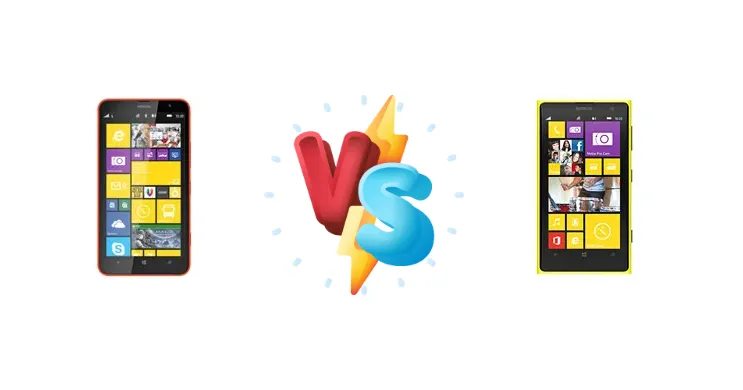
Nokia's Lumia series offered a unique blend of Windows Phone software and impressive hardware. Two standout models, the Lumia 1320 and the Lumia 1020, aimed for different audiences. The 1320 prioritized affordability and battery life, while the 1020 was a camera powerhouse. Let's dive into a head-to-head comparison to see which phone holds up best today.
🏆 Quick Verdict
The Nokia Lumia 1020 wins overall, primarily due to its exceptional 41MP camera, a groundbreaking feature for smartphones at the time. While the 1320 boasts superior battery life, the 1020's camera capabilities and slightly better display make it the more compelling choice for enthusiasts.
| Network |
|---|
| 2G bands | GSM 850 / 900 / 1800 / 1900 - all versions | GSM 850 / 900 / 1800 / 1900 - all versions |
| 3G bands | HSDPA 850 / 900 / 2100 - RM-994 | HSDPA 850 / 900 / 1900 / 2100 - RM-875, RM-877 |
| 4G bands | 3, 7, 20 - RM-994 | 1, 3, 7, 8, 20 - RM-875 |
| Speed | HSPA 42.2/5.76 Mbps, LTE Cat3 100/50 Mbps | HSPA 42.2/5.76 Mbps, LTE Cat3 100/50 Mbps |
| Technology | GSM / HSPA / LTE | GSM / HSPA / LTE |
| | 2, 4, 5, 17 - RM-995 | 2, 4, 5, 17 - RM-877 |
| Launch |
|---|
| Announced | 2013, October. Released 2014, January | 2013, July 11. Released 2013, July 22 |
| Status | Discontinued | Discontinued |
| Body |
|---|
| Build | - | Glass front (Gorilla Glass 3), plastic back, plastic frame |
| Dimensions | 164.2 x 85.9 x 9.8 mm, 125 cc (6.46 x 3.38 x 0.39 in) | 130.4 x 71.4 x 10.4 mm, 96.9 cc (5.13 x 2.81 x 0.41 in) |
| SIM | Micro-SIM | Micro-SIM |
| Weight | 220 g (7.76 oz) | 158 g (5.57 oz) |
| Display |
|---|
| Protection | Corning Gorilla Glass 3 | Corning Gorilla Glass 3 |
| Resolution | 720 x 1280 pixels, 16:9 ratio (~245 ppi density) | 768 x 1280 pixels, 5:3 ratio (~332 ppi density) |
| Size | 6.0 inches, 99.2 cm2 (~70.4% screen-to-body ratio) | 4.5 inches, 57.6 cm2 (~61.9% screen-to-body ratio) |
| Type | IPS LCD | AMOLED |
| | ClearBlack display | PureMotion HD+ ClearBlack display |
| Platform |
|---|
| CPU | Dual-core 1.7 GHz Krait 300 | Dual-core 1.5 GHz Krait |
| Chipset | Qualcomm MSM8230AB Snapdragon 400 (28 nm) (3G model)/ MSM8930AB Snapdragon 400 (28 nm) (LTE model) | Qualcomm MSM8960 Snapdragon S4 Plus |
| GPU | Adreno 305 | Adreno 225 |
| OS | Microsoft Windows Phone 8, upgradable to 8.1 | Microsoft Windows Phone 8, upgradable to 8.1 |
| Memory |
|---|
| Card slot | microSDXC (dedicated slot) | No |
| Internal | 8GB 1GB RAM | 32GB 2GB RAM, 64GB 2GB RAM (Telefonica exclusive) |
| | eMMC 4.5 | - |
| Main Camera |
|---|
| Features | LED flash | Carl Zeiss optics, Xenon & LED flash, panorama |
| Single | 5 MP, f/2.4, 28mm (wide), 1/4.0", AF | 41 MP, f/2.2, 26mm (wide), 1/1.5", 1.12µm, AF, OIS |
| Video | 1080p@30fps | 1080p@30fps, 4x lossless digital zoom |
| Selfie camera |
|---|
| Single | VGA | 1.2 MP |
| Video | - | 720p@30fps |
| Sound |
|---|
| 3.5mm jack | Yes | Yes |
| 35mm jack | Yes | Yes |
| Loudspeaker | Yes | Yes |
| Comms |
|---|
| Bluetooth | 4.0, A2DP, EDR, LE/ aptX after WP8 Denim update | 4.0, A2DP, EDR, LE/ aptX after WP8 Denim update |
| NFC | No | Yes |
| Positioning | GPS, GLONASS | GPS, GLONASS |
| Radio | FM radio | Stereo FM radio, RDS |
| USB | microUSB 2.0 | microUSB 2.0 |
| WLAN | Wi-Fi 802.11 b/g/n, hotspot | Wi-Fi 802.11 a/b/g/n, dual-band, DLNA, hotspot |
| Features |
|---|
| Sensors | Accelerometer, proximity, compass | Accelerometer, gyro, proximity, compass, barometer |
| Battery |
|---|
| Music play | Up to 98 h | Up to 63 h |
| Stand-by | Up to 672 h (2G) / Up to 672 h (3G) | Up to 384 h (3G) |
| Talk time | Up to 25 h (2G) / Up to 21 h (3G) | Up to 19 h (2G) / Up to 13 h 20 min (3G) |
| Type | Li-Ion 3400 mAh, non-removable (BV-4BW) | Li-Ion 2000 mAh, non-removable (BV-5XW) |
| Misc |
|---|
| Colors | Yellow, white, black, red | Yellow, white, black, red (AT&T exclusive) |
| Price | About 210 EUR | About 400 EUR |
| SAR | 0.47 W/kg (head) 0.29 W/kg (body) | 1.23 W/kg (head) 0.97 W/kg (body) |
| SAR EU | 0.46 W/kg (head) 0.44 W/kg (body) | 0.76 W/kg (head) 0.67 W/kg (body) |
| Tests |
|---|
| Audio quality |
Noise -89.1dB / Crosstalk -88.6dB | - |
| Battery life |
Endurance rating 75h
|
Endurance rating 61h
|
| Camera |
Photo / Video |
Photo / Video |
| Display |
Contrast ratio: 1089:1 (nominal), 1.941 (sunlight) |
Contrast ratio: Infinite (nominal), 2.103 (sunlight) |
| Loudspeaker |
Voice 61dB / Noise 60dB / Ring 66dB
|
Voice 69dB / Noise 66dB / Ring 72dB
|
Nokia Lumia 1320
- Excellent battery life
- Large 6-inch display
- Affordable price (when new)
- Good sunlight readability
- Less powerful camera
- Slower processor compared to some contemporaries
- Larger size can be unwieldy
Nokia Lumia 1020
- Exceptional 41MP PureView camera
- Superior image quality
- Excellent sunlight readability
- Slightly sharper display
- Shorter battery life
- Less powerful processor
- Smaller screen size
- Higher price (when new)
Display Comparison
Both phones feature displays with excellent sunlight readability, boasting contrast ratios of 1089:1 and 1.941 for the 1320, and 'Infinite' (effectively very high) and 2.103 for the 1020. The 1020's 'Infinite' contrast suggests superior black levels and overall image quality, though the 1320's larger screen size (6 inches vs 4.5 inches) provides more real estate for viewing content. The 1020's display is also sharper due to its higher resolution.
Camera Comparison
This is where the Lumia 1020 truly shines. Its 41MP PureView camera was revolutionary, offering incredible detail and oversampling capabilities. The 1320's camera is perfectly adequate, but it can't compete with the 1020's image quality, zoom capabilities, and low-light performance. The 1020's ability to capture multiple images and combine them for improved detail is a significant advantage.
Performance
The Lumia 1320's Snapdragon 400 chipset with a dual-core 1.7 GHz Krait 300 CPU offers decent performance for everyday tasks. The Lumia 1020, with its Snapdragon S4 Plus and dual-core 1.5 GHz Krait processor, is slightly less powerful. However, the difference in real-world performance is minimal for typical usage. Both phones run Windows Phone 8.1, which is optimized for their hardware.
Battery Life
The Lumia 1320 takes the crown here. Its endurance rating of 75 hours significantly surpasses the Lumia 1020's 61 hours. This difference is largely due to the 1320's larger battery capacity and less power-hungry display.
Buying Guide
The Nokia Lumia 1320 is a good choice for users prioritizing long battery life and a large screen on a budget. The Nokia Lumia 1020 is ideal for photography enthusiasts who value image quality above all else, and are willing to accept shorter battery life.
Frequently Asked Questions
❓ Is the Nokia Lumia 1020 still worth buying?
If you prioritize camera quality and can live with shorter battery life, the Lumia 1020 remains a compelling option, especially at its current used price. However, modern smartphones offer significantly better overall performance and features.
❓ Which Lumia is better for gaming?
The Lumia 1320 is slightly better for gaming due to its more powerful processor, although neither phone is a gaming powerhouse by today's standards. Both will struggle with demanding modern games.