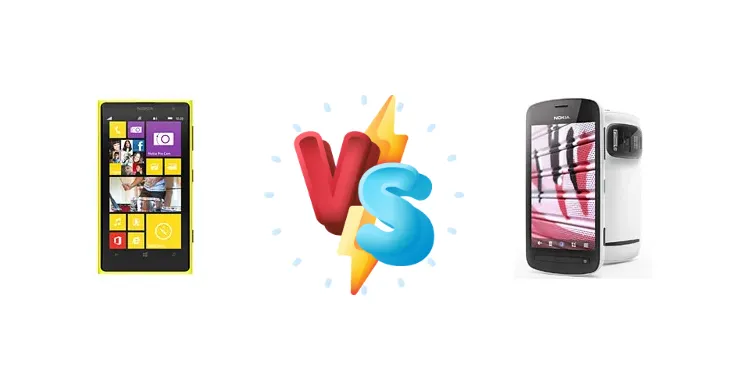
The Nokia Lumia 1020 and 808 PureView were legendary camera phones, pushing the boundaries of mobile photography. Both offered incredible image quality for their time, but they took different approaches. This comparison dives deep into their strengths and weaknesses to help you understand which one was truly the better choice.
🏆 Quick Verdict
The Lumia 1020 edges out the 808 PureView thanks to its faster processor, Windows Phone OS, and slightly better overall user experience. However, the 808 PureView boasts a larger sensor and arguably superior image quality in certain conditions, making it a compelling choice for dedicated photographers.
| Network |
|---|
| 2G bands | GSM 850 / 900 / 1800 / 1900 - all versions | GSM 850 / 900 / 1800 / 1900 |
| 3G bands | HSDPA 850 / 900 / 1900 / 2100 - RM-875, RM-877 | HSDPA 850 / 900 / 1700 / 1900 / 2100 |
| 4G bands | 1, 3, 7, 8, 20 - RM-875 | - |
| Speed | HSPA 42.2/5.76 Mbps, LTE Cat3 100/50 Mbps | HSPA 14.4/5.76 Mbps |
| Technology | GSM / HSPA / LTE | GSM / HSPA |
| | 2, 4, 5, 17 - RM-877 | - |
| Launch |
|---|
| Announced | 2013, July 11. Released 2013, July 22 | 2012, February. Released 2012, June |
| Status | Discontinued | Discontinued |
| Body |
|---|
| Build | Glass front (Gorilla Glass 3), plastic back, plastic frame | - |
| Dimensions | 130.4 x 71.4 x 10.4 mm, 96.9 cc (5.13 x 2.81 x 0.41 in) | 123.9 x 60.2 x 13.9 mm, 95.5 cc (4.88 x 2.37 x 0.55 in) |
| SIM | Micro-SIM | Micro-SIM |
| Weight | 158 g (5.57 oz) | 169 g (5.96 oz) |
| Display |
|---|
| Protection | Corning Gorilla Glass 3 | Corning Gorilla Glass |
| Resolution | 768 x 1280 pixels, 5:3 ratio (~332 ppi density) | 360 x 640 pixels, 16:9 ratio (~184 ppi density) |
| Size | 4.5 inches, 57.6 cm2 (~61.9% screen-to-body ratio) | 4.0 inches, 44.1 cm2 (~59.1% screen-to-body ratio) |
| Type | AMOLED | AMOLED |
| | PureMotion HD+ ClearBlack display | Nokia ClearBlack display |
| Platform |
|---|
| CPU | Dual-core 1.5 GHz Krait | 1.3 GHz ARM 11 |
| Chipset | Qualcomm MSM8960 Snapdragon S4 Plus | - |
| GPU | Adreno 225 | Broadcom BCM2763 |
| OS | Microsoft Windows Phone 8, upgradable to 8.1 | Nokia Belle OS |
| Memory |
|---|
| Card slot | No | microSDHC (dedicated slot) |
| Internal | 32GB 2GB RAM, 64GB 2GB RAM (Telefonica exclusive) | 16GB 512MB RAM |
| Main Camera |
|---|
| Features | Carl Zeiss optics, Xenon & LED flash, panorama | Carl Zeiss optics, Xenon flash |
| Single | 41 MP, f/2.2, 26mm (wide), 1/1.5", 1.12µm, AF, OIS | 41 MP (38 MP effective), f/2.4, 1/1.2", AF |
| Video | 1080p@30fps, 4x lossless digital zoom | 1080p@30fps, 4x lossless digital zoom |
| Selfie camera |
|---|
| Single | 1.2 MP | VGA |
| Video | 720p@30fps | VGA@30fps |
| Sound |
|---|
| 3.5mm jack | Yes | Yes |
| 35mm jack | Yes | Yes |
| Loudspeaker | Yes | Yes |
| Comms |
|---|
| Bluetooth | 4.0, A2DP, EDR, LE/ aptX after WP8 Denim update | 3.0, A2DP |
| NFC | Yes | Yes |
| Positioning | GPS, GLONASS | GPS, A-GPS |
| Radio | Stereo FM radio, RDS | Stereo FM radio, RDS; FM transmitter |
| USB | microUSB 2.0 | microUSB 2.0, OTG |
| WLAN | Wi-Fi 802.11 a/b/g/n, dual-band, DLNA, hotspot | Wi-Fi 802.11 b/g/n, DLNA, UPnP technology |
| Features |
|---|
| Sensors | Accelerometer, gyro, proximity, compass, barometer | Accelerometer, proximity, compass |
| | - | HDMI port |
| Battery |
|---|
| Music play | Up to 63 h | - |
| Stand-by | Up to 384 h (3G) | Up to 465 h (2G) / Up to 540 h (3G) |
| Talk time | Up to 19 h (2G) / Up to 13 h 20 min (3G) | Up to 11 h (2G) / Up to 6 h 50 min (3G) |
| Type | Li-Ion 2000 mAh, non-removable (BV-5XW) | Removable Li-Ion 1400 mAh battery (BV-4D) |
| Misc |
|---|
| Colors | Yellow, white, black, red (AT&T exclusive) | Black, White, Red |
| Price | About 400 EUR | About 280 EUR |
| SAR | 1.23 W/kg (head) 0.97 W/kg (body) | 1.21 W/kg (head) 1.46 W/kg (body) |
| SAR EU | 0.76 W/kg (head) 0.67 W/kg (body) | 1.23 W/kg (head) |
| Tests |
|---|
| Audio quality | - |
Noise -89.7dB / Crosstalk -89.0dB |
| Battery life |
Endurance rating 61h
|
Endurance rating 34h
|
| Camera |
Photo / Video |
Photo / Video |
| Display |
Contrast ratio: Infinite (nominal), 2.103 (sunlight) |
Contrast ratio: Infinite (nominal) / 4.698:1 (sunlight) |
| Loudspeaker |
Voice 69dB / Noise 66dB / Ring 72dB
|
Voice 71dB / Noise 64dB / Ring 78dB
|
Nokia Lumia 1020
- Faster Processor
- Better Battery Life
- More Modern OS (Windows Phone)
- Slightly Better Display
- Refined Image Processing
- Discontinued Software Support
- Larger Sensor on 808 for Low Light
Nokia 808 PureView
- Larger Camera Sensor (Excellent Low Light)
- Lossless Digital Zoom
- Accurate Color Reproduction
- Dedicated Camera Experience
- Slower Processor
- Shorter Battery Life
- Older Symbian OS
- Less Responsive UI
Display Comparison
Both phones feature AMOLED displays with impressive contrast ratios, particularly in direct sunlight. The Lumia 1020's display is slightly brighter and more vibrant, while the 808 PureView's is known for its accurate color reproduction. The 1020's resolution is also higher, resulting in a sharper image.
Camera Comparison
This is where the battle gets interesting. The 808 PureView's 41-megapixel sensor was groundbreaking, allowing for incredible detail and lossless digital zoom. The Lumia 1020's 41-megapixel sensor, combined with Nokia's oversampling technology, produced excellent results as well. The 808 often excels in low-light situations due to its larger sensor size. The Lumia 1020's image processing and software features were generally considered more refined.
Performance
The Lumia 1020's Qualcomm Snapdragon S4 Plus processor and Krait CPU offer noticeably better performance than the 808 PureView's older ARM 11 processor. This translates to smoother multitasking, faster app loading times, and a more responsive user interface. The 1020's Windows Phone OS, while discontinued, felt more modern at the time.
Battery Life
The Lumia 1020 holds a significant advantage in battery life, boasting an endurance rating of 61 hours compared to the 808 PureView's 34 hours. This difference is largely due to the 1020's more efficient processor and software optimization.
Buying Guide
The Nokia Lumia 1020 is ideal for users who prefer a more modern smartphone experience with a responsive OS and access to apps. The Nokia 808 PureView is best suited for photography enthusiasts prioritizing raw image quality and a dedicated camera experience, even if it means sacrificing some modern conveniences.
Frequently Asked Questions
❓ Which phone has better image quality overall?
It's nuanced. The 808 PureView often wins in low light and offers superior lossless zoom. The Lumia 1020's processing and software often produce more pleasing results in well-lit conditions.
❓ Are apps available for both phones?
The Lumia 1020 runs Windows Phone, which has limited app support now. The 808 PureView runs Symbian, which has even less app support. Finding apps for either phone can be challenging.