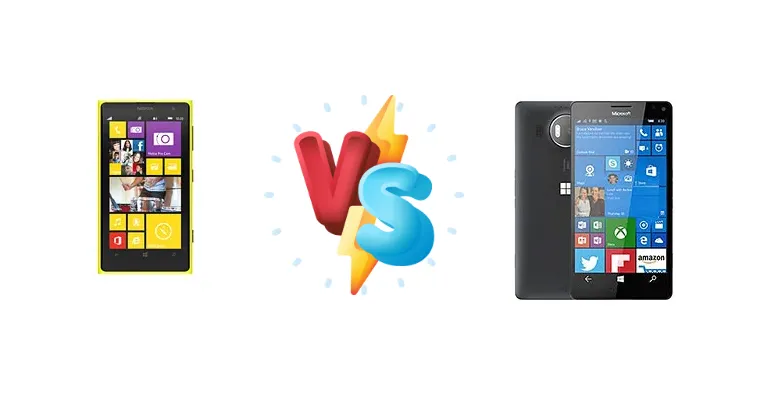
The Nokia Lumia 1020 was legendary for its groundbreaking 41MP camera, while the Microsoft Lumia 950 XL aimed for a more modern, powerful experience. Both devices ran Windows Phone, but offered vastly different approaches. Let's dive into a detailed comparison to see which phone holds up best today.
🏆 Quick Verdict
The Lumia 950 XL wins overall due to its significantly faster processor, modern features like wireless charging, and slightly better display. However, the 1020's camera remains a compelling reason to consider it, especially for photography enthusiasts seeking a unique experience.
| Network |
|---|
| 2G bands | GSM 850 / 900 / 1800 / 1900 - all versions | GSM 850 / 900 / 1800 / 1900 |
| 3G bands | HSDPA 850 / 900 / 1900 / 2100 - RM-875, RM-877 | HSDPA 850 / 900 / 1700(AWS) / 1900 / 2100 |
| 4G bands | 1, 3, 7, 8, 20 - RM-875 | 1, 2, 3, 4, 5, 7, 8, 12, 20, 28, 38, 40 - EMEA |
| Speed | HSPA 42.2/5.76 Mbps, LTE Cat3 100/50 Mbps | HSPA 42.2/5.76 Mbps, LTE Cat6 300/50 Mbps |
| Technology | GSM / HSPA / LTE | GSM / HSPA / LTE |
| | 2, 4, 5, 17 - RM-877 | 1, 2, 3, 4, 5, 7, 8, 12, 17, 20, 28, 38, 40, 41 - USA |
| Launch |
|---|
| Announced | 2013, July 11. Released 2013, July 22 | 2015, October. Released 2015, November |
| Status | Discontinued | Discontinued |
| Body |
|---|
| Build | Glass front (Gorilla Glass 3), plastic back, plastic frame | - |
| Dimensions | 130.4 x 71.4 x 10.4 mm, 96.9 cc (5.13 x 2.81 x 0.41 in) | 151.9 x 78.4 x 8.1 mm (5.98 x 3.09 x 0.32 in) |
| SIM | Micro-SIM | Nano-SIM |
| Weight | 158 g (5.57 oz) | 165 g (5.82 oz) |
| Display |
|---|
| Protection | Corning Gorilla Glass 3 | Corning Gorilla Glass 4 |
| Resolution | 768 x 1280 pixels, 5:3 ratio (~332 ppi density) | 1440 x 2560 pixels, 16:9 ratio (~518 ppi density) |
| Size | 4.5 inches, 57.6 cm2 (~61.9% screen-to-body ratio) | 5.7 inches, 88.5 cm2 (~74.3% screen-to-body ratio) |
| Type | AMOLED | AMOLED |
| | PureMotion HD+ ClearBlack display | ClearBlack display |
| Platform |
|---|
| CPU | Dual-core 1.5 GHz Krait | Octa-core (4x1.5 GHz Cortex-A53 & 4x2.0 GHz Cortex-A57) |
| Chipset | Qualcomm MSM8960 Snapdragon S4 Plus | Qualcomm MSM8994 Snapdragon 810 (20 nm) |
| GPU | Adreno 225 | Adreno 430 |
| OS | Microsoft Windows Phone 8, upgradable to 8.1 | Microsoft Windows 10 |
| Memory |
|---|
| Card slot | No | microSDXC (dedicated slot) |
| Internal | 32GB 2GB RAM, 64GB 2GB RAM (Telefonica exclusive) | 32GB 3GB RAM |
| | - | eMMC 5.0 |
| Main Camera |
|---|
| Features | Carl Zeiss optics, Xenon & LED flash, panorama | Zeiss optics, triple-LED RGB flash, panorama, HDR |
| Single | 41 MP, f/2.2, 26mm (wide), 1/1.5", 1.12µm, AF, OIS | 20 MP, f/1.9, 26mm (wide), 1/2.4", 1.12µm, AF, OIS |
| Video | 1080p@30fps, 4x lossless digital zoom | 4K@30fps, stereo sound rec., 1080p@30/60fps (after SW update) |
| Selfie camera |
|---|
| Single | 1.2 MP | 5 MP, f/2.4 |
| Video | 720p@30fps | 1080p@30fps |
| Sound |
|---|
| 3.5mm jack | Yes | Yes |
| 35mm jack | Yes | Yes |
| Loudspeaker | Yes | Yes |
| Comms |
|---|
| Bluetooth | 4.0, A2DP, EDR, LE/ aptX after WP8 Denim update | 4.1, A2DP |
| NFC | Yes | Yes |
| Positioning | GPS, GLONASS | GPS, GLONASS, BDS |
| Radio | Stereo FM radio, RDS | FM radio |
| USB | microUSB 2.0 | USB Type-C 3.1 |
| WLAN | Wi-Fi 802.11 a/b/g/n, dual-band, DLNA, hotspot | Wi-Fi 802.11 a/b/g/n/ac, dual-band, hotspot |
| Features |
|---|
| Sensors | Accelerometer, gyro, proximity, compass, barometer | Iris scanner, accelerometer, gyro, proximity, compass, barometer, sensor core |
| | - | Microsoft Continuum support |
| Battery |
|---|
| Charging | - | 18W wired
Wireless (Qi) (market dependent) |
| Music play | Up to 63 h | Up to 75 h |
| Stand-by | Up to 384 h (3G) | Up to 288 h (2G) / Up to 288 h (3G) |
| Talk time | Up to 19 h (2G) / Up to 13 h 20 min (3G) | Up to 25 h (2G) / Up to 19 h (3G) |
| Type | Li-Ion 2000 mAh, non-removable (BV-5XW) | Li-Ion 3340 mAh, removable |
| Misc |
|---|
| Colors | Yellow, white, black, red (AT&T exclusive) | Black, White |
| Price | About 400 EUR | About 350 EUR |
| SAR | 1.23 W/kg (head) 0.97 W/kg (body) | - |
| SAR EU | 0.76 W/kg (head) 0.67 W/kg (body) | - |
| Tests |
|---|
| Audio quality | - |
Noise -91.6dB / Crosstalk -89.3dB |
| Battery life |
Endurance rating 61h
|
Endurance rating 62h
|
| Camera |
Photo / Video |
Photo / Video |
| Display |
Contrast ratio: Infinite (nominal), 2.103 (sunlight) |
Contrast ratio: Infinite (nominal), 3.837 (sunlight) |
| Loudspeaker |
Voice 69dB / Noise 66dB / Ring 72dB
|
Voice 74dB / Noise 75dB / Ring 84dB
|
| Performance | - |
Basemark OS II 2.0: 1472Basemark X: 32178 |
Nokia Lumia 1020
- Exceptional 41MP camera
- Excellent image detail
- Compact design
- Bright display with great contrast
- Outdated processor
- Limited app availability (Windows Phone end-of-life)
- No wireless charging
- Smaller battery
Microsoft Lumia 950 XL
- Powerful Snapdragon 810 processor
- Larger, higher-resolution display
- Wireless charging support
- More modern features
- Better low-light camera performance
- Bulky design
- Windows Phone end-of-life
- Camera not as impressive as 1020 in ideal lighting
Display Comparison
Both phones boast excellent contrast ratios, with the Lumia 950 XL edging out the 1020 in sunlight readability (3.837 vs 2.103). The 950 XL's display is also larger (5.7 inches vs 4.5 inches) and has a higher resolution (1440 x 768 vs 1080 x 1920), offering a more immersive viewing experience. While both have 'infinite' contrast, this is a marketing term and doesn't reflect true black levels.
Camera Comparison
This is where things get interesting. The Lumia 1020's 41MP PureView camera was revolutionary, offering incredible detail and oversampling capabilities. While the 950 XL's 20MP camera is no slouch, it doesn't quite match the 1020's image quality in ideal conditions. However, the 950 XL benefits from more modern image processing and features. Low-light performance is improved on the 950 XL.
Performance
The Lumia 950 XL's Snapdragon 810 octa-core processor is a massive upgrade over the 1020's dual-core Snapdragon S4 Plus. This translates to significantly faster app loading times, smoother multitasking, and a more responsive overall experience. The 950 XL handles demanding games and applications with ease, while the 1020 can feel sluggish at times.
Battery Life
Both phones offer similar endurance ratings (61h vs 62h), suggesting comparable battery life in typical usage. The Lumia 950 XL's larger battery capacity (3350 mAh vs 1830 mAh) contributes to this, despite its more power-hungry processor. The 950 XL also supports 18W wired charging and Qi wireless charging, a significant advantage over the 1020.
Buying Guide
The Nokia Lumia 1020 is for photography purists who prioritize image quality above all else and appreciate a simpler, more focused user experience. The Microsoft Lumia 950 XL is for users who want a more powerful and versatile smartphone with modern features, even if it means sacrificing some of the 1020's camera-centric charm.
Frequently Asked Questions
❓ Is Windows Phone still supported?
No, Microsoft has ended support for Windows Phone. Apps are no longer being developed, and security updates are unavailable. Using either of these phones carries security risks.
❓ Which phone is better for photography?
The Nokia Lumia 1020 excels in capturing incredibly detailed images in good lighting conditions. The Microsoft Lumia 950 XL offers more versatile camera features and better low-light performance.