
Nokia G60 vs Nokia X20: A Head-to-Head Showdown
| Phones Images | |||||
|---|---|---|---|---|---|
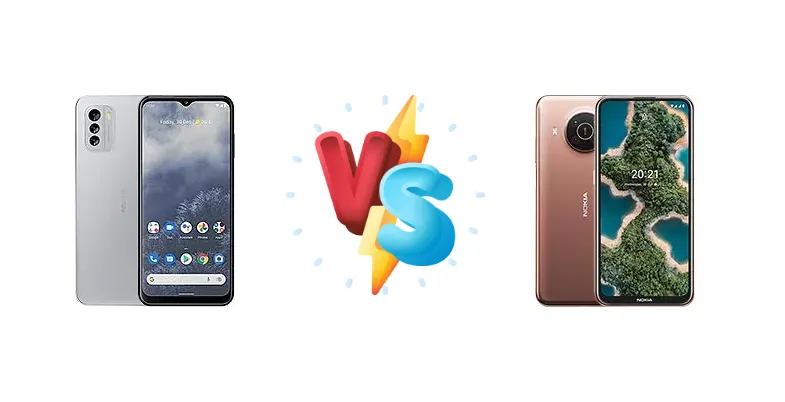
|
🏆 Quick Verdict
The Nokia G60 edges out the X20 thanks to its significantly more powerful Snapdragon 695 chipset and brighter display. While the X20 offers a slightly more efficient 8nm process, the G60's performance boost makes it the preferable choice for most users.
| PHONES | ||
|---|---|---|
| Phone Names | Nokia G60 | Nokia X20 |
| Network | ||
|---|---|---|
| 2G bands | GSM 850 / 900 / 1800 / 1900 | GSM 850 / 900 / 1800 / 1900 |
| 3G bands | HSDPA 850 / 900 / 1900 / 2100 - International | HSDPA 850 / 900 / 1700(AWS) / 1900 / 2100 |
| 4G bands | 1, 3, 5, 7, 8, 20, 28, 38, 39, 40, 41 - International | 1, 2, 3, 4, 5, 7, 8, 12, 20, 28, 66, 38, 39, 40, 41 |
| 5G bands | 1, 3, 5, 7, 28, 38, 40, 41, 77, 78 SA/NSA/Sub6 - International | 1, 2, 3, 5, 7, 28, 38, 41, 66, 78 SA/NSA/Sub6 |
| Speed | HSPA, LTE, 5G | HSPA, LTE, 5G |
| Technology | GSM / HSPA / LTE / 5G | GSM / HSPA / LTE / 5G |
| 1, 3, 5, 7, 28, 38, 40, 41, 66, 78 SA/NSA/Sub6 - LATAM | - | |
| Launch | ||
|---|---|---|
| Announced | 2022, September 01 | 2021, April 08 |
| Status | Available. Released 2022, September 01 | Available. Released 2021, May 12 |
| Body | ||
|---|---|---|
| Build | Glass front (Gorilla Glass 5), plastic frame, plastic back | - |
| Dimensions | 166 x 75.9 x 8.6 mm (6.54 x 2.99 x 0.34 in) | 168.9 x 79.7 x 9.1 mm (6.65 x 3.14 x 0.36 in) |
| SIM | · Nano-SIM + eSIM· Nano-SIM + Nano-SIM | · Nano-SIM· Nano-SIM + Nano-SIM |
| Weight | 190 g (6.70 oz) | 220 g (7.76 oz) |
| Splash resistant | - | |
| Display | ||
|---|---|---|
| Protection | Corning Gorilla Glass 5 | Corning Gorilla Glass 5 |
| Resolution | 1080 x 2408 pixels, 20:9 ratio (~401 ppi density) | 1080 x 2400 pixels, 20:9 ratio (~395 ppi density) |
| Size | 6.58 inches, 104.3 cm2 (~82.8% screen-to-body ratio) | 6.67 inches, 107.4 cm2 (~79.8% screen-to-body ratio) |
| Type | IPS LCD, 120Hz, 400 nits (typ) | IPS LCD, 450 nits (typ) |
| Platform | ||
|---|---|---|
| CPU | Octa-core (2x2.2 GHz Kryo 660 Gold & 6x1.7 GHz Kryo 660 Silver) | Octa-core (2x2.0 GHz Kryo 460 & 6x1.8 GHz Kryo 460) |
| Chipset | Qualcomm SM6375 Snapdragon 695 5G (6 nm) | Qualcomm SM4350 Snapdragon 480 5G (8 nm) |
| GPU | Adreno 619 | Adreno 619 |
| OS | Android 12 | Android 11, upgradable to Android 14 |
| Memory | ||
|---|---|---|
| Card slot | microSDXC (uses shared SIM slot) | microSDXC (uses shared SIM slot) |
| Internal | 64GB 4GB RAM, 128GB 4GB RAM, 128GB 6GB RAM | 128GB 6GB RAM, 128GB 8GB RAM |
| Main Camera | ||
|---|---|---|
| Features | LED flash, HDR, panorama | Zeiss optics, LED flash, HDR, panorama |
| Quad | - | 64 MP, (wide), PDAF 5 MP, (ultrawide) 2 MP (macro) Auxiliary lens |
| Single | 8 MP, f/2.0, (wide), 1/4.0", 1.12µm | 32 MP, (wide) |
| Triple | 50 MP, f/1.8, (wide), 1/2.5", 0.7µm, PDAF 5 MP, f/2.2, (ultrawide), 1/5.0" Auxiliary lens | - |
| Video | 1080p@30fps | 1080p@30/60fps |
| Selfie camera | ||
|---|---|---|
| Single | 8 MP, f/2.0, (wide), 1/4.0", 1.12µm | 32 MP, (wide) |
| Video | 1080p@30fps | 1080p@30fps |
| Sound | ||
|---|---|---|
| 3.5mm jack | Yes | Yes |
| 35mm jack | Yes | Yes |
| Loudspeaker | Yes | Yes |
| Comms | ||
|---|---|---|
| Bluetooth | 5.1, A2DP, LE, aptX HD, aptX Adaptive | 5.0, A2DP, LE, aptX HD |
| NFC | Yes (market/region dependent) | Yes |
| Positioning | GPS, GALILEO, BDS | GPS, GLONASS, GALILEO |
| Radio | FM radio | FM radio |
| USB | USB Type-C 2.0, OTG | USB Type-C 2.0, OTG |
| WLAN | Wi-Fi 802.11 a/b/g/n/ac/6, dual-band | Wi-Fi 802.11 a/b/g/n/ac, dual-band, Wi-Fi Direct |
| Features | ||
|---|---|---|
| Sensors | Fingerprint (side-mounted), accelerometer, gyro, proximity, compass | Fingerprint (side-mounted), accelerometer, gyro, proximity |
| Battery | ||
|---|---|---|
| Charging | 20W wired, PD3.0 | 18W wired |
| Type | Li-Po 4500 mAh | Li-Po 4470 mAh |
| Misc | ||
|---|---|---|
| Colors | Pure Black, Ice Gray | Midnight Sun, Nordic Blue |
| Models | TA-1490, TA-1481, TA-1479, TA-1475 | TA-1341, TA-1344 |
| Price | About 240 EUR | About 130 EUR |
| SAR | 1.30 W/kg (head) 0.83 W/kg (body) | 1.04 W/kg (head) 0.62 W/kg (body) |
| SAR EU | 1.10 W/kg (head) 1.27 W/kg (body) | 0.51 W/kg (head) 1.29 W/kg (body) |
Nokia G60
- More powerful processor
- Brighter display
- Sleek design
- Clean Android experience
- Slower charging speed
- Potential for slightly shorter battery life than X20
Nokia X20
- Slightly better power efficiency
- Clean Android experience
- Generally more affordable
- Weaker processor
- Dimmer display
- Slower performance
Display Comparison
The Nokia G60 boasts a measured 444 nits of peak brightness, significantly brighter than the X20's display (estimated around 380-400 nits). The G60's 1523:1 contrast ratio also suggests better image quality. Both phones feature similar display resolutions and sizes, but the G60's superior brightness makes it the clear winner for outdoor visibility and overall visual experience.
Camera Comparison
Both phones feature a triple-camera setup, typically including a main sensor, ultrawide lens, and macro lens. While specific megapixel counts are similar, the G60's more powerful processor likely contributes to better image processing and overall photo quality, especially in low-light conditions. The X20's camera is decent, but not exceptional.
Performance
Here's where the G60 truly shines. Its Snapdragon 695 5G chipset, built on a 6nm process, offers a substantial performance advantage over the X20's Snapdragon 480 5G (8nm). Expect smoother multitasking, faster app loading times, and better gaming performance on the G60. The X20's chipset is adequate for basic tasks, but struggles with more demanding applications.
Battery Life
The Nokia X20's 8nm chipset offers slightly better power efficiency, potentially leading to marginally longer battery life under light usage. However, the G60's larger battery capacity (typically around 4400mAh vs X20's 4470mAh) helps offset this, and the difference in real-world usage is likely minimal. Both support 18-20W charging, which is relatively slow by modern standards.
Buying Guide
The Nokia G60 is ideal for users who prioritize performance and a vibrant display for media consumption and light gaming. The Nokia X20 is a good option for those seeking a budget-friendly 5G phone with a focus on software updates and a slightly longer battery life, but are willing to compromise on speed.