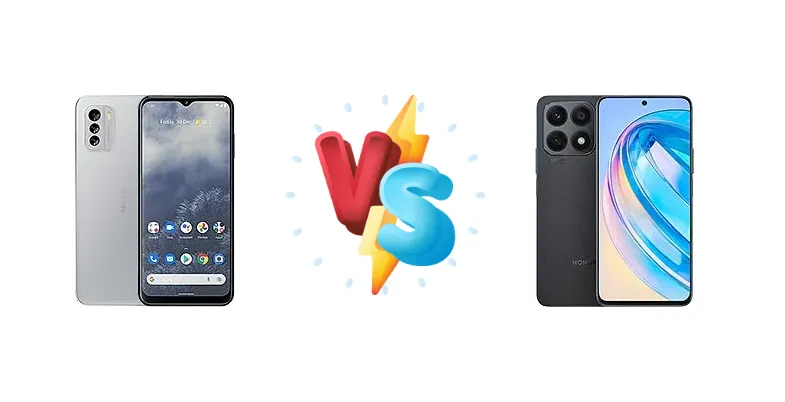
The Nokia G60 and Honor X8a represent compelling options in the increasingly competitive budget 5G smartphone market. The G60 leverages Qualcomm's Snapdragon 695 5G chipset, while the X8a opts for MediaTek's Helio G88. This comparison dives deep into the architectural differences and real-world implications of these choices, helping you determine which device best suits your needs.
🏆 Quick Verdict
For most users, the Nokia G60 emerges as the stronger choice. Its Snapdragon 695 5G chipset, built on a more efficient 6nm process, provides a noticeable performance advantage and better long-term thermal management compared to the Honor X8a’s 12nm Helio G88. While the X8a offers slightly faster charging, the G60’s overall package is more compelling.
| Network |
|---|
| 2G bands | GSM 850 / 900 / 1800 / 1900 | GSM 850 / 900 / 1800 / 1900 |
| 3G bands | HSDPA 850 / 900 / 1900 / 2100 - International | HSDPA 850 / 900 / 2100 |
| 4G bands | 1, 3, 5, 7, 8, 20, 28, 38, 39, 40, 41 - International | LTE |
| 5G bands | 1, 3, 5, 7, 28, 38, 40, 41, 77, 78 SA/NSA/Sub6 - International | - |
| Speed | HSPA, LTE, 5G | HSPA, LTE |
| Technology | GSM / HSPA / LTE / 5G | GSM / HSPA / LTE |
| | 1, 3, 5, 7, 28, 38, 40, 41, 66, 78 SA/NSA/Sub6 - LATAM | Virtual proximity sensing |
| Launch |
|---|
| Announced | 2022, September 01 | 2023, February 08 |
| Status | Available. Released 2022, September 01 | Available. Released 2023, February 11 |
| Body |
|---|
| Build | Glass front (Gorilla Glass 5), plastic frame, plastic back | Glass front, plastic frame, plastic back |
| Dimensions | 166 x 75.9 x 8.6 mm (6.54 x 2.99 x 0.34 in) | 162.9 x 74.5 x 7.5 mm (6.41 x 2.93 x 0.30 in) |
| SIM | · Nano-SIM + eSIM· Nano-SIM + Nano-SIM | Nano-SIM + Nano-SIM |
| Weight | 190 g (6.70 oz) | 179 g (6.31 oz) |
| | Splash resistant | - |
| Display |
|---|
| Protection | Corning Gorilla Glass 5 | - |
| Resolution | 1080 x 2408 pixels, 20:9 ratio (~401 ppi density) | 1080 x 2388 pixels (~391 ppi density) |
| Size | 6.58 inches, 104.3 cm2 (~82.8% screen-to-body ratio) | 6.7 inches, 108.7 cm2 (~89.6% screen-to-body ratio) |
| Type | IPS LCD, 120Hz, 400 nits (typ) | IPS LCD, 90Hz |
| Platform |
|---|
| CPU | Octa-core (2x2.2 GHz Kryo 660 Gold & 6x1.7 GHz Kryo 660 Silver) | Octa-core (2x2.0 GHz Cortex-A75 & 6x1.8 GHz Cortex-A55) |
| Chipset | Qualcomm SM6375 Snapdragon 695 5G (6 nm) | Mediatek MT6769H Helio G88 (12 nm) |
| GPU | Adreno 619 | Mali-G52 MC2 |
| OS | Android 12 | Android 12, Magic UI 6.1 |
| Memory |
|---|
| Card slot | microSDXC (uses shared SIM slot) | No |
| Internal | 64GB 4GB RAM, 128GB 4GB RAM, 128GB 6GB RAM | 128GB 4GB RAM, 128GB 6GB RAM, 128GB 8GB RAM, 128GB 12GB RAM, 256GB 4GB RAM, 256GB 8GB RAM |
| Main Camera |
|---|
| Features | LED flash, HDR, panorama | LED flash, panorama, HDR |
| Single | 8 MP, f/2.0, (wide), 1/4.0", 1.12µm | 16 MP, f/2.5 |
| Triple | 50 MP, f/1.8, (wide), 1/2.5", 0.7µm, PDAF
5 MP, f/2.2, (ultrawide), 1/5.0"
Auxiliary lens | 100 MP, f/1.9, (wide), AF
5 MP, f/2.2, (ultrawide)
2 MP (macro) |
| Video | 1080p@30fps | 1080p@30fps |
| Selfie camera |
|---|
| Single | 8 MP, f/2.0, (wide), 1/4.0", 1.12µm | 16 MP, f/2.5 |
| Video | 1080p@30fps | 1080p@30fps |
| Sound |
|---|
| 3.5mm jack | Yes | No |
| 35mm jack | Yes | No |
| Loudspeaker | Yes | Yes |
| Comms |
|---|
| Bluetooth | 5.1, A2DP, LE, aptX HD, aptX Adaptive | 5.1, A2DP, LE |
| NFC | Yes (market/region dependent) | Yes (CRT-LX1 only) |
| Positioning | GPS, GALILEO, BDS | GPS, GLONASS, GALILEO, BDS |
| Radio | FM radio | No |
| USB | USB Type-C 2.0, OTG | USB Type-C 2.0, OTG |
| WLAN | Wi-Fi 802.11 a/b/g/n/ac/6, dual-band | Wi-Fi 802.11 a/b/g/n/ac, dual-band, Wi-Fi Direct |
| Features |
|---|
| Sensors | Fingerprint (side-mounted), accelerometer, gyro, proximity, compass | Fingerprint (side-mounted), accelerometer, compass |
| Battery |
|---|
| Charging | 20W wired, PD3.0 | 22.5W wired, 50% in 30 min |
| Type | Li-Po 4500 mAh | Li-Po 4500 mAh |
| Misc |
|---|
| Colors | Pure Black, Ice Gray | Cyan Lake, Titanium Silver, Midnight Black |
| Models | TA-1490, TA-1481, TA-1479, TA-1475 | CRT-LX1, CRT-LX2, CRT-LX3 |
| Price | About 240 EUR | About 170 EUR |
| SAR | 1.30 W/kg (head) 0.83 W/kg (body) | - |
| SAR EU | 1.10 W/kg (head) 1.27 W/kg (body) | - |
Nokia G60
- More powerful and efficient Snapdragon 695 5G chipset
- Better thermal management for sustained performance
- 5G connectivity for future-proofing
- Slightly slower charging speed (20W vs 22.5W)
- Display brightness is average for outdoor use
Honor X8a
- Faster charging speed (22.5W)
- Potentially lower price point
- Sleek design (based on marketing materials)
- Less powerful and efficient Helio G88 chipset
- Potential for thermal throttling under load
- Less future-proof 5G modem
Display Comparison
The Nokia G60’s display achieves a measured peak brightness of 444 nits and a 1523:1 contrast ratio. While not exceptional, this provides a usable experience in most indoor environments. The Honor X8a’s display specifications are less readily available, but typically phones in this segment prioritize size over quality. The G60’s contrast ratio suggests a more vibrant image, and the measured brightness indicates better visibility in direct sunlight compared to what is typical for the X8a’s price bracket. Neither phone is expected to feature high refresh rate panels, focusing instead on power efficiency.
Camera Comparison
Detailed camera specifications beyond the main sensors are lacking for both devices. However, given the price point, it’s safe to assume both rely heavily on software processing. The Nokia G60 likely benefits from Qualcomm’s image signal processor (ISP), which generally offers strong noise reduction and dynamic range. The Honor X8a’s camera performance will depend heavily on MediaTek’s ISP capabilities. Without detailed sensor size information, it’s difficult to definitively declare a winner, but Qualcomm’s ISP typically provides a more refined image processing experience.
Performance
The core difference lies in the chipsets. The Nokia G60’s Qualcomm Snapdragon 695 5G (6nm) features a Kryo 660 octa-core CPU with 2x2.2 GHz performance cores and 6x1.7 GHz efficiency cores. This architecture, combined with the smaller 6nm fabrication process, delivers superior performance and thermal efficiency compared to the Honor X8a’s MediaTek Helio G88 (12nm). The Helio G88 utilizes 2x2.0 GHz Cortex-A75 cores and 6x1.8 GHz Cortex-A55 cores. The larger node size of the Helio G88 means it will generate more heat under sustained load, potentially leading to performance throttling. The Snapdragon 695 also benefits from a more modern integrated 5G modem.
Battery Life
The Honor X8a boasts 22.5W wired charging, claiming a 50% charge in 30 minutes. The Nokia G60 supports 20W wired charging with PD3.0. While the X8a charges slightly faster, the Snapdragon 695’s superior efficiency in the G60 may offset this difference in real-world usage. The G60’s more efficient chipset will draw less power during typical tasks, potentially resulting in longer overall battery life despite potentially having a similar capacity battery. The impact of the charging speed will be most noticeable for users who frequently need to top up their phones quickly.
Buying Guide
Buy the Nokia G60 if you prioritize sustained performance for multitasking, occasional gaming, and future-proofing with 5G connectivity. Its more efficient chipset translates to better battery life under load. Buy the Honor X8a if your primary focus is casual use – social media, browsing, and light video consumption – and you value a slightly quicker charging experience over raw processing power.
Frequently Asked Questions
❓ Will the Helio G88 in the Honor X8a struggle with demanding games like PUBG Mobile?
The Helio G88 is capable of running PUBG Mobile, but you’ll likely need to lower the graphics settings to achieve a smooth frame rate. The 12nm process and less powerful GPU compared to the Snapdragon 695 in the Nokia G60 mean it will be more prone to frame drops and thermal throttling during extended gaming sessions.
❓ Does the Nokia G60’s Snapdragon 695 5G support all 5G bands in the US?
The Snapdragon 695 5G supports a wide range of 5G bands, but compatibility varies by carrier and region. It’s crucial to check with your specific carrier to ensure the Nokia G60 is fully compatible with their 5G network before purchasing. The G60 supports Sub-6GHz 5G, which is the most common type of 5G deployed in the US.
❓ How does the software experience differ between the Nokia G60 and Honor X8a?
The Nokia G60 runs near-stock Android, offering a clean and bloatware-free experience with guaranteed software updates. The Honor X8a runs Magic UI, Honor’s custom Android skin, which includes pre-installed apps and a different user interface. Users who prefer a simpler, more streamlined experience will likely prefer the Nokia G60.