
Google Pixel 7a vs. Nokia G60: A Detailed Comparison of Mid-Range Contenders
| Phones Images | |||||
|---|---|---|---|---|---|
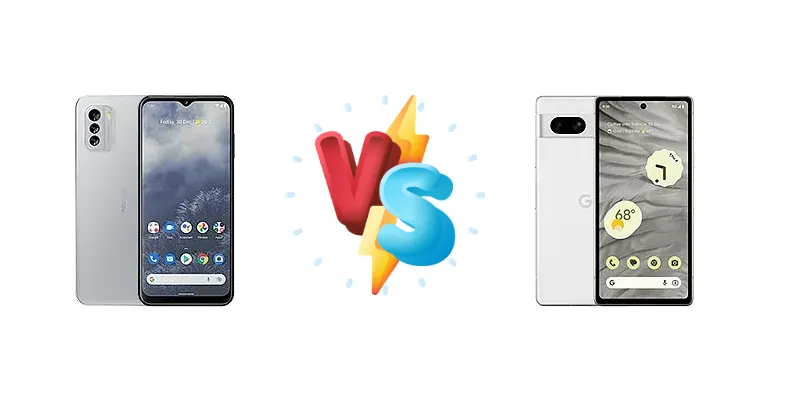
|
🏆 Quick Verdict
For most users, the Google Pixel 7a is the superior choice. Its significantly brighter display (1070 nits vs 444 nits), vastly more powerful Tensor G2 chipset, and exceptional camera capabilities justify the price premium. However, the Nokia G60 offers compelling value for those prioritizing 5G and a budget-friendly price.
| PHONES | ||
|---|---|---|
| Phone Names | Nokia G60 | Google Pixel 7a |
| Network | ||
|---|---|---|
| 2G bands | GSM 850 / 900 / 1800 / 1900 | GSM 850 / 900 / 1800 / 1900 |
| 3G bands | HSDPA 850 / 900 / 1900 / 2100 - International | HSDPA 800 / 850 / 900 / 1700(AWS) / 1900 / 2100 |
| 4G bands | 1, 3, 5, 7, 8, 20, 28, 38, 39, 40, 41 - International | 1, 2, 3, 4, 5, 7, 8, 12, 13, 14, 17, 20, 25, 26, 28, 29, 30, 38, 40, 41, 48, 66, 71 - GWKK3, G0DZQ |
| 5G bands | 1, 3, 5, 7, 28, 38, 40, 41, 77, 78 SA/NSA/Sub6 - International | 1, 2, 3, 5, 7, 8, 12, 14, 20, 25, 28, 30, 38, 41, 48, 66, 71, 77, 78 SA/NSA/Sub6 - GWKK3 |
| Speed | HSPA, LTE, 5G | HSPA, LTE, 5G |
| Technology | GSM / HSPA / LTE / 5G | GSM / HSPA / LTE / 5G |
| 1, 3, 5, 7, 28, 38, 40, 41, 66, 78 SA/NSA/Sub6 - LATAM | 1, 2, 3, 5, 7, 8, 12, 20, 25, 28, 38, 40, 41, 66, 75, 76, 77, 78, 79 SA/NSA/Sub6 - GHL1X, G82U8 | |
| Launch | ||
|---|---|---|
| Announced | 2022, September 01 | 2023, May 10 |
| Status | Available. Released 2022, September 01 | Available. Released 2023, May 10 |
| Body | ||
|---|---|---|
| Build | Glass front (Gorilla Glass 5), plastic frame, plastic back | Glass front (Gorilla Glass 3), aluminum frame, plastic back |
| Dimensions | 166 x 75.9 x 8.6 mm (6.54 x 2.99 x 0.34 in) | 152 x 72.9 x 9 mm (5.98 x 2.87 x 0.35 in) |
| SIM | · Nano-SIM + eSIM· Nano-SIM + Nano-SIM | Nano-SIM + eSIM |
| Weight | 190 g (6.70 oz) | 193.5 g (6.84 oz) |
| Splash resistant | IP67 dust/water resistant (up to 1m for 30 min) | |
| Display | ||
|---|---|---|
| Protection | Corning Gorilla Glass 5 | Corning Gorilla Glass 3 |
| Resolution | 1080 x 2408 pixels, 20:9 ratio (~401 ppi density) | 1080 x 2400 pixels, 20:9 ratio (~429 ppi density) |
| Size | 6.58 inches, 104.3 cm2 (~82.8% screen-to-body ratio) | 6.1 inches, 90.7 cm2 (~81.8% screen-to-body ratio) |
| Type | IPS LCD, 120Hz, 400 nits (typ) | OLED, HDR, 90Hz |
| - | Always-on display | |
| Platform | ||
|---|---|---|
| CPU | Octa-core (2x2.2 GHz Kryo 660 Gold & 6x1.7 GHz Kryo 660 Silver) | Octa-core (2x2.85 GHz Cortex-X1 & 2x2.35 GHz Cortex-A78 & 4x1.80 GHz Cortex-A55) |
| Chipset | Qualcomm SM6375 Snapdragon 695 5G (6 nm) | Google Tensor G2 (5 nm) |
| GPU | Adreno 619 | Mali-G710 MP7 |
| OS | Android 12 | Android 13, upgradable to Android 15, up to 5 major Android upgrades |
| Memory | ||
|---|---|---|
| Card slot | microSDXC (uses shared SIM slot) | No |
| Internal | 64GB 4GB RAM, 128GB 4GB RAM, 128GB 6GB RAM | 128GB 8GB RAM |
| - | UFS 3.1 | |
| Main Camera | ||
|---|---|---|
| Dual | - | 64 MP, f/1.9, 26mm (wide), 1/1.73", 0.8µm, dual pixel PDAF, OIS 13 MP, f/2.2, 120˚ (ultrawide), 1.12µm |
| Features | LED flash, HDR, panorama | Dual-LED flash, Pixel Shift, Auto-HDR, panorama |
| Single | 8 MP, f/2.0, (wide), 1/4.0", 1.12µm | - |
| Triple | 50 MP, f/1.8, (wide), 1/2.5", 0.7µm, PDAF 5 MP, f/2.2, (ultrawide), 1/5.0" Auxiliary lens | - |
| Video | 1080p@30fps | 4K@30/60fps, 1080p@30/60/120/240fps, OIS |
| Selfie camera | ||
|---|---|---|
| Features | - | HDR, panorama |
| Single | 8 MP, f/2.0, (wide), 1/4.0", 1.12µm | 13 MP, f/2.2, 20mm (ultrawide), 1.12µm |
| Video | 1080p@30fps | 4K@30fps, 1080p@30fps |
| Sound | ||
|---|---|---|
| 3.5mm jack | Yes | No |
| 35mm jack | Yes | No |
| Loudspeaker | Yes | Yes, with stereo speakers |
| Comms | ||
|---|---|---|
| Bluetooth | 5.1, A2DP, LE, aptX HD, aptX Adaptive | 5.3, A2DP, LE |
| NFC | Yes (market/region dependent) | Yes |
| Positioning | GPS, GALILEO, BDS | GPS, GLONASS, GALILEO, BDS, QZSS, NavIC |
| Radio | FM radio | No |
| USB | USB Type-C 2.0, OTG | USB Type-C 3.2 |
| WLAN | Wi-Fi 802.11 a/b/g/n/ac/6, dual-band | Wi-Fi 802.11 a/b/g/n/ac/6e, tri-band |
| Features | ||
|---|---|---|
| Sensors | Fingerprint (side-mounted), accelerometer, gyro, proximity, compass | Fingerprint (under display, optical), accelerometer, gyro, proximity, compass, barometer |
| Battery | ||
|---|---|---|
| Charging | 20W wired, PD3.0 | 18W wired, PD3.0 7.5W wireless |
| Type | Li-Po 4500 mAh | Li-Po 4385 mAh |
| Misc | ||
|---|---|---|
| Colors | Pure Black, Ice Gray | Charcoal, Snow, Sea, Coral |
| Models | TA-1490, TA-1481, TA-1479, TA-1475 | GWKK3, GHL1X, G0DZQ, G82U8 |
| Price | About 240 EUR | € 179.90 / $ 150.00 / £ 170.00 / ₹ 25,980 |
| SAR | 1.30 W/kg (head) 0.83 W/kg (body) | - |
| SAR EU | 1.10 W/kg (head) 1.27 W/kg (body) | - |
Nokia G60
- Superior camera performance with Google’s computational photography
- Significantly faster processor (Tensor G2) for smooth multitasking and gaming
- Brighter and more vibrant display for better outdoor visibility
- Wireless charging support
- Higher price point
- Potentially more thermal throttling under sustained load
Google Pixel 7a
- More affordable price
- 5G connectivity
- Longer software support commitment from Nokia
- Decent battery life
- Significantly slower processor
- Inferior camera quality
- Dimmer display
- No wireless charging
Display Comparison
The Pixel 7a’s display is a clear winner, boasting a peak brightness of 1070 nits compared to the Nokia G60’s 444 nits. This translates to significantly better visibility outdoors and a more engaging viewing experience. While both support PD3.0 charging, the Nokia G60’s 1523:1 contrast ratio is respectable, it can’t overcome the brightness deficit. The Pixel 7a’s panel, though not specified as LTPO, benefits from Google’s display calibration, offering more accurate colors and wider viewing angles.
Camera Comparison
The Pixel 7a’s camera system is its standout feature. While specific sensor details are missing, Google’s computational photography prowess, powered by the Tensor G2’s image signal processor (ISP), delivers exceptional image quality in all lighting conditions. The Nokia G60, while capable, simply cannot compete in terms of detail, dynamic range, and low-light performance. The Pixel 7a’s video capabilities are also superior, benefiting from advanced stabilization and processing algorithms. The Nokia G60’s camera is adequate for casual snapshots, but serious photographers will find it lacking.
Performance
The performance gap between these devices is substantial. The Google Pixel 7a’s Tensor G2, built on a 5nm process, features a tri-cluster configuration with high-performance Cortex-X1 cores clocked at 2.85 GHz. This contrasts sharply with the Nokia G60’s Snapdragon 695 5G (6nm), which relies on Kryo 660 cores peaking at 2.2 GHz. The Tensor G2’s architectural advantages and more efficient node result in significantly faster app loading times, smoother multitasking, and superior gaming performance. While the Nokia G60 handles everyday tasks adequately, it will struggle with demanding applications.
Battery Life
The Pixel 7a boasts an endurance rating of 76 hours, suggesting efficient power management despite its powerful processor. While the Nokia G60’s battery capacity isn’t specified, its Snapdragon 695 5G chipset and lower screen brightness contribute to reasonable battery life. The Pixel 7a also offers 7.5W wireless charging, a feature absent on the Nokia G60. Both support 20W (Pixel 7a is 18W) wired charging with PD3.0, but the Pixel 7a’s faster processor and more demanding display may offset some of the battery efficiency gains.
Buying Guide
Buy the Nokia G60 if you need a reliable 5G phone with a focus on longevity and software updates, and are willing to compromise on camera quality and raw processing power. Buy the Google Pixel 7a if you prioritize camera performance, a smoother user experience, and a brighter, more vibrant display, and are willing to spend a bit more for these features.