
Nokia G50 vs Nokia X20: A Detailed Comparison
| Phones Images | |||||
|---|---|---|---|---|---|
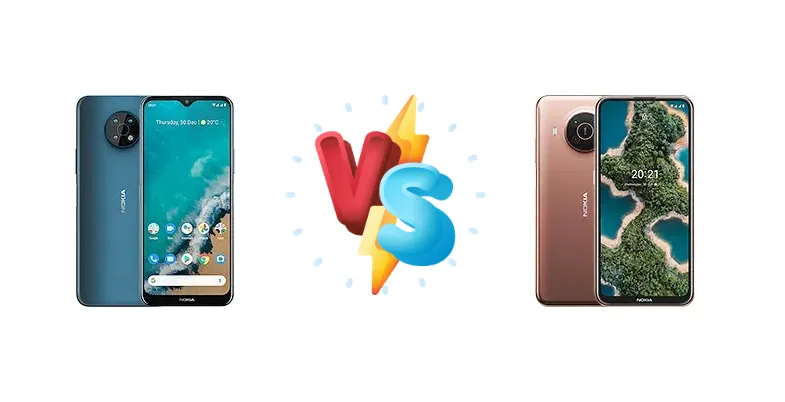
|
🏆 Quick Verdict
The Nokia X20 generally edges out the G50 thanks to its slightly better camera system, more premium build quality, and cleaner Android experience. However, the G50 might be a better choice if you prioritize a larger display and slightly more affordable price point.
| PHONES | ||
|---|---|---|
| Phone Names | Nokia G50 | Nokia X20 |
| Network | ||
|---|---|---|
| 2G bands | GSM 850 / 900 / 1800 / 1900 | GSM 850 / 900 / 1800 / 1900 |
| 3G bands | HSDPA 850 / 900 / 1900 / 2100 - EU, ROW, China | HSDPA 850 / 900 / 1700(AWS) / 1900 / 2100 |
| 4G bands | 1, 3, 5, 7, 8, 20, 28, 38, 39, 40, 41 - EU, ROW, China | 1, 2, 3, 4, 5, 7, 8, 12, 20, 28, 66, 38, 39, 40, 41 |
| 5G bands | 1, 3, 5, 7, 28, 38, 40, 41, 78 SA/NSA/Sub6 - EU, ROW, China | 1, 2, 3, 5, 7, 28, 38, 41, 66, 78 SA/NSA/Sub6 |
| Speed | HSPA, LTE, 5G | HSPA, LTE, 5G |
| Technology | GSM / HSPA / LTE / 5G | GSM / HSPA / LTE / 5G |
| 2, 5, 7, 38, 41, 66, 71, 78 SA/NSA/Sub6 - NA | - | |
| Launch | ||
|---|---|---|
| Announced | 2021, September 22 | 2021, April 08 |
| Status | Available. Released 2021, October 13 | Available. Released 2021, May 12 |
| Body | ||
|---|---|---|
| Dimensions | 173.8 x 77.7 x 8.9 mm (6.84 x 3.06 x 0.35 in) | 168.9 x 79.7 x 9.1 mm (6.65 x 3.14 x 0.36 in) |
| SIM | · Nano-SIM· Nano-SIM + Nano-SIM | · Nano-SIM· Nano-SIM + Nano-SIM |
| Weight | 220 g (7.76 oz) | 220 g (7.76 oz) |
| Display | ||
|---|---|---|
| Protection | - | Corning Gorilla Glass 5 |
| Resolution | 720 x 1560 pixels, 19.5:9 ratio (~252 ppi density) | 1080 x 2400 pixels, 20:9 ratio (~395 ppi density) |
| Size | 6.82 inches, 114.2 cm2 (~84.5% screen-to-body ratio) | 6.67 inches, 107.4 cm2 (~79.8% screen-to-body ratio) |
| Type | IPS LCD, 450 nits (typ) | IPS LCD, 450 nits (typ) |
| Platform | ||
|---|---|---|
| CPU | Octa-core (2x2.0 GHz Kryo 460 & 6x1.8 GHz Kryo 460) | Octa-core (2x2.0 GHz Kryo 460 & 6x1.8 GHz Kryo 460) |
| Chipset | Qualcomm SM4350 Snapdragon 480 5G (8 nm) | Qualcomm SM4350 Snapdragon 480 5G (8 nm) |
| GPU | Adreno 619 | Adreno 619 |
| OS | Android 11, upgradable to Android 13 | Android 11, upgradable to Android 14 |
| Memory | ||
|---|---|---|
| Card slot | microSDXC | microSDXC (uses shared SIM slot) |
| Internal | 64GB 4GB RAM, 128GB 4GB RAM, 128GB 6GB RAM | 128GB 6GB RAM, 128GB 8GB RAM |
| Main Camera | ||
|---|---|---|
| Features | LED flash, HDR, panorama | Zeiss optics, LED flash, HDR, panorama |
| Quad | - | 64 MP, (wide), PDAF 5 MP, (ultrawide) 2 MP (macro) Auxiliary lens |
| Single | 8 MP, (wide) | 32 MP, (wide) |
| Triple | 48 MP, f/1.8, (wide), PDAF 5 MP, (ultrawide) Auxiliary lens | - |
| Video | 1080p@30fps | 1080p@30/60fps |
| Selfie camera | ||
|---|---|---|
| Single | 8 MP, (wide) | 32 MP, (wide) |
| Video | 1080p@30fps | 1080p@30fps |
| Sound | ||
|---|---|---|
| 3.5mm jack | Yes | Yes |
| 35mm jack | Yes | Yes |
| Loudspeaker | Yes | Yes |
| Comms | ||
|---|---|---|
| Bluetooth | 5.0, A2DP, LE | 5.0, A2DP, LE, aptX HD |
| NFC | Yes (market/region dependent) | Yes |
| Positioning | GPS, GALILEO, BDS | GPS, GLONASS, GALILEO |
| Radio | FM radio | FM radio |
| USB | USB Type-C 2.0, OTG | USB Type-C 2.0, OTG |
| WLAN | Wi-Fi 802.11 a/b/g/n/ac/6, dual-band | Wi-Fi 802.11 a/b/g/n/ac, dual-band, Wi-Fi Direct |
| Features | ||
|---|---|---|
| Sensors | Fingerprint (side-mounted), accelerometer, gyro, proximity, compass | Fingerprint (side-mounted), accelerometer, gyro, proximity |
| Battery | ||
|---|---|---|
| Charging | 18W wired | 18W wired |
| Type | Li-Po 5000 mAh | Li-Po 4470 mAh |
| Misc | ||
|---|---|---|
| Colors | Midnight Sun, Ocean Blue | Midnight Sun, Nordic Blue |
| Models | TA-1358, TA-1390, TA-1370, TA-1367, TA-1361 | TA-1341, TA-1344 |
| Price | About 180 EUR | About 130 EUR |
| SAR | 0.79 W/kg (head) 0.96 W/kg (body) | 1.04 W/kg (head) 0.62 W/kg (body) |
| SAR EU | 1.15 W/kg (head) 1.13 W/kg (body) | 0.51 W/kg (head) 1.29 W/kg (body) |
Nokia G50
- Larger Display
- More Affordable
- 120Hz Refresh Rate (Screen)
- Less Premium Build
- Slightly Slower Software Updates
- Inferior Camera
Nokia X20
- Better Camera System
- More Premium Design
- Cleaner Android Experience
- More Consistent Software Updates
- Smaller Display
- Slightly Higher Price
- 60Hz Refresh Rate (Screen)
Display Comparison
The Nokia G50 boasts a larger 6.82-inch display compared to the X20's 6.67-inch screen. Both utilize an IPS LCD panel with a 120Hz refresh rate (G50) or standard 60Hz (X20), offering smooth scrolling. The G50's larger size makes it better for media consumption, while the X20's slightly more compact form factor might be preferred for one-handed use.
Camera Comparison
The Nokia X20 features a more versatile camera system, including a 64MP main sensor, a 5MP ultrawide lens, and a 2MP depth sensor. The G50 has a 48MP main sensor, a 5MP ultrawide, and a 2MP macro lens. The X20 generally produces better image quality, especially in low light, thanks to its superior image processing and potentially better sensor. Both record video up to 4K resolution.
Performance
Both phones share the same Qualcomm Snapdragon 480 5G chipset, so performance will be largely similar. Expect adequate performance for everyday tasks, social media, and light gaming. Demanding games may require lower graphics settings. The X20's software optimization might offer a slightly smoother experience.
Battery Life
Both devices feature a 4470mAh battery, offering all-day battery life under moderate usage. Charging speeds are identical at 18W wired, which is relatively slow compared to modern standards. Expect around 1.5-2 hours to fully charge.
Buying Guide
The Nokia G50 is ideal for users seeking a large screen for media consumption and gaming on a tight budget. The Nokia X20 is better suited for those who value a more refined design, a slightly better camera, and a cleaner Android experience, even if it means spending a bit more.