
Nokia G50 vs Nokia G400: A Detailed Comparison
| Phones Images | |||||
|---|---|---|---|---|---|
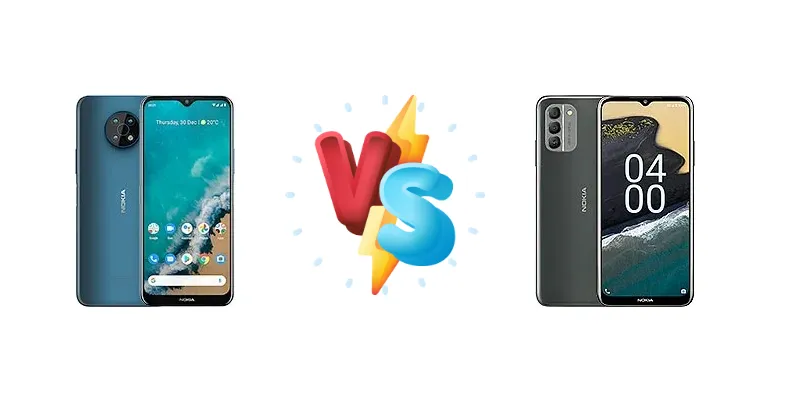
|
🏆 Quick Verdict
The Nokia G400 edges out the G50 thanks to its slightly faster processor, faster charging (PD3.0), and often more competitive pricing. While the G50 has a slightly better camera setup on paper, the G400's overall performance and charging capabilities make it the better choice for most users.
| PHONES | ||
|---|---|---|
| Phone Names | Nokia G50 | Nokia G400 |
| Network | ||
|---|---|---|
| 2G bands | GSM 850 / 900 / 1800 / 1900 | GSM 850 / 900 / 1800 / 1900 |
| 3G bands | HSDPA 850 / 900 / 1900 / 2100 - EU, ROW, China | HSDPA 850 / 1700(AWS) / 1900 |
| 4G bands | 1, 3, 5, 7, 8, 20, 28, 38, 39, 40, 41 - EU, ROW, China | 2, 4, 5, 12, 13, 25, 26, 41, 66, 71 |
| 5G bands | 1, 3, 5, 7, 28, 38, 40, 41, 78 SA/NSA/Sub6 - EU, ROW, China | 2, 5, 25, 41, 66, 71, 77 SA/NSA |
| Speed | HSPA, LTE, 5G | HSPA, LTE, 5G |
| Technology | GSM / HSPA / LTE / 5G | GSM / HSPA / LTE / 5G |
| 2, 5, 7, 38, 41, 66, 71, 78 SA/NSA/Sub6 - NA | - | |
| Launch | ||
|---|---|---|
| Announced | 2021, September 22 | 2022, January 05 |
| Status | Available. Released 2021, October 13 | Available. Released 2022, August 24 |
| Body | ||
|---|---|---|
| Build | - | Glass front (Gorilla Glass 3), aluminum frame |
| Dimensions | 173.8 x 77.7 x 8.9 mm (6.84 x 3.06 x 0.35 in) | 166.4 x 76.7 x 8.8 mm (6.55 x 3.02 x 0.35 in) |
| SIM | · Nano-SIM· Nano-SIM + Nano-SIM | Nano-SIM |
| Weight | 220 g (7.76 oz) | 198 g (6.98 oz) |
| Display | ||
|---|---|---|
| Protection | - | Corning Gorilla Glass 3 |
| Resolution | 720 x 1560 pixels, 19.5:9 ratio (~252 ppi density) | 1080 x 2408 pixels, 20:9 ratio (~401 ppi density) |
| Size | 6.82 inches, 114.2 cm2 (~84.5% screen-to-body ratio) | 6.58 inches, 104.3 cm2 (~81.7% screen-to-body ratio) |
| Type | IPS LCD, 450 nits (typ) | IPS LCD, 120Hz |
| Platform | ||
|---|---|---|
| CPU | Octa-core (2x2.0 GHz Kryo 460 & 6x1.8 GHz Kryo 460) | Octa-core (2x2.2 GHz Kryo 460 & 6x1.9 GHz Kryo 460) |
| Chipset | Qualcomm SM4350 Snapdragon 480 5G (8 nm) | Qualcomm SM4350-AC Snapdragon 480+ 5G (8 nm) |
| GPU | Adreno 619 | Adreno 619 |
| OS | Android 11, upgradable to Android 13 | Android 12 |
| Memory | ||
|---|---|---|
| Card slot | microSDXC | microSDXC (dedicated slot) |
| Internal | 64GB 4GB RAM, 128GB 4GB RAM, 128GB 6GB RAM | 64GB 4GB RAM |
| Main Camera | ||
|---|---|---|
| Features | LED flash, HDR, panorama | LED flash, HDR, panorama |
| Single | 8 MP, (wide) | 16 MP, (wide) |
| Triple | 48 MP, f/1.8, (wide), PDAF 5 MP, (ultrawide) Auxiliary lens | 48 MP, f/1.8, (wide), PDAF 5 MP, f/2.2, 115˚ (ultrawide) Auxiliary lens |
| Video | 1080p@30fps | 1080p@30/60fps |
| Selfie camera | ||
|---|---|---|
| Single | 8 MP, (wide) | 16 MP, (wide) |
| Video | 1080p@30fps | 1080p@30fps |
| Sound | ||
|---|---|---|
| 3.5mm jack | Yes | Yes |
| 35mm jack | Yes | Yes |
| Loudspeaker | Yes | Yes |
| Comms | ||
|---|---|---|
| Bluetooth | 5.0, A2DP, LE | 5.1, A2DP, LE, aptX HD, aptX Adaptive |
| NFC | Yes (market/region dependent) | Yes |
| Positioning | GPS, GALILEO, BDS | GPS, GALILEO |
| Radio | FM radio | FM radio |
| USB | USB Type-C 2.0, OTG | USB Type-C 2.0, OTG |
| WLAN | Wi-Fi 802.11 a/b/g/n/ac/6, dual-band | Wi-Fi 802.11 b/g/n/ac |
| Features | ||
|---|---|---|
| Sensors | Fingerprint (side-mounted), accelerometer, gyro, proximity, compass | Fingerprint (side-mounted), accelerometer, gyro, proximity, compass, barometer |
| Battery | ||
|---|---|---|
| Charging | 18W wired | 20W wired, PD3.0 |
| Type | Li-Po 5000 mAh | Li-Po 5000 mAh |
| Misc | ||
|---|---|---|
| Colors | Midnight Sun, Ocean Blue | Meteor Grey |
| Models | TA-1358, TA-1390, TA-1370, TA-1367, TA-1361 | TA-1530, TA-1448, TA-1476, N1530DL |
| Price | About 180 EUR | About 70 EUR |
| SAR | 0.79 W/kg (head) 0.96 W/kg (body) | 1.05 W/kg (head) 1.09 W/kg (body) |
| SAR EU | 1.15 W/kg (head) 1.13 W/kg (body) | - |
Nokia G50
- Quad-camera system
- Slightly larger display
- Clean Android experience
- Slower charging
- Slightly lower performance than G400
- Can be pricier than G400
Nokia G400
- Faster processor (Snapdragon 480+)
- Faster charging (PD3.0)
- Often better value
- Triple-camera system
- Slightly smaller display
- May have slightly less RAM in some configurations
Display Comparison
Both phones feature a 6.6-inch display, but the G400 boasts a slightly higher resolution (1080 x 2400) compared to the G50 (1080 x 2400). While both are IPS LCD panels, the G400's slightly sharper display provides a marginally better viewing experience. Brightness levels are comparable, offering decent visibility in most lighting conditions.
Camera Comparison
The Nokia G50 features a quad-camera setup (48MP main, 5MP ultrawide, 2MP macro, 2MP depth) while the G400 has a triple-camera setup (48MP main, 5MP ultrawide, 2MP macro). While the G50 has more lenses, the G400's image processing often produces more natural-looking results. Low-light performance is decent on both, but not exceptional.
Performance
The G400's Snapdragon 480+ 5G offers a slight performance advantage over the G50's Snapdragon 480 5G. This translates to snappier app loading times and smoother multitasking. Both phones handle everyday tasks well, but the G400 feels a bit more responsive. Gaming performance is adequate on both, but don't expect high frame rates on demanding titles.
Battery Life
Both phones have a 5000mAh battery, providing all-day battery life for moderate users. However, the G400's support for 20W PD3.0 charging allows for significantly faster charging speeds compared to the G50's 18W wired charging.
Buying Guide
The Nokia G50 is a good option for users prioritizing camera quality and a slightly larger display. The Nokia G400 is ideal for those seeking a smoother overall experience, faster charging, and a potentially better value proposition.