
Nokia G400 vs Nokia G50: A Detailed Comparison
| Phones Images | |||||
|---|---|---|---|---|---|
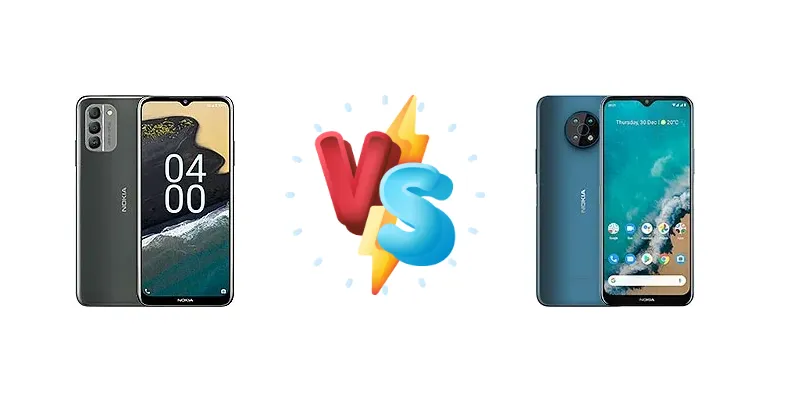
|
🏆 Quick Verdict
The Nokia G400 edges out the G50 thanks to its slightly faster processor and quicker charging. While both offer 5G, the G400's performance advantage and faster charging make it the better overall value, especially considering similar pricing.
| PHONES | ||
|---|---|---|
| Phone Names | Nokia G400 | Nokia G50 |
| Network | ||
|---|---|---|
| 2G bands | GSM 850 / 900 / 1800 / 1900 | GSM 850 / 900 / 1800 / 1900 |
| 3G bands | HSDPA 850 / 1700(AWS) / 1900 | HSDPA 850 / 900 / 1900 / 2100 - EU, ROW, China |
| 4G bands | 2, 4, 5, 12, 13, 25, 26, 41, 66, 71 | 1, 3, 5, 7, 8, 20, 28, 38, 39, 40, 41 - EU, ROW, China |
| 5G bands | 2, 5, 25, 41, 66, 71, 77 SA/NSA | 1, 3, 5, 7, 28, 38, 40, 41, 78 SA/NSA/Sub6 - EU, ROW, China |
| Speed | HSPA, LTE, 5G | HSPA, LTE, 5G |
| Technology | GSM / HSPA / LTE / 5G | GSM / HSPA / LTE / 5G |
| - | 2, 5, 7, 38, 41, 66, 71, 78 SA/NSA/Sub6 - NA | |
| Launch | ||
|---|---|---|
| Announced | 2022, January 05 | 2021, September 22 |
| Status | Available. Released 2022, August 24 | Available. Released 2021, October 13 |
| Body | ||
|---|---|---|
| Build | Glass front (Gorilla Glass 3), aluminum frame | - |
| Dimensions | 166.4 x 76.7 x 8.8 mm (6.55 x 3.02 x 0.35 in) | 173.8 x 77.7 x 8.9 mm (6.84 x 3.06 x 0.35 in) |
| SIM | Nano-SIM | · Nano-SIM· Nano-SIM + Nano-SIM |
| Weight | 198 g (6.98 oz) | 220 g (7.76 oz) |
| Display | ||
|---|---|---|
| Protection | Corning Gorilla Glass 3 | - |
| Resolution | 1080 x 2408 pixels, 20:9 ratio (~401 ppi density) | 720 x 1560 pixels, 19.5:9 ratio (~252 ppi density) |
| Size | 6.58 inches, 104.3 cm2 (~81.7% screen-to-body ratio) | 6.82 inches, 114.2 cm2 (~84.5% screen-to-body ratio) |
| Type | IPS LCD, 120Hz | IPS LCD, 450 nits (typ) |
| Platform | ||
|---|---|---|
| CPU | Octa-core (2x2.2 GHz Kryo 460 & 6x1.9 GHz Kryo 460) | Octa-core (2x2.0 GHz Kryo 460 & 6x1.8 GHz Kryo 460) |
| Chipset | Qualcomm SM4350-AC Snapdragon 480+ 5G (8 nm) | Qualcomm SM4350 Snapdragon 480 5G (8 nm) |
| GPU | Adreno 619 | Adreno 619 |
| OS | Android 12 | Android 11, upgradable to Android 13 |
| Memory | ||
|---|---|---|
| Card slot | microSDXC (dedicated slot) | microSDXC |
| Internal | 64GB 4GB RAM | 64GB 4GB RAM, 128GB 4GB RAM, 128GB 6GB RAM |
| Main Camera | ||
|---|---|---|
| Features | LED flash, HDR, panorama | LED flash, HDR, panorama |
| Single | 16 MP, (wide) | 8 MP, (wide) |
| Triple | 48 MP, f/1.8, (wide), PDAF 5 MP, f/2.2, 115˚ (ultrawide) Auxiliary lens | 48 MP, f/1.8, (wide), PDAF 5 MP, (ultrawide) Auxiliary lens |
| Video | 1080p@30/60fps | 1080p@30fps |
| Selfie camera | ||
|---|---|---|
| Single | 16 MP, (wide) | 8 MP, (wide) |
| Video | 1080p@30fps | 1080p@30fps |
| Sound | ||
|---|---|---|
| 3.5mm jack | Yes | Yes |
| 35mm jack | Yes | Yes |
| Loudspeaker | Yes | Yes |
| Comms | ||
|---|---|---|
| Bluetooth | 5.1, A2DP, LE, aptX HD, aptX Adaptive | 5.0, A2DP, LE |
| NFC | Yes | Yes (market/region dependent) |
| Positioning | GPS, GALILEO | GPS, GALILEO, BDS |
| Radio | FM radio | FM radio |
| USB | USB Type-C 2.0, OTG | USB Type-C 2.0, OTG |
| WLAN | Wi-Fi 802.11 b/g/n/ac | Wi-Fi 802.11 a/b/g/n/ac/6, dual-band |
| Features | ||
|---|---|---|
| Sensors | Fingerprint (side-mounted), accelerometer, gyro, proximity, compass, barometer | Fingerprint (side-mounted), accelerometer, gyro, proximity, compass |
| Battery | ||
|---|---|---|
| Charging | 20W wired, PD3.0 | 18W wired |
| Type | Li-Po 5000 mAh | Li-Po 5000 mAh |
| Misc | ||
|---|---|---|
| Colors | Meteor Grey | Midnight Sun, Ocean Blue |
| Models | TA-1530, TA-1448, TA-1476, N1530DL | TA-1358, TA-1390, TA-1370, TA-1367, TA-1361 |
| Price | About 70 EUR | About 180 EUR |
| SAR | 1.05 W/kg (head) 1.09 W/kg (body) | 0.79 W/kg (head) 0.96 W/kg (body) |
| SAR EU | - | 1.15 W/kg (head) 1.13 W/kg (body) |
Nokia G400
- Slightly faster processor
- Faster 20W charging
- Good value for money
- Lower screen resolution (HD+)
- Less impressive ultrawide camera
Nokia G50
- Higher screen resolution (FHD+)
- Better camera system overall
- Larger ultrawide lens
- Slightly slower processor
- Slower 18W charging
Display Comparison
Both phones feature a 6.6-inch display, but the G50 boasts a slightly higher resolution (FHD+ vs G400's HD+). This results in a sharper image on the G50, though the difference isn't massive. Both use IPS LCD panels, so expect decent viewing angles but not the vibrant colors of OLED.
Camera Comparison
The G50 generally has a more well-regarded camera system. It features a 48MP main sensor, an 8MP ultrawide, a 2MP macro, and a 2MP depth sensor. The G400 has a 48MP main sensor, a 5MP ultrawide, and a 2MP depth sensor. While megapixels aren't everything, the G50's wider ultrawide lens and generally better image processing give it an advantage.
Performance
The G400 has a slight edge in performance due to its marginally faster CPU clock speeds (2.2 GHz vs 2.0 GHz for the G50). While both use the Snapdragon 480 5G, the G400's slightly higher clock speeds translate to a snappier feel in everyday tasks and slightly better gaming performance. Both phones have 4GB or 6GB of RAM.
Battery Life
Both phones have a 5000mAh battery, offering all-day battery life. However, the G400 supports 20W charging, while the G50 is limited to 18W. This means the G400 will charge noticeably faster.
Buying Guide
The Nokia G400 is ideal for users prioritizing a bit more processing power and faster charging speeds on a budget. The Nokia G50 is a solid choice for those seeking a slightly larger screen and a more established camera system, but are willing to compromise a little on performance.