
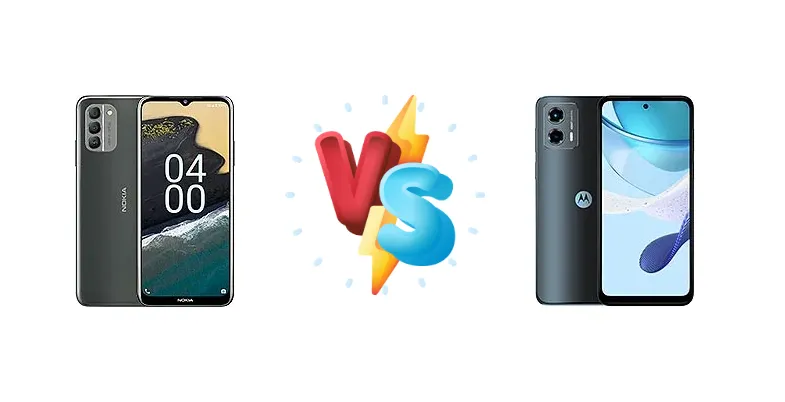
Nokia G400 vs. Motorola Moto G (2023): A Detailed Budget 5G Showdown
| Phones Images | |||||
|---|---|---|---|---|---|
|
🏆 Quick Verdict
The Nokia G400 edges out the Moto G (2023) thanks to its faster charging and slightly more powerful CPU. While both offer similar core performance, the G400's charging speed and potentially better software support give it a slight advantage for users prioritizing convenience and longevity.
| PHONES | ||
|---|---|---|
| Phone Names | Nokia G400 | Motorola Moto G (2023) |
| Network | ||
|---|---|---|
| 2G bands | GSM 850 / 900 / 1800 / 1900 | GSM 850 / 900 / 1800 / 1900 |
| 3G bands | HSDPA 850 / 1700(AWS) / 1900 | HSDPA 850 / 900 / 1700(AWS) / 1900 / 2100 |
| 4G bands | 2, 4, 5, 12, 13, 25, 26, 41, 66, 71 | 1, 2, 3, 4, 5, 7, 8, 12, 13, 14, 17, 18, 20, 25, 26, 29, 30, 38, 39, 40, 41, 48, 66, 71 |
| 5G bands | 2, 5, 25, 41, 66, 71, 77 SA/NSA | 2, 5, 7, 12, 14, 25, 26, 29, 30, 41, 48, 66, 70, 71, 78 SA/NSA |
| Speed | HSPA, LTE, 5G | HSPA, LTE, 5G |
| Technology | GSM / HSPA / LTE / 5G | GSM / HSPA / LTE / 5G |
| Launch | ||
|---|---|---|
| Announced | 2022, January 05 | 2023, May 02 |
| Status | Available. Released 2022, August 24 | Available. Released 2023, May 25 |
| Body | ||
|---|---|---|
| Build | Glass front (Gorilla Glass 3), aluminum frame | Glass front, plastic frame, plastic back |
| Dimensions | 166.4 x 76.7 x 8.8 mm (6.55 x 3.02 x 0.35 in) | 164 x 75 x 8.4 mm (6.46 x 2.95 x 0.33 in) |
| SIM | Nano-SIM | Nano-SIM |
| Weight | 198 g (6.98 oz) | 189 g (6.67 oz) |
| - | Water-repellent design | |
| Display | ||
|---|---|---|
| Protection | Corning Gorilla Glass 3 | - |
| Resolution | 1080 x 2408 pixels, 20:9 ratio (~401 ppi density) | 720 x 1600 pixels, 20:9 ratio (~270 ppi density) |
| Size | 6.58 inches, 104.3 cm2 (~81.7% screen-to-body ratio) | 6.5 inches, 102.0 cm2 (~82.9% screen-to-body ratio) |
| Type | IPS LCD, 120Hz | IPS LCD, 120Hz |
| Platform | ||
|---|---|---|
| CPU | Octa-core (2x2.2 GHz Kryo 460 & 6x1.9 GHz Kryo 460) | Octa-core (2x2.2 GHz Kryo 460 & 6x1.8 GHz Kryo 460) |
| Chipset | Qualcomm SM4350-AC Snapdragon 480+ 5G (8 nm) | Qualcomm SM4350-AC Snapdragon 480+ 5G (8 nm) |
| GPU | Adreno 619 | Adreno 619 |
| OS | Android 12 | Android 13, planned upgrade to Android 14 |
| Memory | ||
|---|---|---|
| Card slot | microSDXC (dedicated slot) | microSDXC (dedicated slot) |
| Internal | 64GB 4GB RAM | 64GB 4GB RAM, 128GB 4GB RAM |
| Main Camera | ||
|---|---|---|
| Dual | - | 48 MP, f/1.7, (wide), 0.8µm, PDAF 2 MP (macro) |
| Features | LED flash, HDR, panorama | LED flash, HDR, panorama |
| Single | 16 MP, (wide) | - |
| Triple | 48 MP, f/1.8, (wide), PDAF 5 MP, f/2.2, 115˚ (ultrawide) Auxiliary lens | - |
| Video | 1080p@30/60fps | 1080p@30fps |
| Selfie camera | ||
|---|---|---|
| Features | - | HDR |
| Single | 16 MP, (wide) | 8 MP, f/2.0, (wide), 1/4.0", 1.12µm |
| Video | 1080p@30fps | 1080p@30fps |
| Sound | ||
|---|---|---|
| 3.5mm jack | Yes | Yes |
| 35mm jack | Yes | Yes |
| Loudspeaker | Yes | Yes, with stereo speakers |
| Comms | ||
|---|---|---|
| Bluetooth | 5.1, A2DP, LE, aptX HD, aptX Adaptive | 5.1, A2DP, LE |
| NFC | Yes | No |
| Positioning | GPS, GALILEO | GPS, GLONASS, GALILEO, BDS |
| Radio | FM radio | No |
| USB | USB Type-C 2.0, OTG | USB Type-C 2.0 |
| WLAN | Wi-Fi 802.11 b/g/n/ac | Wi-Fi 802.11 a/b/g/n/ac, dual-band |
| Features | ||
|---|---|---|
| Sensors | Fingerprint (side-mounted), accelerometer, gyro, proximity, compass, barometer | Fingerprint (side-mounted), accelerometer, gyro, proximity, compass |
| Battery | ||
|---|---|---|
| Charging | 20W wired, PD3.0 | 15W wired |
| Type | Li-Po 5000 mAh | Li-Po 5000 mAh |
| Misc | ||
|---|---|---|
| Colors | Meteor Grey | Ink Blue |
| Models | TA-1530, TA-1448, TA-1476, N1530DL | XT2313 |
| Price | About 70 EUR | $ 56.55 |
| SAR | 1.05 W/kg (head) 1.09 W/kg (body) | - |
Nokia G400
- Faster 20W Charging
- Slightly Faster CPU
- Potentially Longer Software Support (Nokia's track record varies)
- Larger Screen (potentially)
- Design may be less appealing to some
- Camera performance may not be exceptional
Motorola Moto G (2023)
- Clean Android Experience
- Compact Design (potentially)
- Reliable Motorola Software Updates (generally)
- Slower 15W Charging
- Slightly Slower CPU
- Camera performance may not be exceptional
Display Comparison
Both phones feature a 6.6-inch display, likely with a resolution around 1080 x 2400 pixels. The Nokia G400 might have a slightly brighter panel, but both should offer decent viewing experiences for everyday use. Expect similar color accuracy and viewing angles.
Camera Comparison
The Nokia G400 typically features a 48MP main camera, an 8MP ultrawide, and a 2MP macro lens. The Moto G (2023) likely has a similar setup, potentially with a slightly different sensor. Image quality will depend on software processing, but expect decent results in good lighting conditions. Low-light performance will be a challenge for both.
Performance
While both utilize the Snapdragon 480+ 5G, the Nokia G400 has a marginally faster CPU clock speed (2.2 GHz vs 1.8 GHz for some cores). This translates to slightly snappier performance in demanding apps and games, though both will handle everyday tasks without issue. RAM and storage configurations will likely be similar, impacting multitasking capabilities.
Battery Life
Both phones likely have a 5000mAh battery, providing all-day battery life for moderate users. However, the Nokia G400 supports 20W fast charging, while the Moto G (2023) is limited to 15W. This means the G400 will charge significantly faster.
Buying Guide
The Nokia G400 is ideal for users who value faster charging speeds and potentially longer software support. The Motorola Moto G (2023) is a great choice for those prioritizing a clean Android experience and a slightly more compact design, especially if charging speed isn't a top concern.