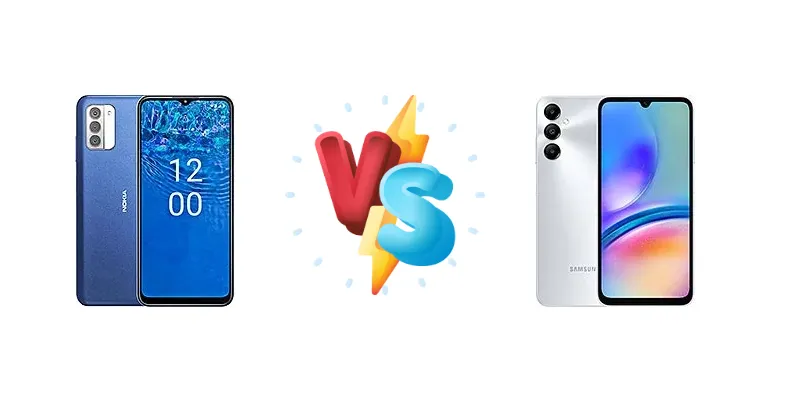
The Nokia G310 and Samsung Galaxy A05s represent two distinct approaches to the ultra-budget smartphone market. The Nokia prioritizes 5G connectivity with the Snapdragon 480+ platform, while the Samsung A05s opts for a more mature 4G chipset, the Snapdragon 680, and focuses on display quality and battery endurance. This comparison dissects their key differences to determine which device offers the best value.
🏆 Quick Verdict
For the average user prioritizing longevity and a more refined experience, the Samsung Galaxy A05s emerges as the better choice. Its Snapdragon 680 offers a noticeable performance edge, coupled with a brighter, higher-contrast display and impressive battery life. While the Nokia G310 offers 5G, the A05s delivers a more consistently usable experience.
| Network |
|---|
| 2G bands | GSM 850 / 900 / 1800 / 1900 | GSM 850 / 900 / 1800 / 1900 |
| 3G bands | HSDPA 850 / 1700(AWS) / 1900 / 2100 | HSDPA 850 / 900 / 2100 |
| 4G bands | LTE | 1, 3, 5, 7, 8, 20, 28, 38, 40, 41 |
| 5G bands | SA/NSA | - |
| Speed | HSPA, LTE, 5G | HSPA, LTE |
| Technology | GSM / HSPA / LTE / 5G | GSM / HSPA / LTE |
| Launch |
|---|
| Announced | 2023, August 16 | 2023, September 25 |
| Status | Available. Released 2023, August 24 | Available. Released 2023, October 18 |
| Body |
|---|
| Build | - | Glass front, plastic back, plastic frame |
| Dimensions | 165.1 x 75.7 x 8.6 mm (6.5 x 2.98 x 0.34 in) | 168 x 77.8 x 8.8 mm (6.61 x 3.06 x 0.35 in) |
| SIM | Nano-SIM | · Nano-SIM· Nano-SIM + Nano-SIM |
| Weight | 195.1 g (6.88 oz) | 194 g (6.84 oz) |
| Display |
|---|
| Protection | Corning Gorilla Glass 3 | - |
| Resolution | 720 x 1612 pixels, 20:9 ratio (~269 ppi density) | 1080 x 2400 pixels, 20:9 ratio (~393 ppi density) |
| Size | 6.56 inches, 103.4 cm2 (~82.7% screen-to-body ratio) | 6.7 inches, 108.4 cm2 (~82.9% screen-to-body ratio) |
| Type | IPS LCD, 90Hz | PLS LCD, 90Hz |
| Platform |
|---|
| CPU | Octa-core (2x2.2 GHz Kryo 460 & 6x1.8 GHz Kryo 460) | Octa-core (4x2.4 GHz Kryo 265 Gold & 4x1.9 GHz Kryo 265 Silver) |
| Chipset | Qualcomm SM4350-AC Snapdragon 480+ 5G (8 nm) | Qualcomm SM6225 Snapdragon 680 4G (6 nm) |
| GPU | Adreno 619 | Adreno 610 |
| OS | Android 13 | Android 13, up to 2 major Android upgrades, One UI 7 |
| Memory |
|---|
| Card slot | microSDXC (dedicated slot) | microSDXC (dedicated slot) |
| Internal | 128GB 4GB RAM | 64GB 4GB RAM, 128GB 4GB RAM, 128GB 6GB RAM |
| Main Camera |
|---|
| Features | LED flash, HDR, panorama | LED flash |
| Triple | 50 MP, (wide), AF
2 MP (macro)
Auxiliary lens | 50 MP, f/1.8, (wide), 1/2.8", 0.64µm, AF
2 MP (macro)
Auxiliary lens |
| Video | 1080p@30/60fps | 1080p@30/60fps |
| Selfie camera |
|---|
| Single | 8 MP, (wide) | 13 MP, f/2.0, (wide), 1/3.X", 1.12µm |
| Video | 1080p@30fps | 1080p@30fps |
| Sound |
|---|
| 35mm jack | Yes | Yes |
| Loudspeaker | Yes | Yes |
| Comms |
|---|
| Bluetooth | 5.1, A2DP, LE | 5.1, A2DP, LE |
| NFC | No | Yes (market/region dependent) |
| Positioning | GPS (L1+L5) | GPS, GLONASS, GALILEO, BDS, QZSS |
| Radio | No | Unspecified |
| USB | USB Type-C 2.0, OTG | USB Type-C 2.0 |
| WLAN | Wi-Fi 802.11 b/g/n/ac | Wi-Fi 802.11 a/b/g/n/ac, dual-band, Wi-Fi Direct |
| Features |
|---|
| Sensors | Fingerprint (side-mounted), accelerometer, proximity | Fingerprint (side-mounted), accelerometer, proximity |
| Battery |
|---|
| Charging | 20W wired, PD, QC | 25W wired |
| Type | Li-Po 5000 mAh | Li-Po 5000 mAh |
| Misc |
|---|
| Colors | Blue | Black, Silver, Light Green, Violet |
| Models | - | SM-A057F, SM-A057F/DS, SM-A057M, SM-A057M/DS, SM-A057G/DSN, SM-A057G |
| Price | About 170 EUR | $ 134.00 / C$ 146.99 / £ 83.94 / € 100.99 |
| SAR EU | - | 0.58 W/kg (head) 1.31 W/kg (body) |
Nokia G310
- 5G Connectivity
- Qualcomm Snapdragon 480+ 5G chipset
- Supports 20W fast charging (PD, QC)
- Likely lower display quality
- Potentially less powerful CPU than A05s
Samsung Galaxy A05s
- Brighter and higher contrast display
- More powerful Snapdragon 680 chipset
- Excellent battery life (11:32h active use)
- Lacks 5G connectivity
- Basic camera system
Display Comparison
The Samsung Galaxy A05s boasts a significantly more impressive display, achieving a measured peak brightness of 468 nits and a 1418:1 contrast ratio. This translates to a more visible screen outdoors and richer, more defined visuals. The Nokia G310’s display specifications are not provided, but given its price point, it likely features a lower brightness and contrast ratio. The A05s’ superior display makes it the better choice for media consumption and general usability, especially in bright environments.
Camera Comparison
Both phones’ camera capabilities are likely limited, typical of this price segment. The context data only mentions 'Photo / Video' for the A05s, suggesting a basic camera setup. Without specific sensor details for either device, it’s difficult to make a definitive judgment. However, the A05s’ likely more mature image signal processor (ISP) within the Snapdragon 680 could offer slightly better image processing and noise reduction. We can assume both phones will struggle in low-light conditions, and any macro camera included will likely be of minimal utility.
Performance
The core difference lies in the chipsets. The Samsung Galaxy A05s utilizes the Qualcomm Snapdragon 680 (6nm), featuring a more powerful CPU configuration – 4x2.4 GHz Kryo 265 Gold & 4x1.9 GHz Kryo 265 Silver – compared to the Nokia G310’s Snapdragon 480+ (8nm) with its 2x2.2 GHz Kryo 460 & 6x1.8 GHz Kryo 460. The 6nm process node of the Snapdragon 680 also contributes to better power efficiency. While the Nokia G310 has 5G, the Snapdragon 680’s optimized architecture delivers a smoother experience for everyday tasks and potentially better sustained performance in demanding applications. The A05s will likely exhibit less throttling under load.
Battery Life
The Samsung Galaxy A05s shines in battery life, achieving an active use score of 11 hours and 32 minutes. While the Nokia G310’s battery capacity isn’t specified, the Snapdragon 680’s 6nm efficiency and the A05s’ optimized power management contribute to its impressive endurance. The A05s also supports 25W wired charging, faster than the Nokia G310’s 20W charging, allowing for quicker top-ups. This combination of long battery life and faster charging makes the A05s the clear winner in this category.
Buying Guide
Buy the Nokia G310 if you absolutely require 5G connectivity on a tight budget and are willing to compromise on raw performance and display quality. It's ideal for users in areas with strong 5G coverage who primarily use their phone for basic tasks. Buy the Samsung Galaxy A05s if you prioritize a smoother user experience, a vibrant display for media consumption, and all-day battery life, even if it means sacrificing 5G support. This phone is best suited for everyday users who value reliability and usability.
Frequently Asked Questions
❓ Does the Snapdragon 680 in the Samsung Galaxy A05s get hot during extended gaming sessions?
The Snapdragon 680 is known for its efficiency. While it will warm up during prolonged gaming, its 6nm process node and optimized architecture help to mitigate thermal throttling, providing a more consistent frame rate compared to less efficient chipsets. Expect playable performance in most mobile games, but don't expect flagship-level graphics settings.
❓ Is the 5G connectivity on the Nokia G310 worth the trade-offs in other areas?
The value of 5G depends heavily on your location and carrier coverage. If you live in an area with robust 5G infrastructure and frequently use data-intensive applications, the Nokia G310's 5G capability might be beneficial. However, if 5G is unavailable or rarely used, the Samsung Galaxy A05s' superior overall experience is likely a better investment.
❓ How does the charging speed of the Samsung Galaxy A05s compare to the Nokia G310 in real-world use?
The Samsung Galaxy A05s' 25W charging will noticeably reduce charging times compared to the Nokia G310's 20W charging. While both support fast charging protocols, the A05s will likely reach a full charge approximately 20-30 minutes faster, offering greater convenience.