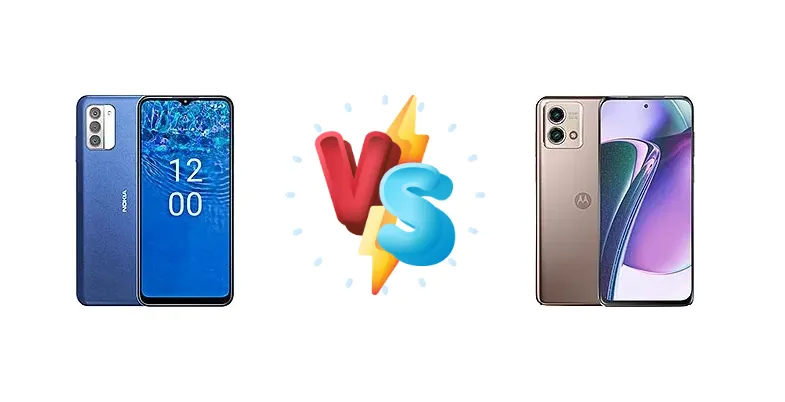
Both the Nokia G310 and the Motorola Moto G Stylus 5G (2023) aim to deliver affordable 5G connectivity, but they take different approaches. The Nokia prioritizes a lower entry price, while the Motorola leverages a newer chipset for improved performance. This comparison dissects the key differences to determine which phone offers the best value for your money.
🏆 Quick Verdict
For most users, the Motorola Moto G Stylus 5G (2023) is the superior choice. Its Snapdragon 6 Gen 1 chipset, built on a more efficient 4nm process, provides a noticeable performance uplift over the Nokia G310’s Snapdragon 480+ 5G, translating to smoother multitasking and gaming. While both offer 20W charging, the Motorola’s more modern architecture justifies the likely price premium.
| Network |
|---|
| 2G bands | GSM 850 / 900 / 1800 / 1900 | GSM 850 / 900 / 1800 / 1900 |
| 3G bands | HSDPA 850 / 1700(AWS) / 1900 / 2100 | HSDPA 850 / 900 / 1700(AWS) / 1900 / 2100 |
| 4G bands | LTE | 1, 2, 3, 4, 5, 7, 8, 12, 13, 14, 17, 18, 19, 20, 25, 26, 29, 30, 38, 39, 40, 41, 48, 66, 71 |
| 5G bands | SA/NSA | 1, 2, 3, 5, 7, 12, 13, 14, 25, 26, 29, 30, 38, 41, 48, 66, 70, 71, 77, 78 SA/NSA |
| Speed | HSPA, LTE, 5G | HSPA, LTE, 5G |
| Technology | GSM / HSPA / LTE / 5G | GSM / HSPA / LTE / 5G |
| Launch |
|---|
| Announced | 2023, August 16 | 2023, May 30 |
| Status | Available. Released 2023, August 24 | Available. Released 2023, June 02 |
| Body |
|---|
| Build | - | Glass front, plastic frame, plastic back |
| Dimensions | 165.1 x 75.7 x 8.6 mm (6.5 x 2.98 x 0.34 in) | 162.8 x 73.8 x 9.2 mm (6.41 x 2.91 x 0.36 in) |
| SIM | Nano-SIM | Nano-SIM |
| Weight | 195.1 g (6.88 oz) | 202 g (7.13 oz) |
| Display |
|---|
| Protection | Corning Gorilla Glass 3 | - |
| Resolution | 720 x 1612 pixels, 20:9 ratio (~269 ppi density) | 1080 x 2400 pixels, 20:9 ratio (~399 ppi density) |
| Size | 6.56 inches, 103.4 cm2 (~82.7% screen-to-body ratio) | 6.6 inches, 105.2 cm2 (~87.5% screen-to-body ratio) |
| Type | IPS LCD, 90Hz | IPS LCD, 120Hz |
| Platform |
|---|
| CPU | Octa-core (2x2.2 GHz Kryo 460 & 6x1.8 GHz Kryo 460) | Octa-core (4x2.2 GHz Cortex-A78 & 4x1.8 GHz Cortex-A55) |
| Chipset | Qualcomm SM4350-AC Snapdragon 480+ 5G (8 nm) | Qualcomm SM6450 Snapdragon 6 Gen 1 (4 nm) |
| GPU | Adreno 619 | Adreno 710 |
| OS | Android 13 | Android 13, planned upgrade to Android 14 |
| Memory |
|---|
| Card slot | microSDXC (dedicated slot) | microSDXC (dedicated slot) |
| Internal | 128GB 4GB RAM | 64GB 4GB RAM, 128GB 4GB RAM, 128GB 6GB RAM, 256GB 6GB RAM |
| Main Camera |
|---|
| Dual | - | 50 MP, f/1.9, (wide), 1.0µm, PDAF
8 MP, f/2.2, (ultrawide), 1/4.0", 1.12µm, AF |
| Features | LED flash, HDR, panorama | LED flash, HDR, panorama |
| Triple | 50 MP, (wide), AF
2 MP (macro)
Auxiliary lens | - |
| Video | 1080p@30/60fps | 4K@30fps, 1080p@30/60fps |
| Selfie camera |
|---|
| Features | - | HDR |
| Single | 8 MP, (wide) | 16 MP, f/2.5, (wide), 1.0µm |
| Video | 1080p@30fps | 1080p@30fps |
| Sound |
|---|
| 35mm jack | Yes | Yes |
| Loudspeaker | Yes | Yes, with stereo speakers |
| Comms |
|---|
| Bluetooth | 5.1, A2DP, LE | 5.1, A2DP, LE |
| NFC | No | Yes |
| Positioning | GPS (L1+L5) | GPS (L1+L5), GALILEO |
| Radio | No | FM radio |
| USB | USB Type-C 2.0, OTG | USB Type-C 2.0 |
| WLAN | Wi-Fi 802.11 b/g/n/ac | Wi-Fi 802.11 a/b/g/n/ac, dual-band |
| Features |
|---|
| Sensors | Fingerprint (side-mounted), accelerometer, proximity | Fingerprint (side-mounted), accelerometer, gyro, proximity, compass, barometer |
| Battery |
|---|
| Charging | 20W wired, PD, QC | 20W wired |
| Type | Li-Po 5000 mAh | Li-Po 5000 mAh |
| Misc |
|---|
| Colors | Blue | Cosmic Black, Rose Champagne |
| Models | - | XT2315-1, XT2315-4 |
| Price | About 170 EUR | $ 93.43 |
Nokia G310
- Potentially lower price point
- 5G connectivity
- Likely larger battery capacity
- Less powerful Snapdragon 480+ 5G chipset
- 8nm fabrication process less efficient
- Potentially slower app loading and multitasking
Motorola Moto G Stylus 5G (2023)
- More powerful Snapdragon 6 Gen 1 chipset
- 4nm fabrication process for better efficiency
- Smoother gaming and multitasking experience
- Likely higher price
- Potentially smaller battery capacity
- May not include a headphone jack (market dependent)
Display Comparison
Neither device boasts a standout display. Both likely utilize LCD panels, common in this price bracket. The key difference lies under the hood: processing power impacts UI smoothness. While specific display specs (resolution, brightness) are missing, the Motorola’s more powerful chipset will contribute to a more responsive touch experience and faster rendering of graphics. Bezels are expected to be similar, reflecting the budget nature of both phones.
Camera Comparison
Without detailed camera specs, a direct comparison is difficult. However, the Motorola likely benefits from a more advanced image signal processor (ISP) integrated within the Snapdragon 6 Gen 1. This ISP can deliver better noise reduction, dynamic range, and overall image quality, even with similar sensor sizes. The Nokia G310’s camera will likely be adequate for casual snapshots, but the Motorola should offer a more refined photography experience. We anticipate both phones will include a standard wide lens and potentially a depth sensor, but detailed analysis requires sensor size and aperture information.
Performance
The Motorola Moto G Stylus 5G (2023) holds a significant advantage in performance. Its Snapdragon 6 Gen 1 (4nm) utilizes a more modern CPU architecture – four Cortex-A78 cores versus the Nokia’s two Kryo 460 cores – offering superior single-core and multi-core performance. The 4nm fabrication process is also crucial; it’s more power-efficient than the Nokia’s 8nm Snapdragon 480+ 5G, leading to less thermal throttling during sustained workloads. This translates to smoother gaming and faster app loading times for the Motorola.
Battery Life
Both phones feature 20W wired charging, suggesting similar charging speeds – approximately 1.5 to 2 hours for a full charge. The Nokia G310 may have a slightly larger battery capacity (often a strategy for budget phones), but the Motorola’s more efficient Snapdragon 6 Gen 1 chipset will likely offset this advantage. The 4nm process consumes less power, resulting in comparable or even better real-world battery life despite a potentially smaller battery size.
Buying Guide
Buy the Nokia G310 if you absolutely need the lowest possible price for 5G connectivity and are willing to compromise on performance. It’s a solid option for basic tasks like calls, texts, and light social media. Buy the Motorola Moto G Stylus 5G (2023) if you prioritize a smoother user experience, better gaming capabilities, and a more future-proof chipset, even if it means spending a bit more.
Frequently Asked Questions
❓ Will the Snapdragon 6 Gen 1 in the Moto G Stylus 5G (2023) handle demanding games like Genshin Impact?
While the Snapdragon 6 Gen 1 isn't a flagship chipset, it's capable of running Genshin Impact at lower settings (medium or low) with acceptable frame rates. The 4nm process helps mitigate thermal throttling, allowing for sustained performance during gaming sessions. The Nokia G310's Snapdragon 480+ 5G would struggle significantly with this title.
❓ Does the Motorola Moto G Stylus 5G (2023) support software updates for an extended period?
Motorola's software update commitment is typically two major Android updates and three years of security patches. While not as extensive as Google or Samsung, this is a reasonable level of support for a phone in this price range. Nokia's update policy can vary, but historically, it's been similar to Motorola's.
❓ Is the difference in performance between the Snapdragon 480+ and 6 Gen 1 noticeable in everyday tasks?
Yes, the difference is noticeable. While both chips can handle basic tasks like browsing and social media, the Snapdragon 6 Gen 1 offers a smoother and more responsive experience when multitasking, opening apps, and navigating the user interface. The Nokia G310 may exhibit occasional lag or stuttering during heavier use.