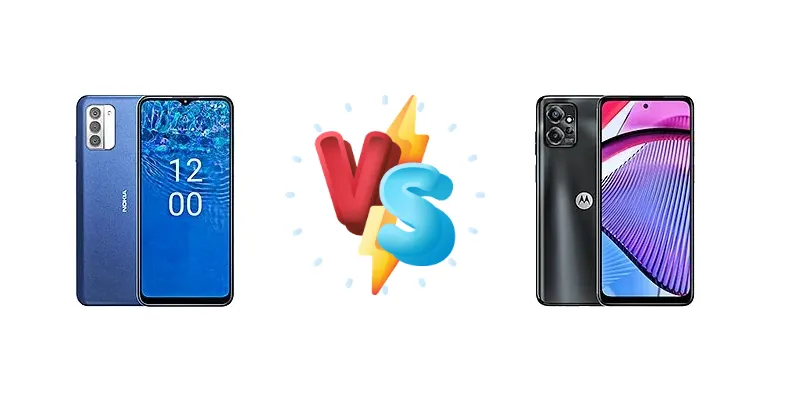
The Nokia G310 and Motorola Moto G Power 5G represent compelling options in the increasingly competitive budget 5G smartphone market. While both aim to deliver 5G connectivity at an accessible price point, they take distinctly different approaches to achieving this, primarily through chipset selection. This comparison dissects those differences, focusing on real-world implications for performance, battery life, and charging speed.
🏆 Quick Verdict
For the average user prioritizing overall performance and future-proofing, the Motorola Moto G Power 5G is the stronger choice. Its Mediatek Dimensity 930 chipset, built on a more efficient 6nm process, provides a noticeable performance uplift over the Nokia G310’s Snapdragon 480+ 5G. However, the Nokia G310’s 20W charging offers a convenience advantage.
| Network |
|---|
| 2G bands | GSM 850 / 900 / 1800 / 1900 | GSM 850 / 900 / 1800 / 1900 |
| 3G bands | HSDPA 850 / 1700(AWS) / 1900 / 2100 | HSDPA 850 / 900 / 1700(AWS) / 1900 / 2100 |
| 4G bands | LTE | 1, 2, 3, 4, 5, 7, 8, 12, 13, 14, 17, 20, 25, 26, 29, 30, 38, 39, 40, 41, 48, 66, 71 |
| 5G bands | SA/NSA | 2, 5, 7, 12, 25, 30, 41, 66, 71, 77, 78 SA/NSA/Sub6 |
| Speed | HSPA, LTE, 5G | HSPA, LTE, 5G |
| Technology | GSM / HSPA / LTE / 5G | GSM / HSPA / LTE / 5G |
| Launch |
|---|
| Announced | 2023, August 16 | 2023, April 06 |
| Status | Available. Released 2023, August 24 | Available. Released 2023, April 13 |
| Body |
|---|
| Build | - | Glass front, plastic back, plastic frame |
| Dimensions | 165.1 x 75.7 x 8.6 mm (6.5 x 2.98 x 0.34 in) | 163.1 x 74.8 x 8.5 mm (6.42 x 2.94 x 0.33 in) |
| SIM | Nano-SIM | Nano-SIM |
| Weight | 195.1 g (6.88 oz) | 185 g (6.53 oz) |
| | - | Water-repellent design |
| Display |
|---|
| Protection | Corning Gorilla Glass 3 | - |
| Resolution | 720 x 1612 pixels, 20:9 ratio (~269 ppi density) | 1080 x 2400 pixels, 20:9 ratio (~405 ppi density) |
| Size | 6.56 inches, 103.4 cm2 (~82.7% screen-to-body ratio) | 6.5 inches, 102.0 cm2 (~83.6% screen-to-body ratio) |
| Type | IPS LCD, 90Hz | IPS LCD, 120Hz |
| Platform |
|---|
| CPU | Octa-core (2x2.2 GHz Kryo 460 & 6x1.8 GHz Kryo 460) | Octa-core (2x2.2 GHz Cortex-A78 & 6x2.0 GHz Cortex-A55) |
| Chipset | Qualcomm SM4350-AC Snapdragon 480+ 5G (8 nm) | Mediatek Dimensity 930 (6 nm) |
| GPU | Adreno 619 | IMG BXM-8-256 |
| OS | Android 13 | Android 13, upgradable to Android 14 |
| Memory |
|---|
| Card slot | microSDXC (dedicated slot) | microSDXC (dedicated slot) |
| Internal | 128GB 4GB RAM | 128GB 4GB RAM, 256GB 6GB RAM |
| Main Camera |
|---|
| Features | LED flash, HDR, panorama | LED flash, HDR, panorama |
| Triple | 50 MP, (wide), AF
2 MP (macro)
Auxiliary lens | 50 MP, f/1.8, (wide), 0.64µm, PDAF
2 MP (macro)
Auxiliary lens |
| Video | 1080p@30/60fps | 1080p@30fps, gyro-EIS |
| Selfie camera |
|---|
| Single | 8 MP, (wide) | 16 MP, f/2.4, (wide), 1.0µm |
| Video | 1080p@30fps | 1080p@30fps |
| Sound |
|---|
| 3.5mm jack | - | Yes |
| 35mm jack | Yes | Yes |
| Loudspeaker | Yes | Yes, with stereo speakers |
| Comms |
|---|
| Bluetooth | 5.1, A2DP, LE | 5.3, A2DP, LE |
| NFC | No | No |
| Positioning | GPS (L1+L5) | GPS, GLONASS, GALILEO |
| Radio | No | No |
| USB | USB Type-C 2.0, OTG | USB Type-C 2.0 |
| WLAN | Wi-Fi 802.11 b/g/n/ac | Wi-Fi 802.11 a/b/g/n/ac, dual-band |
| Features |
|---|
| Sensors | Fingerprint (side-mounted), accelerometer, proximity | Fingerprint (side-mounted), accelerometer, gyro, proximity, compass |
| Battery |
|---|
| Charging | 20W wired, PD, QC | 15W wired |
| Type | Li-Po 5000 mAh | Li-Po 5000 mAh |
| Misc |
|---|
| Colors | Blue | Dark Blue |
| Price | About 170 EUR | $ 97.90 / £ 199.00 |
Nokia G310
- Faster 20W charging with PD/QC support
- Potentially more streamlined software experience (Nokia's Android One heritage)
- Slightly lower price point (likely, based on chipset)
- Less powerful Snapdragon 480+ chipset
- 8nm process node less efficient than 6nm
- Potentially slower app loading and multitasking
Motorola Moto G Power 5G
- More powerful Mediatek Dimensity 930 chipset
- 6nm process node for better efficiency
- Superior CPU architecture (Cortex-A78 cores)
- Potentially better image processing
- Slower 15W charging
- Potentially higher price point
- Motorola's software can include bloatware
Display Comparison
Neither device boasts a standout display. While specific panel details (like peak brightness or color gamut coverage) are absent, the focus here is on the underlying processing power impacting UI smoothness. The difference in chipsets won't directly affect display quality, but a faster processor like the Dimensity 930 will ensure a more responsive user experience when navigating the interface and interacting with apps.
Camera Comparison
Without detailed camera specs beyond the chipsets, a direct comparison is limited. However, the processing capabilities of the Dimensity 930 in the Moto G Power 5G suggest superior image processing, potentially leading to better dynamic range and noise reduction. The Snapdragon 480+ is capable, but the Dimensity 930’s ISP (Image Signal Processor) is likely more advanced. The presence of a dedicated ISP within the Dimensity 930 allows for more complex image processing algorithms, potentially resulting in sharper and more vibrant photos.
Performance
The core difference lies in the chipsets. The Motorola Moto G Power 5G’s Mediatek Dimensity 930 (6nm) is a significant step up from the Nokia G310’s Qualcomm Snapdragon 480+ 5G (8nm). The 6nm process node inherently offers better power efficiency, translating to less heat generation and potentially sustained performance during prolonged tasks. Furthermore, the Dimensity 930 utilizes Cortex-A78 cores, which are architecturally superior to the Kryo 460 cores found in the Snapdragon 480+. This means the Motorola will handle demanding apps and games with greater ease. The Snapdragon 480+ is adequate for everyday tasks, but will likely show its limitations with more intensive workloads.
Battery Life
Both phones target all-day battery life, but the charging speeds differ significantly. The Nokia G310 supports 20W wired charging with PD and QC, while the Motorola Moto G Power 5G is limited to 15W. This means the Nokia G310 will charge noticeably faster, potentially reaching a full charge in less time. However, the Dimensity 930’s superior power efficiency could offset the slower charging speed, resulting in comparable real-world battery endurance despite the Motorola potentially having a slightly smaller battery capacity (not specified in the data).
Buying Guide
Buy the Nokia G310 if you prioritize faster charging speeds and a slightly more streamlined software experience, and your usage primarily revolves around basic tasks like calling, texting, and light social media. Buy the Motorola Moto G Power 5G if you demand better performance for gaming, multitasking, and demanding applications, and are willing to trade off slightly slower charging for a more capable processor.
Frequently Asked Questions
❓ Will the Motorola Moto G Power 5G overheat during extended gaming sessions?
The Mediatek Dimensity 930’s 6nm process node is designed for improved thermal efficiency compared to the Nokia G310’s 8nm Snapdragon 480+. While some heat generation is inevitable during gaming, the Dimensity 930 is less prone to throttling under sustained load, offering a more consistent gaming experience.
❓ Is the 20W charging on the Nokia G310 a significant advantage in daily use?
Yes, the 20W charging is a practical benefit. While both phones should last a full day, the Nokia G310 can top up its battery much faster when you have limited time. A quick 30-minute charge can provide several hours of usage, which is convenient for users on the go.
❓ Does the Motorola Moto G Power 5G support higher refresh rate displays?
The provided specifications do not mention refresh rate support. However, given the Dimensity 930’s capabilities, it *could* support a 90Hz or 120Hz display, though this is not confirmed. The Nokia G310 is likely limited to a standard 60Hz panel.
❓ How will the chipset difference affect software updates and long-term performance on the Nokia G310?
The Snapdragon 480+ is a capable chipset, but the Dimensity 930 offers more headroom for future software updates and demanding applications. Over time, as Android evolves and apps become more resource-intensive, the Motorola Moto G Power 5G is more likely to maintain a smooth and responsive user experience.