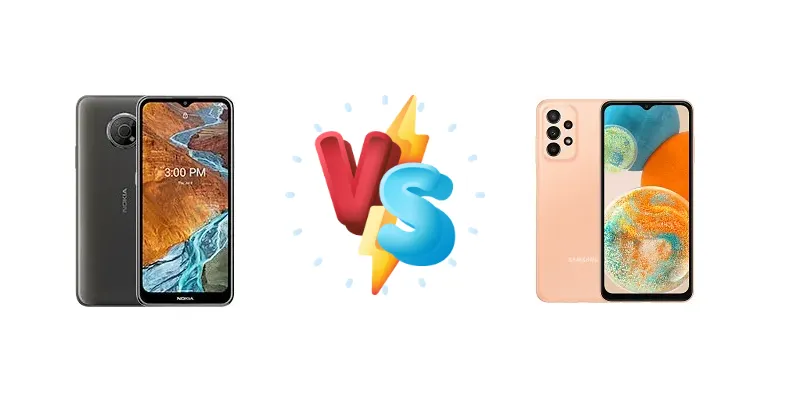
The budget smartphone market is booming, offering incredible value for money. Two contenders vying for your attention are the Nokia G300 and the Samsung Galaxy A23 5G. Both promise 5G connectivity and a decent experience, but which one truly delivers? Let's dive in and find out.
🏆 Quick Verdict
The Samsung Galaxy A23 5G edges out the Nokia G300 thanks to its superior chipset, brighter display, faster charging, and generally more polished software experience. While the G300 offers a clean Android experience, the A23 5G provides a more well-rounded package for the price.
| Network |
|---|
| 2G bands | GSM 850 / 900 / 1800 / 1900 | GSM 850 / 900 / 1800 / 1900 |
| 3G bands | HSDPA 850 / 900 / 1900 / 2100 | HSDPA 850 / 900 / 1700(AWS) / 1900 / 2100 |
| 4G bands | 2, 4, 5, 12, 13, 41, 66, 71 | 1, 2, 3, 4, 5, 7, 8, 12, 17, 20, 26, 28, 32, 38, 40, 41, 66 - International |
| 5G bands | 2, 5, 25, 41, 66, 71, 77 SA/NSA | 1, 3, 7, 8, 20, 28, 38, 40, 41, 77, 78 SA/NSA/Sub6 - International |
| Speed | HSPA, LTE, 5G | HSPA, LTE, 5G |
| Technology | GSM / HSPA / LTE / 5G | GSM / HSPA / LTE / 5G |
| | - | 2, 5, 30, 66, 77 SA/NSA/Sub6/mmWave - USA |
| Launch |
|---|
| Announced | 2021, October 12 | 2022, August 05 |
| Status | Available. Released 2021, October 19 | Available. Released 2022, September 02 |
| Body |
|---|
| Build | - | Glass front (Gorilla Glass 5), plastic frame, plastic back |
| Dimensions | 169.4 x 78.4 x 9.3 mm (6.67 x 3.09 x 0.37 in) | 165.4 x 76.9 x 8.4 mm (6.51 x 3.03 x 0.33 in) |
| SIM | Nano-SIM | · Nano-SIM· Nano-SIM + Nano-SIM |
| Weight | 210.1 g (7.41 oz) | 197 g (6.95 oz) |
| Display |
|---|
| Protection | - | Corning Gorilla Glass 5 |
| Resolution | 720 x 1600 pixels, 20:9 ratio (~269 ppi density) | 1080 x 2408 pixels, 20:9 ratio (~400 ppi density) |
| Size | 6.52 inches, 102.6 cm2 (~77.3% screen-to-body ratio) | 6.6 inches, 104.9 cm2 (~82.5% screen-to-body ratio) |
| Type | IPS LCD | PLS LCD, 120Hz |
| Platform |
|---|
| CPU | Octa-core (2x2.0 GHz Kryo 460 & 6x1.8 GHz Kryo 460) | Octa-core (2x2.2 GHz Kryo 660 Gold & 6x1.7 GHz Kryo 660 Silver) |
| Chipset | Qualcomm SM4350 Snapdragon 480 5G (8 nm) | Qualcomm SM6375 Snapdragon 695 5G (6 nm) |
| GPU | Adreno 619 | Adreno 619 |
| OS | Android 11 | Android 12, upgradable to Android 14, One UI 6 |
| Memory |
|---|
| Card slot | microSDXC (dedicated slot) | microSDXC (dedicated slot) |
| Internal | 64GB 4GB RAM | 64GB 4GB RAM, 64GB 6GB RAM, 128GB 4GB RAM, 128GB 6GB RAM, 128GB 8GB RAM |
| Main Camera |
|---|
| Features | LED flash, HDR, panorama | LED flash, panorama, HDR |
| Quad | - | 50 MP, f/1.8, 26mm (wide), 1/2.76", 0.64µm, PDAF, OIS
5 MP, f/2.2, 13mm, 123˚ (ultrawide), 1/5.0", 1.12µm
2 MP (macro)
Auxiliary lens |
| Single | 8 MP, (wide) | - |
| Triple | 16 MP, f/1.8, 27mm (wide), PDAF
5 MP, f/2.2, 115˚ (ultrawide)
Auxiliary lens | - |
| Video | 1080p@30/60fps | 1080p@30fps |
| Selfie camera |
|---|
| Single | 8 MP, (wide) | 8 MP, f/2.0, 25mm (wide), 1/4.0", 1.12µm - USA
8 MP, f/2.2, 25mm (wide), 1/4.0", 1.12µm - International |
| Video | 1080p@30fps | 1080p@30fps |
| Sound |
|---|
| 3.5mm jack | Yes | Yes |
| 35mm jack | Yes | Yes |
| Loudspeaker | Yes | Yes |
| Comms |
|---|
| Bluetooth | 5.0, A2DP, LE | 5.1, A2DP, LE |
| NFC | Yes | Yes |
| Positioning | GPS (L1+L5) | GPS, GLONASS, GALILEO, BDS |
| Radio | No | FM radio (market/region dependent) |
| USB | USB Type-C 2.0, OTG | USB Type-C 2.0 |
| WLAN | Wi-Fi 802.11 a/b/g/n/ac, dual-band | Wi-Fi 802.11 a/b/g/n/ac, dual-band, Wi-Fi Direct |
| Features |
|---|
| Sensors | Fingerprint (side-mounted), accelerometer, proximity | Fingerprint (side-mounted), accelerometer, gyro, compass, barometer (USA only) |
| | - | Virtual proximity sensing |
| Battery |
|---|
| Charging | 18W wired | 25W wired |
| Type | Li-Po 4470 mAh | Li-Po 5000 mAh |
| Misc |
|---|
| Colors | Meteor Grey | Black, White, Peach, Blue |
| Models | TA-1374, N1374DL | SM-A236U, SM-A236U1, SM-A236B, SM-A236B/DS, SM-A236B/DSN, SM-A236E, SM-S236DL |
| Price | About 100 EUR | $ 84.44 / £ 129.00 / € 125.28 / ₹ 21,000 |
| SAR | 1.44 W/kg (head) 1.09 W/kg (body) | 0.68 W/kg (head) 0.57 W/kg (body) |
| SAR EU | - | 1.49 W/kg (head) 1.25 W/kg (body) |
| Tests |
|---|
| Battery life | - |
Endurance rating 138h
|
| Camera | - |
Photo / Video |
| Display | - |
Contrast ratio: 1328:1 (nominal) |
| Loudspeaker | - |
-25.9 LUFS (Very good)
|
| Performance | - |
AnTuTu: 318821 (v9)
GeekBench: 1940 (v5.1)
GFXBench: 16fps (ES 3.1 onscreen) |
Nokia G300
- Better Performance (Snapdragon 695)
- Brighter Display
- Faster Charging (25W)
- Likely Superior Camera System
- Samsung's Software Support
Samsung Galaxy A23 5G
- Clean Android Experience
- Potentially Lower Price
- Excellent Battery Life (138h Endurance)
- Lower Performance (Snapdragon 480)
- Dimmer Display
- Slower Charging (18W)
- Less Advanced Camera
Display Comparison
The Samsung Galaxy A23 5G boasts a significant advantage in display quality. Its 508 nits of peak brightness is noticeably higher than the G300's, making it easier to view outdoors. Both offer a 1328:1 contrast ratio, but the A23 5G's brightness contributes to a more vibrant and immersive viewing experience. The A23 5G likely has a higher resolution panel as well, though specific resolution details for the G300 are scarce.
Camera Comparison
While both phones offer 'Photo / Video' capabilities, the Galaxy A23 5G is expected to have a more advanced camera system. Samsung typically includes more features and better image processing algorithms in their mid-range devices. The G300's camera is likely adequate for basic photography, but the A23 5G should provide superior image quality, especially in low light. Specific megapixel counts and lens configurations are needed for a more precise comparison.
Performance
The Snapdragon 695 5G in the Galaxy A23 5G is a clear winner here. Built on a more efficient 6nm process, it offers better performance and power efficiency compared to the Nokia G300's Snapdragon 480 5G (8nm). Expect smoother multitasking, faster app loading times, and a more responsive overall experience on the A23 5G. The A23 5G's CPU also has higher clock speeds.
Battery Life
Both phones boast an impressive endurance rating of 138 hours, suggesting excellent battery life. However, the Galaxy A23 5G's 25W wired charging is faster than the Nokia G300's 18W charging, allowing for quicker top-ups.
Buying Guide
The Nokia G300 is a good choice for users prioritizing a clean, stock Android experience and a potentially lower price point. The Samsung Galaxy A23 5G is ideal for those seeking better performance, a vibrant display, a more versatile camera system, and faster charging speeds.
Frequently Asked Questions
❓ Which phone has better 5G connectivity?
Both phones support 5G, but the Snapdragon 695 in the Galaxy A23 5G generally offers broader 5G band support and potentially faster speeds.
❓ Is the Nokia G300 worth buying if I want a pure Android experience?
Yes, the Nokia G300's clean Android experience is a major selling point. However, consider if the performance trade-offs are acceptable compared to the Galaxy A23 5G.