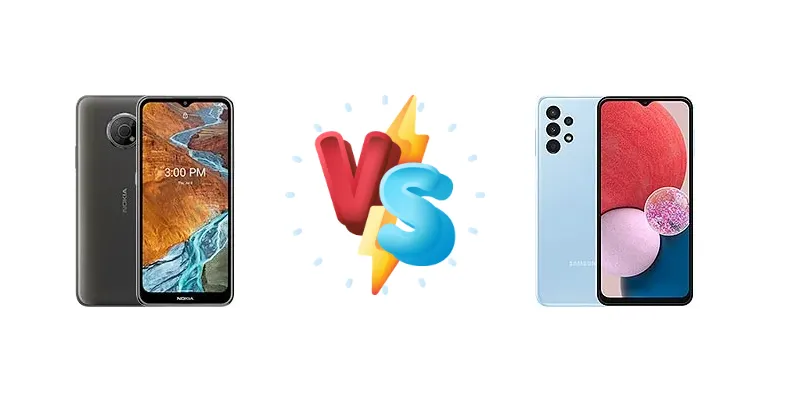
The Nokia G300 and Samsung Galaxy A13 represent compelling options in the sub-$200 smartphone market. While both aim to deliver essential features at an accessible price, they diverge significantly in their core hardware. The G300 prioritizes 5G connectivity and a more modern chipset, while the A13 focuses on a familiar Samsung experience and potentially wider availability. This comparison dissects these differences to determine which device offers the best value.
🏆 Quick Verdict
For the average user prioritizing future-proofing and efficiency, the Nokia G300 is the better choice. Its Snapdragon 480 5G chipset, built on an 8nm process, offers superior performance and power efficiency compared to the Samsung Galaxy A13’s 12nm Helio G80. While the A13 benefits from Samsung’s software ecosystem, the G300’s 5G capability and more efficient processor provide a tangible advantage.
| Network |
|---|
| 2G bands | GSM 850 / 900 / 1800 / 1900 | GSM 850 / 900 / 1800 / 1900 |
| 3G bands | HSDPA 850 / 900 / 1900 / 2100 | HSDPA 850 / 900 / 2100 |
| 4G bands | 2, 4, 5, 12, 13, 41, 66, 71 | 1, 3, 5, 7, 8, 20, 28, 38, 40, 41 |
| 5G bands | 2, 5, 25, 41, 66, 71, 77 SA/NSA | - |
| Speed | HSPA, LTE, 5G | HSPA, LTE |
| Technology | GSM / HSPA / LTE / 5G | GSM / HSPA / LTE |
| Launch |
|---|
| Announced | 2021, October 12 | 2022, June |
| Status | Available. Released 2021, October 19 | Available. Released 2022, July |
| Body |
|---|
| Build | - | Glass front (Gorilla Glass 5), plastic frame, plastic back |
| Dimensions | 169.4 x 78.4 x 9.3 mm (6.67 x 3.09 x 0.37 in) | 165.1 x 76.4 x 8.8 mm (6.5 x 3.01 x 0.35 in) |
| SIM | Nano-SIM | · Nano-SIM· Nano-SIM + Nano-SIM |
| Weight | 210.1 g (7.41 oz) | 195 g (6.88 oz) |
| Display |
|---|
| Protection | - | Corning Gorilla Glass 5 |
| Resolution | 720 x 1600 pixels, 20:9 ratio (~269 ppi density) | 1080 x 2408 pixels, 20:9 ratio (~400 ppi density) |
| Size | 6.52 inches, 102.6 cm2 (~77.3% screen-to-body ratio) | 6.6 inches, 104.9 cm2 (~83.2% screen-to-body ratio) |
| Type | IPS LCD | PLS LCD |
| Platform |
|---|
| CPU | Octa-core (2x2.0 GHz Kryo 460 & 6x1.8 GHz Kryo 460) | Octa-core (2x2.0 GHz Cortex-A75 & 6x1.8 GHz Cortex-A55) |
| Chipset | Qualcomm SM4350 Snapdragon 480 5G (8 nm) | Mediatek MT6769V/CU Helio G80 (12 nm) |
| GPU | Adreno 619 | Mali-G52 MC2 |
| OS | Android 11 | Android 12, upgradable to Android 14, One UI 6.1 |
| Memory |
|---|
| Card slot | microSDXC (dedicated slot) | microSDXC (dedicated slot) |
| Internal | 64GB 4GB RAM | 32GB 3GB RAM, 32GB 4GB RAM, 64GB 4GB RAM, 128GB 4GB RAM |
| | - | eMMC 5.1 |
| Main Camera |
|---|
| Features | LED flash, HDR, panorama | LED flash, panorama, HDR |
| Quad | - | 50 MP, f/1.8, (wide), PDAF
5 MP, f/2.2, 123˚ (ultrawide), 1/5.0", 1.12µm
2 MP (macro)
Auxiliary lens |
| Single | 8 MP, (wide) | 8 MP, f/2.2, (wide) |
| Triple | 16 MP, f/1.8, 27mm (wide), PDAF
5 MP, f/2.2, 115˚ (ultrawide)
Auxiliary lens | - |
| Video | 1080p@30/60fps | 1080p@30fps |
| Selfie camera |
|---|
| Single | 8 MP, (wide) | 8 MP, f/2.2, (wide) |
| Video | 1080p@30fps | 1080p@30fps |
| Sound |
|---|
| 3.5mm jack | Yes | Yes |
| 35mm jack | Yes | Yes |
| Loudspeaker | Yes | Yes |
| Comms |
|---|
| Bluetooth | 5.0, A2DP, LE | 5.2, A2DP, LE |
| NFC | Yes | Yes |
| Positioning | GPS (L1+L5) | GPS, GLONASS, GALILEO, BDS |
| Radio | No | No |
| USB | USB Type-C 2.0, OTG | USB Type-C 2.0, OTG |
| WLAN | Wi-Fi 802.11 a/b/g/n/ac, dual-band | Wi-Fi 802.11 a/b/g/n/ac, dual-band, Wi-Fi Direct |
| Features |
|---|
| Sensors | Fingerprint (side-mounted), accelerometer, proximity | Fingerprint (side-mounted), accelerometer, compass |
| | - | Virtual proximity sensing |
| Battery |
|---|
| Charging | 18W wired | 15W wired |
| Type | Li-Po 4470 mAh | Li-Po 5000 mAh |
| Misc |
|---|
| Colors | Meteor Grey | Black, White, Blue |
| Models | TA-1374, N1374DL | SM-A137F, SM-A137F/DSN, SM-A137F/DS |
| Price | About 100 EUR | About 180 EUR |
| SAR | 1.44 W/kg (head) 1.09 W/kg (body) | - |
| SAR EU | - | 0.35 W/kg (head) 1.22 W/kg (body) |
Nokia G300
- 5G Connectivity for faster data speeds
- More efficient Snapdragon 480 chipset
- Faster 18W charging
- Potentially longer battery life due to chipset efficiency
- Software updates may be less frequent than Samsung
- Brand recognition is lower than Samsung
Samsung Galaxy A13 (SM-A137)
- Familiar Samsung One UI software experience
- Wider availability and brand recognition
- Potentially more versatile camera setup (more lenses)
- Generally good image processing in ideal conditions
- Less efficient Helio G80 chipset
- Slower 15W charging
- No 5G connectivity
- 12nm process leads to more heat
Display Comparison
Neither device boasts a standout display. Both likely utilize LCD panels, a common trait in this price bracket. The focus here isn't on visual fidelity, but functionality. While specific display specs are unavailable, the A13’s larger screen size (typically around 6.6 inches vs. the G300’s 6.5 inches) may appeal to media consumers. However, the lack of high refresh rates or advanced panel technologies on either device means the viewing experience will be fairly standard.
Camera Comparison
Camera performance is likely to be similar, with both phones relying on budget sensors. The A13 may have a more versatile camera setup with potentially more lenses, but sensor size and image processing are crucial. Without specific sensor details, it’s difficult to declare a clear winner. However, Samsung’s image processing algorithms are generally more refined, potentially leading to more pleasing results in well-lit conditions. The G300’s camera will likely focus on delivering acceptable image quality without extensive software enhancements. The inclusion of a 2MP macro lens on the A13 is largely a marketing gimmick and offers limited practical benefit.
Performance
The core difference lies in the chipsets. The Nokia G300’s Qualcomm Snapdragon 480 5G (8nm) is a clear advantage over the Samsung Galaxy A13’s MediaTek Helio G80 (12nm). The 8nm fabrication process of the Snapdragon 480 translates to significantly better power efficiency, meaning less heat generation and potentially longer sustained performance. While both CPUs feature an octa-core configuration with similar clock speeds (2.0 GHz for the prime cores), the Snapdragon 480’s Kryo 460 cores are architecturally more advanced than the Cortex-A75 cores in the Helio G80. This results in better single-core and multi-core performance for the G300, particularly noticeable in demanding applications and multitasking. The G300 also benefits from integrated 5G modem, a feature absent in the A13.
Battery Life
The Nokia G300 and Samsung Galaxy A13 likely feature similar battery capacities (around 4000-5000 mAh). However, the Snapdragon 480’s superior power efficiency gives the G300 an edge in real-world battery life. The A13’s 15W charging is slower than the G300’s 18W charging, meaning it will take longer to replenish the battery. While the difference isn’t massive, the G300’s faster charging and more efficient chipset combine to offer a more convenient and longer-lasting battery experience.
Buying Guide
Buy the Nokia G300 if you need 5G connectivity, value a more efficient processor for longer battery life during demanding tasks, and are comfortable with a potentially less polished software experience. Buy the Samsung Galaxy A13 (SM-A137) if you prefer the Samsung One UI software experience, prioritize brand recognition, and don't require 5G connectivity or peak performance.
Frequently Asked Questions
❓ Does the MediaTek Helio G80 in the Galaxy A13 struggle with demanding games like PUBG Mobile?
The Helio G80 can run PUBG Mobile, but you’ll likely need to lower the graphics settings to medium or low to maintain a stable frame rate. The 12nm process and less powerful GPU compared to the Snapdragon 480 in the G300 mean it will generate more heat and potentially experience throttling during extended gaming sessions.
❓ Is the 5G connectivity on the Nokia G300 actually useful if I don't have 5G coverage in my area?
Even without immediate 5G coverage, the Nokia G300’s 5G modem provides future-proofing. As 5G networks expand, you’ll be ready to take advantage of faster data speeds. Additionally, the 5G modem often includes improvements in 4G LTE connectivity as well, potentially resulting in better performance even on older networks.
❓ How significant is the difference in charging speed between the 15W and 18W chargers?
While a 3W difference doesn't sound massive, it translates to a noticeable reduction in charging time. The Nokia G300’s 18W charger will likely add around 15-20% more battery life per hour of charging compared to the Galaxy A13’s 15W charger.
❓ Are software updates guaranteed for both devices, and for how long?
Samsung typically provides more consistent and longer-term software updates than Nokia. While the G300 will receive updates, they may be less frequent and for a shorter duration. This is a key consideration if long-term software support is important to you.