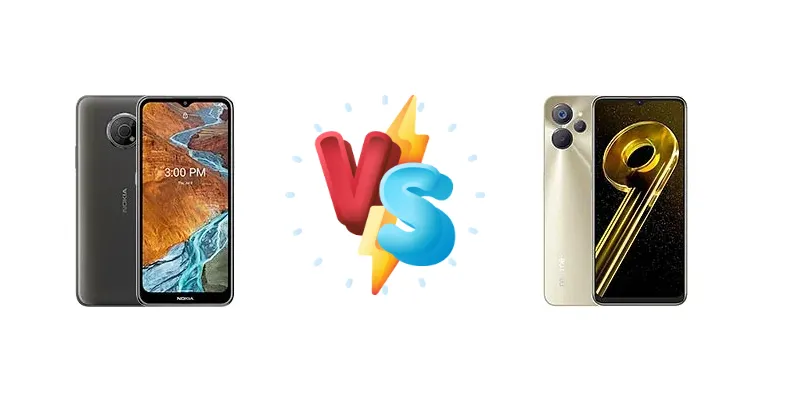
The Nokia G300 and Realme 9i 5G represent compelling options in the increasingly competitive sub-$200 5G smartphone market. While both aim to deliver affordable connectivity, they take different approaches to achieving this, primarily through chipset selection. This comparison dissects the core differences between the Qualcomm Snapdragon 480-powered Nokia G300 and the MediaTek Dimensity 810-equipped Realme 9i 5G, revealing which device offers the best balance of performance, features, and value.
🏆 Quick Verdict
For most users, the Realme 9i 5G emerges as the stronger contender. Its Dimensity 810 chipset, fabricated on a more efficient 6nm process, provides a noticeable performance advantage over the Nokia G300’s Snapdragon 480, translating to smoother multitasking and gaming. While both offer 18W charging, the Realme’s overall efficiency gives it a slight edge in real-world battery endurance.
| Network |
|---|
| 2G bands | GSM 850 / 900 / 1800 / 1900 | GSM 850 / 900 / 1800 / 1900 |
| 3G bands | HSDPA 850 / 900 / 1900 / 2100 | HSDPA 850 / 900 / 1700(AWS) / 1900 / 2100 |
| 4G bands | 2, 4, 5, 12, 13, 41, 66, 71 | 1, 2, 3, 4, 5, 7, 8, 19, 20, 28, 34, 38, 39, 40, 41 |
| 5G bands | 2, 5, 25, 41, 66, 71, 77 SA/NSA | 1, 5, 7, 8, 28, 41, 77, 78 SA/NSA |
| Speed | HSPA, LTE, 5G | HSPA, LTE, 5G |
| Technology | GSM / HSPA / LTE / 5G | GSM / HSPA / LTE / 5G |
| Launch |
|---|
| Announced | 2021, October 12 | 2022, August 18 |
| Status | Available. Released 2021, October 19 | Available. Released 2022, August 24 |
| Body |
|---|
| Dimensions | 169.4 x 78.4 x 9.3 mm (6.67 x 3.09 x 0.37 in) | 164.4 x 75.1 x 8.1 mm (6.47 x 2.96 x 0.32 in) |
| SIM | Nano-SIM | Nano-SIM + Nano-SIM |
| Weight | 210.1 g (7.41 oz) | 187 g (6.60 oz) |
| Display |
|---|
| Protection | - | Panda Glass |
| Resolution | 720 x 1600 pixels, 20:9 ratio (~269 ppi density) | 1080 x 2408 pixels, 20:9 ratio (~400 ppi density) |
| Size | 6.52 inches, 102.6 cm2 (~77.3% screen-to-body ratio) | 6.6 inches, 104.9 cm2 (~85.0% screen-to-body ratio) |
| Type | IPS LCD | IPS LCD, 90Hz, 400 nits (typ) |
| Platform |
|---|
| CPU | Octa-core (2x2.0 GHz Kryo 460 & 6x1.8 GHz Kryo 460) | Octa-core (2x2.4 GHz Cortex-A76 & 6x2.0 GHz Cortex-A55) |
| Chipset | Qualcomm SM4350 Snapdragon 480 5G (8 nm) | Mediatek Dimensity 810 (6 nm) |
| GPU | Adreno 619 | Mali-G57 MC2 |
| OS | Android 11 | Android 12, upgradable to Android 13, Realme UI 4.0 |
| Memory |
|---|
| Card slot | microSDXC (dedicated slot) | microSDXC (dedicated slot) |
| Internal | 64GB 4GB RAM | 64GB 4GB RAM, 128GB 4GB RAM, 128GB 6GB RAM |
| | - | UFS 2.2 |
| Main Camera |
|---|
| Features | LED flash, HDR, panorama | LED flash, HDR, panorama |
| Single | 8 MP, (wide) | 8 MP, f/2.0, 27mm (wide) |
| Triple | 16 MP, f/1.8, 27mm (wide), PDAF
5 MP, f/2.2, 115˚ (ultrawide)
Auxiliary lens | 50 MP, f/1.8, 26mm (wide), 1/2.76", 0.64µm, PDAF
Unspecified MP, 46mm (telephoto)
2 MP (macro) |
| Video | 1080p@30/60fps | 1080p@30fps |
| Selfie camera |
|---|
| Features | - | HDR, panorama |
| Single | 8 MP, (wide) | 8 MP, f/2.0, 27mm (wide) |
| Video | 1080p@30fps | 1080p@30fps |
| Sound |
|---|
| 3.5mm jack | Yes | Yes |
| 35mm jack | Yes | Yes |
| Loudspeaker | Yes | Yes |
| Comms |
|---|
| Bluetooth | 5.0, A2DP, LE | 5.2, A2DP, LE |
| NFC | Yes | No |
| Positioning | GPS (L1+L5) | GPS, GLONASS, GALILEO, BDS |
| Radio | No | No |
| USB | USB Type-C 2.0, OTG | USB Type-C 2.0, OTG |
| WLAN | Wi-Fi 802.11 a/b/g/n/ac, dual-band | Wi-Fi 802.11 a/b/g/n/ac, dual-band |
| Features |
|---|
| Sensors | Fingerprint (side-mounted), accelerometer, proximity | Fingerprint (side-mounted), accelerometer, proximity, compass |
| Battery |
|---|
| Charging | 18W wired | 18W wired |
| Type | Li-Po 4470 mAh | 5000 mAh |
| Misc |
|---|
| Colors | Meteor Grey | Soulful Blue, Rocking Black, Gold |
| Models | TA-1374, N1374DL | RMX3612 |
| Price | About 100 EUR | About 180 EUR |
| SAR | 1.44 W/kg (head) 1.09 W/kg (body) | - |
Nokia G300
- Clean, stock-Android experience
- Potential for faster software updates (Nokia's promise)
- Reliable brand reputation for software support
- Less powerful Snapdragon 480 chipset
- 8nm process less efficient than 6nm
- Potentially lower gaming performance
Realme 9i 5G
- More powerful MediaTek Dimensity 810 chipset
- 6nm process for improved efficiency
- Better gaming performance and multitasking
- Realme UI may include bloatware
- Software update schedule less predictable than Nokia
- Potentially less refined software experience
Display Comparison
Neither device boasts a standout display. Both likely utilize LCD panels, a common cost-saving measure in this price bracket. The key difference lies under the hood: display driver efficiency. While specific display specs are unavailable, the Realme 9i 5G benefits from the Dimensity 810’s more efficient architecture, potentially allowing for slightly better display brightness and color reproduction without significantly impacting battery life. Bezels are expected to be comparable, and color accuracy will likely be standard for this segment.
Camera Comparison
Camera performance is likely to be similar, with both phones relying on budget sensors and image processing. Without specific sensor details, it’s difficult to make definitive claims. However, the Realme 9i 5G’s image signal processor (ISP), integrated within the Dimensity 810, may offer slightly better noise reduction and dynamic range. The prevalence of 2MP macro and depth sensors on both devices suggests limited utility; users should focus on the quality of the primary camera when evaluating image quality. Expect adequate performance in well-lit conditions, but struggles in low-light scenarios.
Performance
The performance gap is the most significant differentiator. The Realme 9i 5G’s MediaTek Dimensity 810, built on a 6nm process, demonstrably outperforms the Nokia G300’s Qualcomm Snapdragon 480 (8nm). The Dimensity 810’s Cortex-A76 cores, clocked at 2.4 GHz, offer a substantial uplift in single-core performance compared to the Snapdragon 480’s Kryo 460 cores (2.0 GHz). This translates to snappier app launches and smoother multitasking. The 6nm process also contributes to better thermal efficiency, reducing the likelihood of performance throttling during extended gaming sessions. While both phones likely feature similar RAM configurations, the chipset’s inherent processing power gives the Realme 9i 5G a clear advantage.
Battery Life
Both the Nokia G300 and Realme 9i 5G feature 18W wired charging, meaning charging speeds will be comparable – roughly 2-3 hours for a full charge. However, the Dimensity 810’s 6nm process efficiency gives the Realme 9i 5G an advantage in battery life. The chipset consumes less power during typical usage, allowing the phone to extract more runtime from its battery. While specific battery capacities are not provided, the Realme 9i 5G is likely to offer slightly longer screen-on time, especially during demanding tasks like gaming or video streaming.
Buying Guide
Buy the Nokia G300 if you prioritize a familiar, stock-Android experience and a brand known for software update consistency, even if it means sacrificing some raw processing power. Buy the Realme 9i 5G if you prioritize performance for gaming and demanding apps, and are comfortable with Realme UI, which offers more customization options but may include pre-installed bloatware. The 9i 5G is the better choice for users who actively use their phones for more than basic tasks.
Frequently Asked Questions
❓ Does the MediaTek Dimensity 810 in the Realme 9i 5G tend to overheat during prolonged gaming sessions?
The Dimensity 810's 6nm fabrication process is designed for improved thermal efficiency compared to the Snapdragon 480's 8nm process. While some heat generation is inevitable during intensive gaming, the 9i 5G is less likely to experience significant throttling, maintaining more consistent performance over extended periods. However, sustained high-intensity gaming will still lead to some temperature increase.
❓ How does Realme UI compare to the stock Android experience on the Nokia G300 in terms of bloatware and customization?
Realme UI, while feature-rich, typically includes a degree of pre-installed bloatware – apps that many users may not want or need. The Nokia G300, on the other hand, offers a cleaner, near-stock Android experience with minimal pre-installed apps. However, Realme UI provides significantly more customization options, allowing users to personalize the interface to a greater extent. The choice depends on your preference: simplicity and cleanliness versus extensive customization.
❓ Is the 5G connectivity on both phones equally reliable, or does one chipset offer a stronger signal?
Both the Snapdragon 480 and Dimensity 810 support 5G connectivity, but the actual signal strength and reliability depend more on network infrastructure and your carrier than the chipset itself. Both chipsets support the necessary 5G bands for most regions. Any differences in signal reception will likely be negligible in real-world usage.