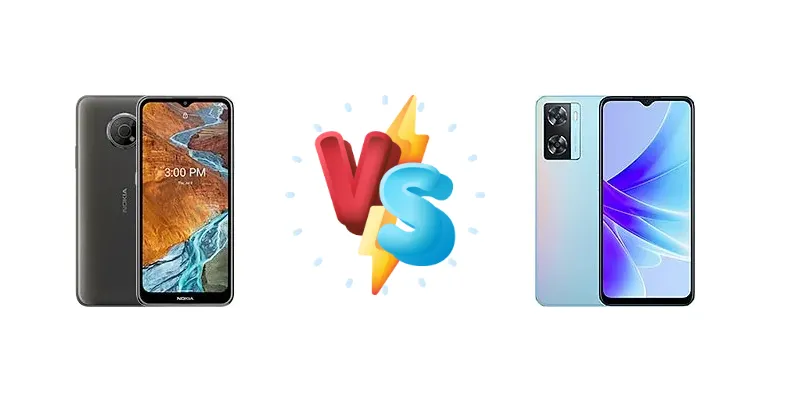
The Nokia G300 and Oppo A57s represent two distinct approaches to the budget smartphone market. The Nokia G300 aims to deliver 5G connectivity at an accessible price point, leveraging Qualcomm's Snapdragon 480. Conversely, the Oppo A57s focuses on a streamlined user experience and exceptionally fast 33W charging, powered by MediaTek's Helio G35. This comparison dissects their core differences to determine which device best suits your needs.
🏆 Quick Verdict
For users prioritizing 5G access and future-proofing, the Nokia G300 is the better choice, despite its slower charging. However, the Oppo A57s wins for those who value rapid replenishment and don't require immediate 5G capabilities, offering a more convenient daily charging experience.
| Network |
|---|
| 2G bands | GSM 850 / 900 / 1800 / 1900 | GSM 850 / 900 / 1800 / 1900 |
| 3G bands | HSDPA 850 / 900 / 1900 / 2100 | HSDPA 850 / 900 / 2100 |
| 4G bands | 2, 4, 5, 12, 13, 41, 66, 71 | 1, 3, 5, 7, 8, 20, 28, 38, 40, 41 |
| 5G bands | 2, 5, 25, 41, 66, 71, 77 SA/NSA | - |
| Speed | HSPA, LTE, 5G | HSPA, LTE |
| Technology | GSM / HSPA / LTE / 5G | GSM / HSPA / LTE |
| Launch |
|---|
| Announced | 2021, October 12 | 2022, August 31 |
| Status | Available. Released 2021, October 19 | Available. Released 2022, September 12 |
| Body |
|---|
| Build | - | Glass front (Panda Glass), plastic frame, plastic back |
| Dimensions | 169.4 x 78.4 x 9.3 mm (6.67 x 3.09 x 0.37 in) | 163.8 x 75 x 8 mm (6.45 x 2.95 x 0.31 in) |
| SIM | Nano-SIM | Nano-SIM + Nano-SIM |
| Weight | 210.1 g (7.41 oz) | 187 g (6.60 oz) |
| | - | IP5X (dust), IPX4 (water) resistance |
| Display |
|---|
| Protection | - | Panda Glass |
| Resolution | 720 x 1600 pixels, 20:9 ratio (~269 ppi density) | 720 x 1612 pixels, 20:9 ratio (~269 ppi density) |
| Size | 6.52 inches, 102.6 cm2 (~77.3% screen-to-body ratio) | 6.56 inches, 103.4 cm2 (~84.2% screen-to-body ratio) |
| Type | IPS LCD | IPS LCD, 480 nits (typ), 600 nits (HBM) |
| Platform |
|---|
| CPU | Octa-core (2x2.0 GHz Kryo 460 & 6x1.8 GHz Kryo 460) | Octa-core (4x2.3 GHz Cortex-A53 & 4x1.8 GHz Cortex-A53) |
| Chipset | Qualcomm SM4350 Snapdragon 480 5G (8 nm) | Mediatek MT6765G Helio G35 (12 nm) |
| GPU | Adreno 619 | PowerVR GE8320 |
| OS | Android 11 | Android 12, ColorOS 12.1 |
| Memory |
|---|
| Card slot | microSDXC (dedicated slot) | microSDXC |
| Internal | 64GB 4GB RAM | 64GB 4GB RAM, 128GB 4GB RAM |
| | - | eMMC 5.1 |
| Main Camera |
|---|
| Dual | - | 50 MP, f/1.8, 27mm (wide), PDAF
Auxiliary lens |
| Features | LED flash, HDR, panorama | LED flash, HDR, panorama |
| Single | 8 MP, (wide) | 8 MP, f/2.0, 26mm (wide) |
| Triple | 16 MP, f/1.8, 27mm (wide), PDAF
5 MP, f/2.2, 115˚ (ultrawide)
Auxiliary lens | - |
| Video | 1080p@30/60fps | 1080p@30fps |
| Selfie camera |
|---|
| Features | - | Panorama |
| Single | 8 MP, (wide) | 8 MP, f/2.0, 26mm (wide) |
| Video | 1080p@30fps | 1080p@30fps |
| Sound |
|---|
| 3.5mm jack | Yes | Yes |
| 35mm jack | Yes | Yes |
| Loudspeaker | Yes | Yes, with stereo speakers |
| Comms |
|---|
| Bluetooth | 5.0, A2DP, LE | 5.3, A2DP, LE, aptX HD |
| NFC | Yes | Yes |
| Positioning | GPS (L1+L5) | GPS, GLONASS, BDS, GALILEO, QZSS |
| Radio | No | No |
| USB | USB Type-C 2.0, OTG | USB Type-C 2.0, OTG |
| WLAN | Wi-Fi 802.11 a/b/g/n/ac, dual-band | Wi-Fi 802.11 a/b/g/n/ac, dual-band, Wi-Fi Direct |
| Features |
|---|
| Sensors | Fingerprint (side-mounted), accelerometer, proximity | Fingerprint (side-mounted), accelerometer, proximity, compass |
| Battery |
|---|
| Charging | 18W wired | 33W wired, 100% in 69 min |
| Type | Li-Po 4470 mAh | Li-Po 5000 mAh |
| Misc |
|---|
| Colors | Meteor Grey | Starry Black, Sky Blue |
| Models | TA-1374, N1374DL | CPH2385 |
| Price | About 100 EUR | - |
| SAR | 1.44 W/kg (head) 1.09 W/kg (body) | - |
Nokia G300
- 5G Connectivity for faster data speeds
- More efficient Snapdragon 480 chipset
- Potentially better camera image processing
- Slower 18W charging
- May have lower peak display brightness
Oppo A57s
- Ultra-fast 33W charging (100% in 69 mins)
- Potentially brighter display
- Streamlined user experience (typical of Oppo)
- Less powerful and efficient Helio G35 chipset
- Lacks 5G connectivity
Display Comparison
Neither device boasts a standout display. Given the context data focuses on processing, we can infer both likely utilize LCD panels common in this price bracket. The Oppo A57s, based on typical Oppo implementations, likely features a higher peak brightness than the Nokia G300, improving outdoor visibility. However, without specific nit ratings, this remains an educated guess. Bezels are expected to be comparable, and color accuracy will likely be standard for the segment, prioritizing power efficiency over color fidelity.
Camera Comparison
Without detailed camera specifications, a direct comparison is limited. However, the market positioning suggests the Nokia G300 may prioritize a more versatile camera system, potentially with a larger main sensor to leverage the Snapdragon 480’s image signal processor. The Oppo A57s likely focuses on software enhancements for social media-ready images. The presence of a 2MP macro lens on either device is largely inconsequential; image quality will be limited. The Snapdragon 480’s ISP will likely provide better dynamic range and low-light performance than the Helio G35’s equivalent.
Performance
The Nokia G300’s Qualcomm Snapdragon 480 5G (8nm) represents a significant architectural advantage over the Oppo A57s’ MediaTek Helio G35 (12nm). The 8nm process node inherently offers better power efficiency and thermal performance, meaning the G300 is less likely to throttle under sustained load. While the Helio G35’s Cortex-A53 cores clock slightly higher (2.3 GHz vs 2.0 GHz on the Kryo 460), the Snapdragon 480’s Kryo cores, coupled with its 5G modem, provide a more robust and future-proof platform. The G300 will handle multitasking and demanding apps more smoothly. The Oppo A57s will be adequate for basic tasks, but will struggle with graphically intensive games or heavy app usage.
Battery Life
The Oppo A57s’ 33W charging is a clear advantage, promising a full charge in just 69 minutes. The Nokia G300’s 18W charging is considerably slower. While battery capacity isn’t specified, the faster charging of the Oppo A57s mitigates the impact of a potentially smaller battery. Users who frequently need to top up their phone throughout the day will greatly benefit from the Oppo A57s’ charging speed. The Nokia G300 will require longer charging times, making it less convenient for users with limited downtime.
Buying Guide
Buy the Nokia G300 if you need 5G connectivity for streaming, downloading, or future network compatibility, and are willing to trade off charging speed. Buy the Oppo A57s if you prioritize a quick and convenient charging experience, frequently find yourself needing to top up quickly, and 5G isn't a critical requirement for your usage patterns.
Frequently Asked Questions
❓ Will the Snapdragon 480 in the Nokia G300 handle demanding games like PUBG Mobile?
The Snapdragon 480 can run PUBG Mobile, but expect to play at medium settings to maintain a stable frame rate. The Helio G35 in the Oppo A57s will struggle with PUBG Mobile, requiring significantly lower settings and potentially experiencing lag.
❓ How much faster is the 33W charging on the Oppo A57s compared to the 18W charging on the Nokia G300 in real-world use?
The Oppo A57s can gain a substantial charge in a short period. Expect a 0-50% charge in around 20-25 minutes, while the Nokia G300 will take closer to 45-60 minutes for the same level. A full charge will take 69 minutes on the Oppo A57s versus over 2 hours on the Nokia G300.
❓ Does the Nokia G300's 5G connectivity require a new SIM card?
Not necessarily. Most carriers are rolling out 5G support on existing SIM cards. However, it's best to check with your mobile carrier to confirm compatibility and ensure your plan supports 5G access.