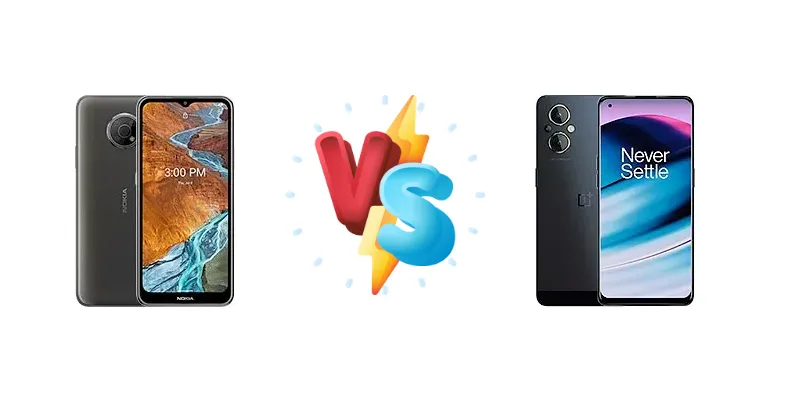
The sub-$300 5G phone market is heating up, and the Nokia G300 and OnePlus Nord N20 5G represent compelling options. While both aim to deliver 5G connectivity at an accessible price, they take different approaches to achieving this, particularly in chipset choice and display technology. This comparison dissects these differences to determine which phone offers the best value.
🏆 Quick Verdict
For most users, the OnePlus Nord N20 5G emerges as the superior choice. Its Snapdragon 695, built on a more efficient 6nm process, delivers noticeably better performance than the Nokia G300’s Snapdragon 480. Coupled with faster 33W charging and a brighter display, the Nord N20 5G offers a more refined experience.
| Network |
|---|
| 2G bands | GSM 850 / 900 / 1800 / 1900 | GSM 850 / 900 / 1800 / 1900 |
| 3G bands | HSDPA 850 / 900 / 1900 / 2100 | HSDPA 850 / 900 / 1700(AWS) / 1900 / 2100 |
| 4G bands | 2, 4, 5, 12, 13, 41, 66, 71 | 1, 2, 3, 4, 5, 7, 8, 12, 13, 17, 20, 25, 26, 28, 38, 39, 40, 41, 66, 71 |
| 5G bands | 2, 5, 25, 41, 66, 71, 77 SA/NSA | 2, 25, 41, 66, 71 SA/NSA |
| Speed | HSPA, LTE, 5G | HSPA 42.2/5.76 Mbps, LTE Cat15 800/200 Mbps, 5G |
| Technology | GSM / HSPA / LTE / 5G | GSM / HSPA / LTE / 5G |
| Launch |
|---|
| Announced | 2021, October 12 | 2022, April 28 |
| Status | Available. Released 2021, October 19 | Available. Released 2022, April 28 |
| Body |
|---|
| Build | - | Glass front (Schott Xensation Up), plastic frame, plastic back |
| Dimensions | 169.4 x 78.4 x 9.3 mm (6.67 x 3.09 x 0.37 in) | 159.9 x 73.2 x 7.5 mm (6.30 x 2.88 x 0.30 in) |
| SIM | Nano-SIM | Nano-SIM |
| Weight | 210.1 g (7.41 oz) | 173 g (6.10 oz) |
| Display |
|---|
| Protection | - | Schott Xensation Up |
| Resolution | 720 x 1600 pixels, 20:9 ratio (~269 ppi density) | 1080 x 2400 pixels, 20:9 ratio (~409 ppi density) |
| Size | 6.52 inches, 102.6 cm2 (~77.3% screen-to-body ratio) | 6.43 inches, 99.8 cm2 (~85.3% screen-to-body ratio) |
| Type | IPS LCD | AMOLED |
| | - | Always-on display |
| Platform |
|---|
| CPU | Octa-core (2x2.0 GHz Kryo 460 & 6x1.8 GHz Kryo 460) | Octa-core (2x2.2 GHz Kryo 660 Gold & 6x1.7 GHz Kryo 660 Silver) |
| Chipset | Qualcomm SM4350 Snapdragon 480 5G (8 nm) | Qualcomm SM6375 Snapdragon 695 5G (6 nm) |
| GPU | Adreno 619 | Adreno 619 |
| OS | Android 11 | Android 11, OxygenOS 11 |
| Memory |
|---|
| Card slot | microSDXC (dedicated slot) | microSDXC (dedicated slot) |
| Internal | 64GB 4GB RAM | 128GB 6GB RAM |
| | - | UFS 2.2 |
| Main Camera |
|---|
| Features | LED flash, HDR, panorama | LED flash, HDR, panorama |
| Single | 8 MP, (wide) | 16 MP, f/2.4, (wide) |
| Triple | 16 MP, f/1.8, 27mm (wide), PDAF
5 MP, f/2.2, 115˚ (ultrawide)
Auxiliary lens | 64 MP, f/1.8, (wide), PDAF
2 MP (macro)
Auxiliary lens |
| Video | 1080p@30/60fps | 1080p@30fps |
| Selfie camera |
|---|
| Features | - | HDR |
| Single | 8 MP, (wide) | 16 MP, f/2.4, (wide) |
| Video | 1080p@30fps | 1080p@30fps |
| Sound |
|---|
| 3.5mm jack | Yes | Yes |
| 35mm jack | Yes | Yes |
| Loudspeaker | Yes | Yes |
| Comms |
|---|
| Bluetooth | 5.0, A2DP, LE | 5.1, A2DP, LE |
| NFC | Yes | Yes |
| Positioning | GPS (L1+L5) | GPS (L1+L5), GLONASS, GALILEO, BDS |
| Radio | No | No |
| USB | USB Type-C 2.0, OTG | USB Type-C 2.0, OTG |
| WLAN | Wi-Fi 802.11 a/b/g/n/ac, dual-band | Wi-Fi 802.11 a/b/g/n/ac, dual-band, Wi-Fi Direct |
| Features |
|---|
| Sensors | Fingerprint (side-mounted), accelerometer, proximity | Fingerprint (under display, optical), accelerometer, gyro, proximity, compass, barometer |
| Battery |
|---|
| Charging | 18W wired | 33W wired |
| Type | Li-Po 4470 mAh | Li-Po 4500 mAh |
| Misc |
|---|
| Colors | Meteor Grey | Blue |
| Models | TA-1374, N1374DL | GN2200, CPH2459 |
| Price | About 100 EUR | About 120 EUR |
| SAR | 1.44 W/kg (head) 1.09 W/kg (body) | - |
| Tests |
|---|
| Battery life | - |
Endurance rating 129h
|
| Display | - |
Contrast ratio: Infinite (nominal) |
| Performance | - |
AnTuTu: 316974 (v8), 380672 (v9)
GeekBench: 1945 (v5.1)
GFXBench: 16fps (ES 3.1 onscreen) |
Nokia G300
- Lower upfront cost
- 5G connectivity
- Acceptable battery endurance
- Less powerful Snapdragon 480 chipset
- Slower 18W charging
- Likely less vibrant display
OnePlus Nord N20 5G
- More powerful Snapdragon 695 chipset
- Faster 33W charging
- Brighter display (647 nits)
- Slightly higher price
- Battery endurance is similar to the G300
- May not be significantly better in all camera scenarios
Display Comparison
The OnePlus Nord N20 5G boasts a significantly brighter display, reaching a measured 647 nits, compared to an unspecified brightness for the Nokia G300. This difference is crucial for outdoor visibility. While both displays are described as having an 'infinite' contrast ratio (typical for OLED/AMOLED panels, though the Nord N20 5G is likely LCD), the higher peak brightness of the Nord N20 5G provides a more dynamic and enjoyable viewing experience. The Nokia G300’s display specifications are less detailed, suggesting a more basic panel.
Camera Comparison
Without detailed camera specifications for either device beyond the chipsets, a direct comparison is difficult. However, the Snapdragon 695 typically offers more advanced image signal processing (ISP) capabilities than the 480, potentially leading to better image quality, especially in low-light conditions. The absence of information regarding sensor sizes and lens apertures makes a definitive judgment impossible, but the OnePlus Nord N20 5G likely benefits from a more sophisticated camera system due to its more powerful chipset.
Performance
The core difference lies in the chipsets. The OnePlus Nord N20 5G’s Snapdragon 695, fabricated on a 6nm process, offers a clear advantage over the Nokia G300’s Snapdragon 480 (8nm). The 695 features Kryo 660 Gold and Silver cores clocked up to 2.2 GHz, versus the 480’s Kryo 460 cores at 2.0 GHz. This translates to faster application loading times, smoother multitasking, and improved gaming performance. The 6nm process also contributes to better thermal efficiency, potentially reducing throttling during sustained workloads. While both support 5G, the 695’s modem is generally more advanced.
Battery Life
Both phones achieve an endurance rating of 129 hours, suggesting similar overall battery life despite the Nokia G300’s unspecified battery capacity. However, the OnePlus Nord N20 5G’s 33W wired charging is a significant advantage over the Nokia G300’s 18W charging. This faster charging speed will dramatically reduce the time spent tethered to an outlet, offering a more convenient user experience. A full charge on the Nord N20 5G will be considerably quicker.
Buying Guide
Buy the Nokia G300 if you prioritize a lower upfront cost and are comfortable with a more basic user experience. It’s a viable option for essential smartphone tasks and light 5G usage. Buy the OnePlus Nord N20 5G if you value smoother performance, faster charging, and a more vibrant display, even if it means spending slightly more. It’s ideal for users who stream video, play mobile games, or simply want a more responsive device.
Frequently Asked Questions
❓ Will the Snapdragon 695 in the Nord N20 5G handle demanding games like Genshin Impact or Call of Duty Mobile?
While the Snapdragon 695 isn't a flagship chipset, it's capable of running many popular games at medium settings. Expect playable frame rates, but don't anticipate the highest graphical fidelity. The Nokia G300's Snapdragon 480 will struggle more with these titles, requiring lower settings and potentially experiencing more lag.
❓ How much faster is the 33W charging on the Nord N20 5G compared to the 18W charging on the G300 in real-world use?
The 33W charging on the Nord N20 5G can realistically reduce charging times by 30-50% compared to the G300’s 18W charging. A full charge from 0% to 100% on the Nord N20 5G will likely take around 60-75 minutes, while the G300 could take over 2 hours.
❓ Is the difference in chipset performance (Snapdragon 480 vs 695) noticeable for everyday tasks like browsing and social media?
Yes, the difference is noticeable. The Snapdragon 695 provides a smoother and more responsive experience when switching between apps, scrolling through webpages, and general navigation. The Snapdragon 480 can feel sluggish at times, especially with multiple apps open.