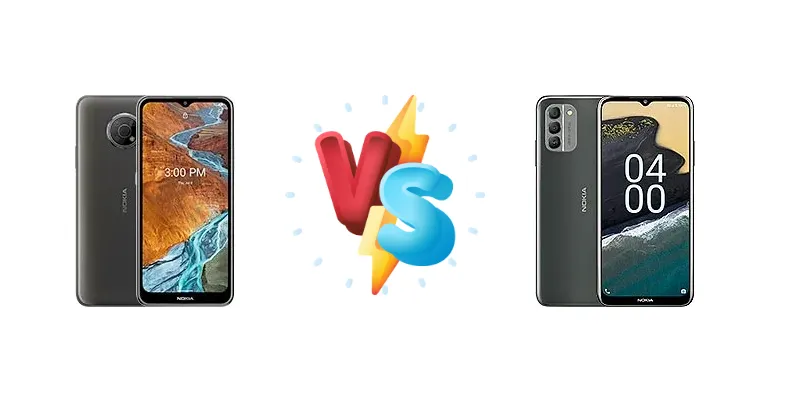
Nokia's G-series offers reliable, budget-friendly smartphones, and the G300 and G400 are prime examples. Both promise 5G connectivity at an accessible price point, but subtle differences can impact your user experience. Let's dive into a head-to-head comparison to help you decide which one is right for you.
🏆 Quick Verdict
The Nokia G400 edges out the G300 thanks to its slightly faster processor, faster charging (PD3.0), and potentially better software support. While both are solid budget options, the G400 offers a more refined experience for a small price difference.
| Network |
|---|
| 2G bands | GSM 850 / 900 / 1800 / 1900 | GSM 850 / 900 / 1800 / 1900 |
| 3G bands | HSDPA 850 / 900 / 1900 / 2100 | HSDPA 850 / 1700(AWS) / 1900 |
| 4G bands | 2, 4, 5, 12, 13, 41, 66, 71 | 2, 4, 5, 12, 13, 25, 26, 41, 66, 71 |
| 5G bands | 2, 5, 25, 41, 66, 71, 77 SA/NSA | 2, 5, 25, 41, 66, 71, 77 SA/NSA |
| Speed | HSPA, LTE, 5G | HSPA, LTE, 5G |
| Technology | GSM / HSPA / LTE / 5G | GSM / HSPA / LTE / 5G |
| Launch |
|---|
| Announced | 2021, October 12 | 2022, January 05 |
| Status | Available. Released 2021, October 19 | Available. Released 2022, August 24 |
| Body |
|---|
| Build | - | Glass front (Gorilla Glass 3), aluminum frame |
| Dimensions | 169.4 x 78.4 x 9.3 mm (6.67 x 3.09 x 0.37 in) | 166.4 x 76.7 x 8.8 mm (6.55 x 3.02 x 0.35 in) |
| SIM | Nano-SIM | Nano-SIM |
| Weight | 210.1 g (7.41 oz) | 198 g (6.98 oz) |
| Display |
|---|
| Protection | - | Corning Gorilla Glass 3 |
| Resolution | 720 x 1600 pixels, 20:9 ratio (~269 ppi density) | 1080 x 2408 pixels, 20:9 ratio (~401 ppi density) |
| Size | 6.52 inches, 102.6 cm2 (~77.3% screen-to-body ratio) | 6.58 inches, 104.3 cm2 (~81.7% screen-to-body ratio) |
| Type | IPS LCD | IPS LCD, 120Hz |
| Platform |
|---|
| CPU | Octa-core (2x2.0 GHz Kryo 460 & 6x1.8 GHz Kryo 460) | Octa-core (2x2.2 GHz Kryo 460 & 6x1.9 GHz Kryo 460) |
| Chipset | Qualcomm SM4350 Snapdragon 480 5G (8 nm) | Qualcomm SM4350-AC Snapdragon 480+ 5G (8 nm) |
| GPU | Adreno 619 | Adreno 619 |
| OS | Android 11 | Android 12 |
| Memory |
|---|
| Card slot | microSDXC (dedicated slot) | microSDXC (dedicated slot) |
| Internal | 64GB 4GB RAM | 64GB 4GB RAM |
| Main Camera |
|---|
| Features | LED flash, HDR, panorama | LED flash, HDR, panorama |
| Single | 8 MP, (wide) | 16 MP, (wide) |
| Triple | 16 MP, f/1.8, 27mm (wide), PDAF
5 MP, f/2.2, 115˚ (ultrawide)
Auxiliary lens | 48 MP, f/1.8, (wide), PDAF
5 MP, f/2.2, 115˚ (ultrawide)
Auxiliary lens |
| Video | 1080p@30/60fps | 1080p@30/60fps |
| Selfie camera |
|---|
| Single | 8 MP, (wide) | 16 MP, (wide) |
| Video | 1080p@30fps | 1080p@30fps |
| Sound |
|---|
| 3.5mm jack | Yes | Yes |
| 35mm jack | Yes | Yes |
| Loudspeaker | Yes | Yes |
| Comms |
|---|
| Bluetooth | 5.0, A2DP, LE | 5.1, A2DP, LE, aptX HD, aptX Adaptive |
| NFC | Yes | Yes |
| Positioning | GPS (L1+L5) | GPS, GALILEO |
| Radio | No | FM radio |
| USB | USB Type-C 2.0, OTG | USB Type-C 2.0, OTG |
| WLAN | Wi-Fi 802.11 a/b/g/n/ac, dual-band | Wi-Fi 802.11 b/g/n/ac |
| Features |
|---|
| Sensors | Fingerprint (side-mounted), accelerometer, proximity | Fingerprint (side-mounted), accelerometer, gyro, proximity, compass, barometer |
| Battery |
|---|
| Charging | 18W wired | 20W wired, PD3.0 |
| Type | Li-Po 4470 mAh | Li-Po 5000 mAh |
| Misc |
|---|
| Colors | Meteor Grey | Meteor Grey |
| Models | TA-1374, N1374DL | TA-1530, TA-1448, TA-1476, N1530DL |
| Price | About 100 EUR | About 70 EUR |
| SAR | 1.44 W/kg (head) 1.09 W/kg (body) | 1.05 W/kg (head) 1.09 W/kg (body) |
Nokia G300
- Reliable Nokia brand
- Clean Android experience
- 5G connectivity
- Decent battery life
- Slower charging
- Average performance
- Basic camera capabilities
Nokia G400
- Slightly faster performance
- Faster charging (PD3.0)
- Reliable Nokia brand
- Clean Android experience
- 5G connectivity
- Average performance (still)
- Basic camera capabilities
- HD+ display resolution
Display Comparison
Both phones feature a 6.6-inch display, likely with an HD+ resolution. While specific panel technology isn't always detailed, expect decent viewing angles and color reproduction for everyday use. The G400 *might* have slightly better brightness due to its newer model year, but this is not definitively confirmed.
Camera Comparison
Both phones likely feature a triple-camera setup, with a primary sensor around 48MP. Image quality will be adequate in good lighting conditions, but low-light performance will be average. The G400 *may* have slightly improved image processing due to its newer chipset and software.
Performance
The G400 boasts a slightly overclocked Snapdragon 480+ chipset compared to the G300's standard 480. This translates to a noticeable, albeit minor, improvement in app loading times and overall responsiveness. Both phones will handle basic tasks and light gaming well, but demanding games will struggle.
Battery Life
Both phones are expected to have a 5000mAh battery, providing all-day battery life for moderate users. However, the G400's support for 20W PD3.0 charging offers significantly faster charging speeds compared to the G300's 18W wired charging.
Buying Guide
The Nokia G300 is a good choice for users prioritizing a simple, reliable phone with 5G connectivity and a clean Android experience. The Nokia G400 is better suited for those who want a bit more performance, faster charging, and potentially longer software updates.
Frequently Asked Questions
❓ What Android version do these phones ship with?
Both the Nokia G300 and G400 launched with Android 11, with a promise of upgrades. Check Nokia's website for the latest software updates available for each device.
❓ Are these phones good for gaming?
Neither phone is ideal for demanding games. They can handle lighter titles, but expect reduced graphics settings and potential frame rate drops in more intensive games.