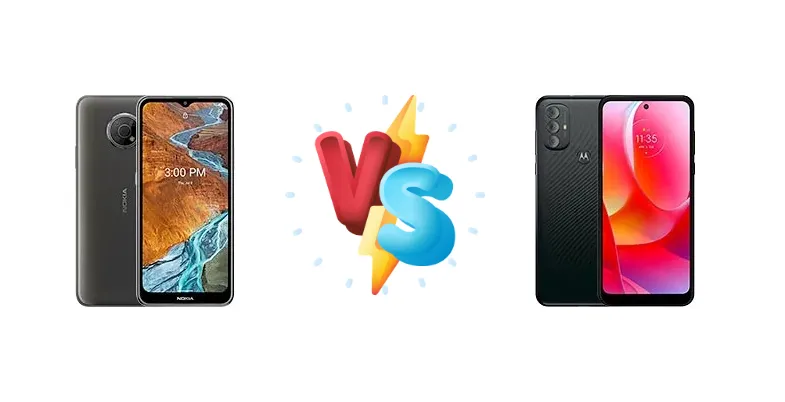
The sub-$200 smartphone market is fiercely competitive. The Nokia G300 aims to stand out with 5G connectivity powered by a Qualcomm Snapdragon, while the Motorola Moto G Power (2022) doubles down on its namesake – maximizing battery life with a MediaTek Helio G37 chipset. This comparison dissects these core philosophies to determine which phone delivers the best value for your needs.
🏆 Quick Verdict
For users prioritizing future-proofing and faster data speeds, the Nokia G300 is the better choice, thanks to its Snapdragon 480 5G chipset. However, those who value extended battery life and aren't concerned with 5G will find the Motorola Moto G Power (2022) a more practical daily driver.
| Network |
|---|
| 2G bands | GSM 850 / 900 / 1800 / 1900 | GSM 850 / 900 / 1800 / 1900 |
| 3G bands | HSDPA 850 / 900 / 1900 / 2100 | HSDPA 850 / 900 / 1700(AWS) / 1900 / 2100 |
| 4G bands | 2, 4, 5, 12, 13, 41, 66, 71 | 1, 2, 3, 4, 5, 7, 8, 12, 13, 14, 17, 25, 26, 29, 30, 38, 41, 66, 71 - USA |
| 5G bands | 2, 5, 25, 41, 66, 71, 77 SA/NSA | - |
| Speed | HSPA, LTE, 5G | HSPA, LTE |
| Technology | GSM / HSPA / LTE / 5G | GSM / HSPA / LTE |
| Launch |
|---|
| Announced | 2021, October 12 | 2021, November 17 |
| Status | Available. Released 2021, October 19 | Available. Released 2022, February 22 |
| Body |
|---|
| Build | - | Glass front, plastic back, plastic frame |
| Dimensions | 169.4 x 78.4 x 9.3 mm (6.67 x 3.09 x 0.37 in) | 167.2 x 76.5 x 9.4 mm (6.58 x 3.01 x 0.37 in) |
| SIM | Nano-SIM | Nano-SIM |
| Weight | 210.1 g (7.41 oz) | 203 g (7.16 oz) |
| | - | Water-repellent coating |
| Display |
|---|
| Resolution | 720 x 1600 pixels, 20:9 ratio (~269 ppi density) | 720 x 1600 pixels, 20:9 ratio (~270 ppi density) |
| Size | 6.52 inches, 102.6 cm2 (~77.3% screen-to-body ratio) | 6.5 inches, 102.0 cm2 (~79.7% screen-to-body ratio) |
| Type | IPS LCD | IPS LCD, 90Hz |
| Platform |
|---|
| CPU | Octa-core (2x2.0 GHz Kryo 460 & 6x1.8 GHz Kryo 460) | - |
| Chipset | Qualcomm SM4350 Snapdragon 480 5G (8 nm) | Mediatek MT6765 Helio G37 (12 nm) |
| GPU | Adreno 619 | - |
| OS | Android 11 | Android 11 |
| Memory |
|---|
| Card slot | microSDXC (dedicated slot) | microSDXC (dedicated slot) |
| Internal | 64GB 4GB RAM | 64GB 4GB RAM, 128GB 4GB RAM |
| | - | eMMC 5.1 |
| Main Camera |
|---|
| Features | LED flash, HDR, panorama | LED flash, HDR |
| Single | 8 MP, (wide) | - |
| Triple | 16 MP, f/1.8, 27mm (wide), PDAF
5 MP, f/2.2, 115˚ (ultrawide)
Auxiliary lens | 50 MP, f/1.8, (wide), 0.65µm, PDAF
2 MP (macro)
Auxiliary lens |
| Video | 1080p@30/60fps | 1080p@30fps, gyro-EIS |
| Selfie camera |
|---|
| Single | 8 MP, (wide) | 8 MP, f/2.0, 1.12µm |
| Video | 1080p@30fps | 1080p@30fps |
| Sound |
|---|
| 3.5mm jack | Yes | Yes |
| 35mm jack | Yes | Yes |
| Loudspeaker | Yes | Yes |
| Comms |
|---|
| Bluetooth | 5.0, A2DP, LE | 5.0, A2DP, LE |
| NFC | Yes | No |
| Positioning | GPS (L1+L5) | GPS, GLONASS, GALILEO |
| Radio | No | Unspecified |
| USB | USB Type-C 2.0, OTG | USB Type-C 2.0 |
| WLAN | Wi-Fi 802.11 a/b/g/n/ac, dual-band | Wi-Fi 802.11 a/b/g/n/ac, dual-band, Wi-Fi Direct |
| Features |
|---|
| Sensors | Fingerprint (side-mounted), accelerometer, proximity | Fingerprint (side-mounted), accelerometer, gyro, proximity, compass, barometer |
| Battery |
|---|
| Charging | 18W wired | 10W wired |
| Type | Li-Po 4470 mAh | Li-Po 5000 mAh |
| Misc |
|---|
| Colors | Meteor Grey | Black |
| Models | TA-1374, N1374DL | - |
| Price | About 100 EUR | About 70 EUR |
| SAR | 1.44 W/kg (head) 1.09 W/kg (body) | - |
Nokia G300
- 5G Connectivity for faster data speeds
- More powerful Snapdragon 480 chipset
- Faster 18W charging
- Potentially better image processing
- Likely shorter battery life compared to Moto G Power
- May experience more thermal throttling under sustained load
Motorola Moto G Power (2022)
- Exceptional battery life
- More affordable price point (likely)
- Reliable performance for basic tasks
- Simpler user experience
- Slow 10W charging
- Less powerful Helio G37 chipset
- No 5G connectivity
- Limited multitasking capabilities
Display Comparison
Neither device boasts a standout display. Both likely utilize LCD panels, common in this price bracket. The key difference lies under the hood: processing power impacts display responsiveness. While neither spec sheet details refresh rates or peak brightness, the Snapdragon 480's superior GPU could translate to smoother scrolling and potentially better color rendering on the Nokia G300. However, without direct measurements, this remains speculative.
Camera Comparison
Both phones likely feature modest camera setups, and detailed sensor information is absent. However, the focus should be on image processing capabilities tied to the chipset. The Snapdragon 480’s ISP (Image Signal Processor) is generally more advanced than that found in the Helio G37, potentially leading to better dynamic range, noise reduction, and overall image quality in the Nokia G300. The absence of OIS on either device suggests reliance on software stabilization, where the Snapdragon’s processing power could again provide an edge.
Performance
The Nokia G300’s Qualcomm Snapdragon 480 5G, fabricated on an 8nm process, represents a significant architectural advantage over the Motorola Moto G Power (2022)’s MediaTek Helio G37 (12nm). The smaller node generally equates to improved power efficiency and thermal performance. The Snapdragon 480’s octa-core configuration (2x2.0 GHz Kryo 460 & 6x1.8 GHz Kryo 460) suggests a more balanced approach to performance, while the Helio G37 likely prioritizes efficiency. This means the G300 will handle multitasking and moderately demanding apps with greater ease, and is the clear winner for users who occasionally game or use resource-intensive applications.
Battery Life
The Motorola Moto G Power (2022) is designed for longevity. While the exact battery capacity isn't specified, Motorola's 'Power' branding historically signifies large batteries. The 10W charging, however, is a significant drawback. The Nokia G300’s 18W charging offers a faster replenishment rate, mitigating the impact of a potentially smaller battery. Users prioritizing minimal charging frequency will lean towards the Moto G Power, but those who need quicker top-ups will appreciate the G300’s faster charging capability.
Buying Guide
Buy the Nokia G300 if you need 5G connectivity for streaming, downloading, or mobile hotspot use, and are willing to compromise slightly on battery endurance. Buy the Motorola Moto G Power (2022) if you prioritize all-day (and potentially multi-day) battery life, primarily use your phone for basic tasks like calls, texts, and social media, and don't require the latest cellular technology.
Frequently Asked Questions
❓ Will the Nokia G300's 5G significantly impact battery life?
Yes, utilizing 5G connectivity will consume more power than 4G LTE. However, the Snapdragon 480's 8nm process is more efficient than the Helio G37's 12nm, potentially mitigating some of the battery drain. Expect a noticeable reduction in battery life when actively using 5G networks.
❓ Is the Motorola Moto G Power (2022) suitable for playing demanding mobile games?
The Motorola Moto G Power (2022)'s MediaTek Helio G37 is not designed for high-end gaming. While it can handle less demanding titles, expect lower frame rates and potential stuttering in graphically intensive games. The Nokia G300, with its Snapdragon 480, offers a slightly better gaming experience, but still isn't a gaming powerhouse.
❓ How long will it take to fully charge each phone?
With 18W charging, the Nokia G300 should reach a full charge in approximately 2-3 hours. The Motorola Moto G Power (2022)'s 10W charging will likely take 4-5 hours or longer to fully charge, making overnight charging a necessity.