
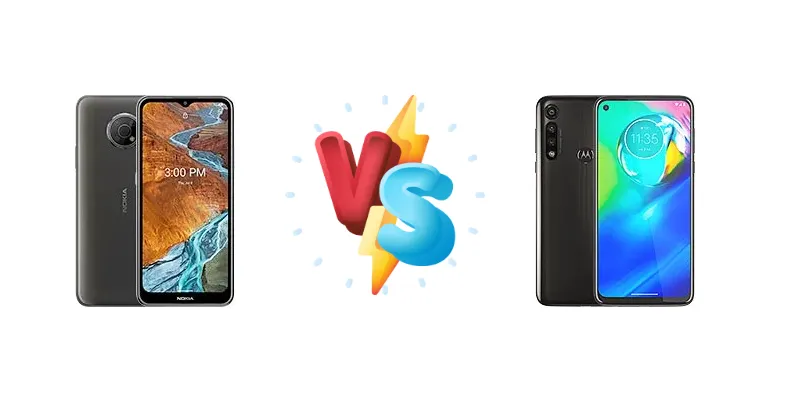
Nokia G300 vs. Motorola Moto G Power: The Ultimate Budget Showdown
| Phones Images | |||||
|---|---|---|---|---|---|
|
🏆 Quick Verdict
The Nokia G300 edges out the Moto G Power thanks to its significantly faster 5G chipset and quicker charging. While the Moto G Power boasts a larger battery, the G300's performance and future-proofing make it the slightly better choice for most users.
| PHONES | ||
|---|---|---|
| Phone Names | Nokia G300 | Motorola Moto G Power |
| Network | ||
|---|---|---|
| 2G bands | GSM 850 / 900 / 1800 / 1900 | GSM 850 / 900 / 1800 / 1900 |
| 3G bands | HSDPA 850 / 900 / 1900 / 2100 | HSDPA 850 / 900 / 1700(AWS) / 1900 / 2100 |
| 4G bands | 2, 4, 5, 12, 13, 41, 66, 71 | 1, 2, 3, 4, 5, 7, 8, 12, 13, 14, 17, 18, 19, 20, 25, 26, 29, 30, 38, 39, 40, 41, 66, 71 |
| 5G bands | 2, 5, 25, 41, 66, 71, 77 SA/NSA | - |
| Speed | HSPA, LTE, 5G | HSPA 42.2/5.76 Mbps, LTE (2CA) Cat13 600/100 Mbps |
| Technology | GSM / HSPA / LTE / 5G | GSM / CDMA / HSPA / EVDO / LTE |
| - | CDMA2000 1xEV-DO | |
| Launch | ||
|---|---|---|
| Announced | 2021, October 12 | 2020, February 07. Released 2020, April 17 |
| Status | Available. Released 2021, October 19 | Discontinued |
| Body | ||
|---|---|---|
| Build | - | Glass front, plastic back, aluminum frame (6000 series) |
| Dimensions | 169.4 x 78.4 x 9.3 mm (6.67 x 3.09 x 0.37 in) | 159.9 x 75.8 x 9.6 mm (6.30 x 2.98 x 0.38 in) |
| SIM | Nano-SIM | Nano-SIM |
| Weight | 210.1 g (7.41 oz) | 199 g (7.02 oz) |
| - | Water-repellent coating | |
| Display | ||
|---|---|---|
| Resolution | 720 x 1600 pixels, 20:9 ratio (~269 ppi density) | 1080 x 2300 pixels (~399 ppi density) |
| Size | 6.52 inches, 102.6 cm2 (~77.3% screen-to-body ratio) | 6.4 inches, 100.7 cm2 (~83.0% screen-to-body ratio) |
| Type | IPS LCD | IPS LCD |
| Platform | ||
|---|---|---|
| CPU | Octa-core (2x2.0 GHz Kryo 460 & 6x1.8 GHz Kryo 460) | Octa-core (4x2.0 GHz Kryo 260 Gold & 4x1.8 GHz Kryo 260 Silver) |
| Chipset | Qualcomm SM4350 Snapdragon 480 5G (8 nm) | Qualcomm SDM665 Snapdragon 665 (11 nm) |
| GPU | Adreno 619 | Adreno 610 |
| OS | Android 11 | Android 10 |
| Memory | ||
|---|---|---|
| Card slot | microSDXC (dedicated slot) | microSDXC (dedicated slot) |
| Internal | 64GB 4GB RAM | 64GB 4GB RAM |
| - | eMMC 5.1 | |
| Main Camera | ||
|---|---|---|
| Features | LED flash, HDR, panorama | LED flash, HDR, panorama |
| Single | 8 MP, (wide) | - |
| Triple | 16 MP, f/1.8, 27mm (wide), PDAF 5 MP, f/2.2, 115˚ (ultrawide) Auxiliary lens | 16 MP, f/1.7, (wide), 1/2.8", 1.12µm, PDAF 8 MP, f/2.2, 118˚ (ultrawide), 1/4.0", 1.12µm 2 MP (macro) |
| Video | 1080p@30/60fps | 4K@30fps, 1080p@30/60fps, 1080p@30fps (gyro-EIS) |
| Selfie camera | ||
|---|---|---|
| Features | - | HDR |
| Single | 8 MP, (wide) | 16 MP, f/2.0, (wide), 1/3.06", 1.0µm |
| Video | 1080p@30fps | 1080p@30/120fps |
| Sound | ||
|---|---|---|
| 3.5mm jack | Yes | Yes |
| 35mm jack | Yes | Yes |
| Loudspeaker | Yes | Yes, with stereo speakers |
| Comms | ||
|---|---|---|
| Bluetooth | 5.0, A2DP, LE | 5.0, A2DP, LE |
| NFC | Yes | No |
| Positioning | GPS (L1+L5) | GPS, GLONASS, BDS, GALILEO |
| Radio | No | FM radio |
| USB | USB Type-C 2.0, OTG | USB Type-C 2.0 |
| WLAN | Wi-Fi 802.11 a/b/g/n/ac, dual-band | Wi-Fi 802.11 a/b/g/n/ac, dual-band, Wi-Fi Direct |
| Features | ||
|---|---|---|
| Sensors | Fingerprint (side-mounted), accelerometer, proximity | Fingerprint (rear-mounted), accelerometer, gyro, proximity |
| Battery | ||
|---|---|---|
| Charging | 18W wired | 10W wired |
| Type | Li-Po 4470 mAh | Li-Po 5000 mAh |
| Misc | ||
|---|---|---|
| Colors | Meteor Grey | Smoke Black |
| Models | TA-1374, N1374DL | XT2041DL |
| Price | About 100 EUR | - |
| SAR | 1.44 W/kg (head) 1.09 W/kg (body) | - |
Nokia G300
- Faster 5G chipset
- Quicker charging (18W)
- Potentially better display quality
- More modern processor
- Smaller battery than Moto G Power
- Camera may be less versatile
- Potentially less RAM depending on configuration
Motorola Moto G Power
- Exceptional battery life
- Larger display
- Often more affordable
- Versatile camera system (multiple lenses)
- Slower processor
- Slower charging (10W)
- Lower resolution display
- Older chipset
Display Comparison
Both phones feature large displays, but the Nokia G300 typically has a slightly higher resolution and potentially better color accuracy. The Moto G Power often prioritizes size over sharpness, offering a larger screen for media consumption, though at a potential cost to visual clarity. Expect both to be LCD panels.
Camera Comparison
The Moto G Power often features a more versatile camera system with multiple lenses, including a dedicated macro lens. The Nokia G300's camera is likely to be simpler, but the Snapdragon 480's image signal processor (ISP) could potentially deliver better image processing. Real-world camera performance will depend on software optimization.
Performance
The Nokia G300's Snapdragon 480 5G chipset is a clear winner here. Its 8nm process and newer architecture provide a noticeable performance boost over the Moto G Power's Snapdragon 665. Expect smoother multitasking and faster app loading times on the G300.
Battery Life
The Motorola Moto G Power is renowned for its exceptional battery life, often exceeding a full day of heavy use. The Nokia G300's battery is likely smaller, but its faster charging (18W vs 10W) helps mitigate this difference.
Buying Guide
The Nokia G300 is ideal for users who prioritize performance and 5G connectivity on a budget. The Motorola Moto G Power is a great option for those who need exceptional battery life and are less concerned about raw processing power.