
Nokia G21 vs Nokia G60: A Detailed Comparison
| Phones Images | |||||
|---|---|---|---|---|---|
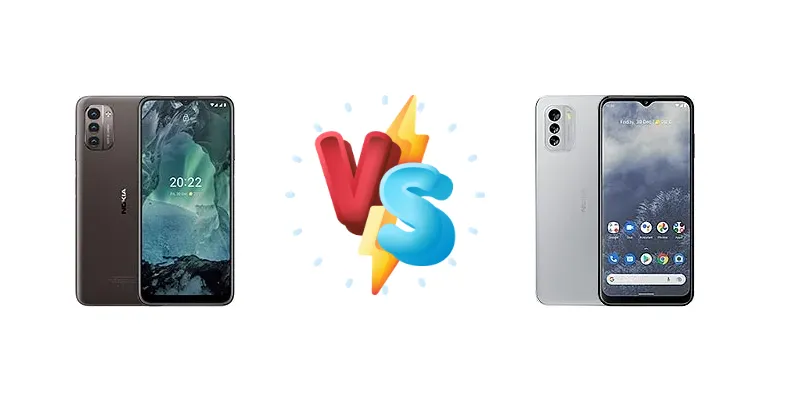
|
🏆 Quick Verdict
The Nokia G60 edges out the G21 thanks to its significantly faster Snapdragon processor, 5G connectivity, and more modern chipset. While the G21 boasts incredible battery life, the G60's overall performance and future-proofing make it the better choice for most users.
| PHONES | ||
|---|---|---|
| Phone Names | Nokia G21 | Nokia G60 |
| Network | ||
|---|---|---|
| 2G bands | GSM 850 / 900 / 1800 / 1900 | GSM 850 / 900 / 1800 / 1900 |
| 3G bands | HSDPA 850 / 900 / 2100 - International | HSDPA 850 / 900 / 1900 / 2100 - International |
| 4G bands | 1, 3, 5, 7, 8, 20, 28, 38, 40, 41 - International | 1, 3, 5, 7, 8, 20, 28, 38, 39, 40, 41 - International |
| 5G bands | - | 1, 3, 5, 7, 28, 38, 40, 41, 77, 78 SA/NSA/Sub6 - International |
| Speed | HSPA 42.2/5.76 Mbps, LTE Cat4 150/50 Mbps | HSPA, LTE, 5G |
| Technology | GSM / HSPA / LTE | GSM / HSPA / LTE / 5G |
| 1, 2, 3, 4, 5, 7, 8, 12, 17, 28, 40, 66 - LATAM | 1, 3, 5, 7, 28, 38, 40, 41, 66, 78 SA/NSA/Sub6 - LATAM | |
| Launch | ||
|---|---|---|
| Announced | 2022, February 14 | 2022, September 01 |
| Status | Available. Released 2022, February 15 | Available. Released 2022, September 01 |
| Body | ||
|---|---|---|
| Build | Glass front, plastic frame, plastic back | Glass front (Gorilla Glass 5), plastic frame, plastic back |
| Dimensions | 164.6 x 75.9 x 8.5 mm (6.48 x 2.99 x 0.33 in) | 166 x 75.9 x 8.6 mm (6.54 x 2.99 x 0.34 in) |
| SIM | · Nano-SIM· Nano-SIM + Nano-SIM | · Nano-SIM + eSIM· Nano-SIM + Nano-SIM |
| Weight | 190 g (6.70 oz) | 190 g (6.70 oz) |
| - | Splash resistant | |
| Display | ||
|---|---|---|
| Protection | - | Corning Gorilla Glass 5 |
| Resolution | 720 x 1600 pixels, 20:9 ratio (~270 ppi density) | 1080 x 2408 pixels, 20:9 ratio (~401 ppi density) |
| Size | 6.5 inches, 102.0 cm2 (~81.6% screen-to-body ratio) | 6.58 inches, 104.3 cm2 (~82.8% screen-to-body ratio) |
| Type | IPS LCD, 90Hz, 400 nits (typ) | IPS LCD, 120Hz, 400 nits (typ) |
| Platform | ||
|---|---|---|
| CPU | Octa-core (2x1.6 GHz Cortex-A75 & 6x1.6 GHz Cortex-A55) | Octa-core (2x2.2 GHz Kryo 660 Gold & 6x1.7 GHz Kryo 660 Silver) |
| Chipset | Unisoc T606 (12 nm) | Qualcomm SM6375 Snapdragon 695 5G (6 nm) |
| GPU | Mali-G57 MP1 | Adreno 619 |
| OS | Android 11, upgradable to Android 13 | Android 12 |
| Memory | ||
|---|---|---|
| Card slot | microSDXC (dedicated slot) | microSDXC (uses shared SIM slot) |
| Internal | 64GB 3GB RAM, 64GB 4GB RAM, 128GB 4GB RAM, 128GB 6GB RAM | 64GB 4GB RAM, 128GB 4GB RAM, 128GB 6GB RAM |
| eMMC 5.1 | - | |
| Main Camera | ||
|---|---|---|
| Features | LED flash, HDR, panorama | LED flash, HDR, panorama |
| Single | 8 MP, f/2.0, (wide) | 8 MP, f/2.0, (wide), 1/4.0", 1.12µm |
| Triple | 50 MP, f/1.8, 28mm (wide), 1/2.76", 0.64µm, PDAF 2 MP (macro) Auxiliary lens | 50 MP, f/1.8, (wide), 1/2.5", 0.7µm, PDAF 5 MP, f/2.2, (ultrawide), 1/5.0" Auxiliary lens |
| Video | 1080p@30fps | 1080p@30fps |
| Selfie camera | ||
|---|---|---|
| Single | 8 MP, f/2.0, (wide) | 8 MP, f/2.0, (wide), 1/4.0", 1.12µm |
| Video | 1080p@30fps | 1080p@30fps |
| Sound | ||
|---|---|---|
| 3.5mm jack | Yes | Yes |
| 35mm jack | Yes | Yes |
| Loudspeaker | Yes | Yes |
| Comms | ||
|---|---|---|
| Bluetooth | 5.0, A2DP, LE | 5.1, A2DP, LE, aptX HD, aptX Adaptive |
| NFC | Yes (market/region dependent) | Yes (market/region dependent) |
| Positioning | GPS, GLONASS, GALILEO | GPS, GALILEO, BDS |
| Radio | FM radio, RDS | FM radio |
| USB | USB Type-C 2.0, OTG | USB Type-C 2.0, OTG |
| WLAN | Wi-Fi 802.11 a/b/g/n/ac, dual-band, Wi-Fi Direct | Wi-Fi 802.11 a/b/g/n/ac/6, dual-band |
| Features | ||
|---|---|---|
| Sensors | Fingerprint (side-mounted), accelerometer, proximity | Fingerprint (side-mounted), accelerometer, gyro, proximity, compass |
| Battery | ||
|---|---|---|
| Charging | 18W wired, PD3.0 | 20W wired, PD3.0 |
| Type | Li-Po 5050 mAh | Li-Po 4500 mAh |
| Misc | ||
|---|---|---|
| Colors | Nordic Blue, Dusk | Pure Black, Ice Gray |
| Models | TA-1418, TA-1477, TA-1415, TA-1405, TA-1404, TA-1412 | TA-1490, TA-1481, TA-1479, TA-1475 |
| Price | About 90 EUR | About 240 EUR |
| SAR | 1.00 W/kg (head) 1.10 W/kg (body) | 1.30 W/kg (head) 0.83 W/kg (body) |
| SAR EU | 0.34 W/kg (head) 1.05 W/kg (body) | 1.10 W/kg (head) 1.27 W/kg (body) |
| Tests | ||
|---|---|---|
| Battery life | Endurance rating 126h | - |
| Camera | Photo / Video | - |
| Display | Contrast ratio: 1631:1 (nominal) | - |
| Loudspeaker | -30.7 LUFS (Below average) | - |
| Performance | AnTuTu: 171299 (v9) GeekBench: 1193 (v5.1) GFXBench: 8.9fps (ES 3.1 onscreen) | - |
Nokia G21
- Exceptional battery life (126h endurance)
- High contrast ratio display
- Simple and reliable user experience
- Slower processor
- No 5G connectivity
- Less future-proof chipset
Nokia G60
- Faster Snapdragon 695 5G processor
- 5G connectivity
- More modern chipset for future updates
- Slightly better display brightness
- Shorter battery life compared to G21
- Potentially slightly higher price
Display Comparison
The Nokia G21 boasts a remarkable 1631:1 contrast ratio, suggesting deep blacks and vibrant colors. However, its 500 nits brightness might struggle in direct sunlight. The G60's 1523:1 contrast ratio is still excellent, and its 444 nits brightness offers slightly better outdoor visibility. Both phones likely use IPS LCD panels, offering good color accuracy but not the same vibrancy as OLED.
Camera Comparison
Both phones offer 'Photo / Video' capabilities, but detailed camera specifications are missing. Based on general knowledge, the G60's Snapdragon chipset likely includes a more advanced image signal processor (ISP), potentially resulting in better image quality, especially in low light. Expect similar camera features like portrait mode and HDR, but the G60 might offer slightly improved results.
Performance
This is where the G60 truly shines. Its Qualcomm Snapdragon 695 5G chipset, built on a 6nm process, is significantly more powerful than the Unisoc T606 in the G21 (12nm). The Kryo 660 Gold and Silver cores provide a noticeable performance boost for multitasking, gaming, and demanding apps. The G21's Unisoc chip is adequate for basic tasks but will feel sluggish under heavier loads.
Battery Life
The Nokia G21's standout feature is its incredible endurance rating of 126 hours. This is exceptional and suggests it can easily last for multiple days on a single charge. The G60, while still offering good battery life, doesn't match the G21's longevity. Both support 18W/20W wired charging with PD3.0, but the G21's larger battery capacity means it will take longer to fully charge.
Buying Guide
The Nokia G21 is ideal for users prioritizing exceptional battery life and a simple, straightforward experience. It's a great option for those who primarily use their phone for calls, texts, and basic apps. The Nokia G60 is better suited for users who want a smoother, faster experience, 5G connectivity, and a more modern chipset for future software updates.