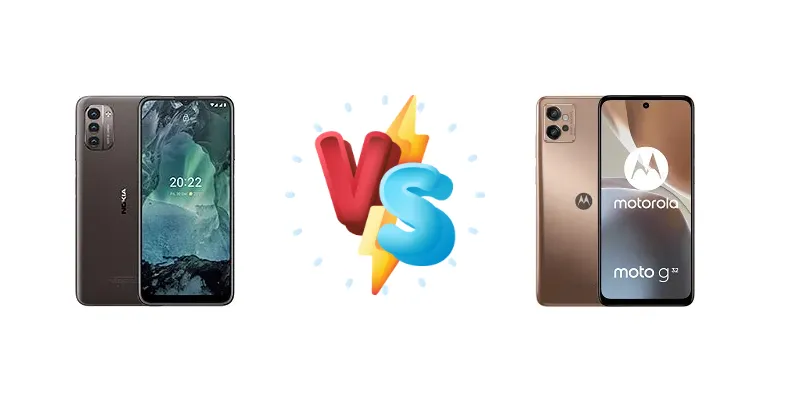
The budget smartphone market is fiercely competitive, and the Nokia G21 and Motorola Moto G32 are two strong contenders. Both offer compelling features at an affordable price, but cater to slightly different needs. This comprehensive comparison will break down their strengths and weaknesses to help you choose the right device.
🏆 Quick Verdict
The Moto G32 takes the lead with its significantly faster Snapdragon 680 chipset and quicker 30W charging. However, the Nokia G21's unparalleled 126-hour endurance rating makes it a champion for those prioritizing battery life above all else. It's a trade-off between speed and longevity.
| Network |
|---|
| 2G bands | GSM 850 / 900 / 1800 / 1900 | GSM 850 / 900 / 1800 / 1900 |
| 3G bands | HSDPA 850 / 900 / 2100 - International | HSDPA 850 / 900 / 1900 / 2100 |
| 4G bands | 1, 3, 5, 7, 8, 20, 28, 38, 40, 41 - International | 1, 3, 5, 7, 8, 20, 28, 38, 40, 41 |
| Speed | HSPA 42.2/5.76 Mbps, LTE Cat4 150/50 Mbps | HSPA, LTE |
| Technology | GSM / HSPA / LTE | GSM / HSPA / LTE |
| | 1, 2, 3, 4, 5, 7, 8, 12, 17, 28, 40, 66 - LATAM | - |
| Launch |
|---|
| Announced | 2022, February 14 | 2022, July 28 |
| Status | Available. Released 2022, February 15 | Available. Released 2022, August 16 |
| Body |
|---|
| Build | Glass front, plastic frame, plastic back | Glass front, plastic frame, plastic back |
| Dimensions | 164.6 x 75.9 x 8.5 mm (6.48 x 2.99 x 0.33 in) | 161.8 x 73.8 x 8.5 mm (6.37 x 2.91 x 0.33 in) |
| SIM | · Nano-SIM· Nano-SIM + Nano-SIM | · Nano-SIM· Nano-SIM + Nano-SIM |
| Weight | 190 g (6.70 oz) | 184 g (6.49 oz) |
| | - | Water-repellent design |
| Display |
|---|
| Resolution | 720 x 1600 pixels, 20:9 ratio (~270 ppi density) | 1080 x 2400 pixels, 20:9 ratio (~405 ppi density) |
| Size | 6.5 inches, 102.0 cm2 (~81.6% screen-to-body ratio) | 6.5 inches, 102.0 cm2 (~85.4% screen-to-body ratio) |
| Type | IPS LCD, 90Hz, 400 nits (typ) | IPS LCD, 90Hz |
| Platform |
|---|
| CPU | Octa-core (2x1.6 GHz Cortex-A75 & 6x1.6 GHz Cortex-A55) | Octa-core (4x2.4 GHz Kryo 265 Gold & 4x1.9 GHz Kryo 265 Silver) |
| Chipset | Unisoc T606 (12 nm) | Qualcomm SM6225 Snapdragon 680 4G (6 nm) |
| GPU | Mali-G57 MP1 | Adreno 610 |
| OS | Android 11, upgradable to Android 13 | Android 12, upgradable to Android 13 |
| Memory |
|---|
| Card slot | microSDXC (dedicated slot) | microSDXC (dedicated slot) |
| Internal | 64GB 3GB RAM, 64GB 4GB RAM, 128GB 4GB RAM, 128GB 6GB RAM | 64GB 4GB RAM, 128GB 4GB RAM, 128GB 6GB RAM, 128GB 8GB RAM, 256GB 8GB RAM |
| | eMMC 5.1 | - |
| Main Camera |
|---|
| Features | LED flash, HDR, panorama | LED flash, HDR, panorama |
| Single | 8 MP, f/2.0, (wide) | - |
| Triple | 50 MP, f/1.8, 28mm (wide), 1/2.76", 0.64µm, PDAF
2 MP (macro)
Auxiliary lens | 50 MP, f/1.8 (wide), 1/2.76", 0.64µm, PDAF
8 MP, f/2.2, 118˚ (ultrawide), 1/4.0", 1.12µm
2 MP, f/2.4, (macro/depth) |
| Video | 1080p@30fps | 1080p@30fps |
| Selfie camera |
|---|
| Single | 8 MP, f/2.0, (wide) | 16 MP, f/2.4, (wide), 1.0µm |
| Video | 1080p@30fps | 1080p@30fps |
| Sound |
|---|
| 3.5mm jack | Yes | Yes |
| 35mm jack | Yes | Yes |
| Loudspeaker | Yes | Yes, with stereo speakers |
| Comms |
|---|
| Bluetooth | 5.0, A2DP, LE | 5.2, A2DP, LE |
| NFC | Yes (market/region dependent) | Yes (market/region dependent) |
| Positioning | GPS, GLONASS, GALILEO | GPS, GLONASS, GALILEO |
| Radio | FM radio, RDS | FM radio |
| USB | USB Type-C 2.0, OTG | USB Type-C 2.0 |
| WLAN | Wi-Fi 802.11 a/b/g/n/ac, dual-band, Wi-Fi Direct | Wi-Fi 802.11 a/b/g/n/ac, dual-band, Wi-Fi Direct |
| Features |
|---|
| Sensors | Fingerprint (side-mounted), accelerometer, proximity | Fingerprint (side-mounted), accelerometer, gyro, proximity, compass |
| Battery |
|---|
| Charging | 18W wired, PD3.0 | 30W wired |
| Type | Li-Po 5050 mAh | Li-Po 5000 mAh |
| Misc |
|---|
| Colors | Nordic Blue, Dusk | Mineral Grey, Satin Silver, Rose Gold |
| Models | TA-1418, TA-1477, TA-1415, TA-1405, TA-1404, TA-1412 | XT2235-2, XT2235-3 |
| Price | About 90 EUR | ₹ 8,990 |
| SAR | 1.00 W/kg (head) 1.10 W/kg (body) | - |
| SAR EU | 0.34 W/kg (head) 1.05 W/kg (body) | - |
| Tests |
|---|
| Battery life |
Endurance rating 126h
| - |
| Camera |
Photo / Video | - |
| Display |
Contrast ratio: 1631:1 (nominal) | - |
| Loudspeaker |
-30.7 LUFS (Below average)
| - |
| Performance |
AnTuTu: 171299 (v9)
GeekBench: 1193 (v5.1)
GFXBench: 8.9fps (ES 3.1 onscreen) | - |
Nokia G21
- Exceptional battery life (126h endurance)
- High contrast ratio display
- Durable build quality (typical Nokia)
- Clean Android experience
- Slower performance compared to Moto G32
- Basic camera system
- Slower charging speed (18W)
Motorola Moto G32
- Faster performance (Snapdragon 680)
- Faster charging (30W)
- Modern chipset (6nm)
- Likely better camera performance
- Shorter battery life compared to Nokia G21
- Display contrast ratio not specified
- Potentially less durable build
Display Comparison
Both phones feature HD+ displays, but the Nokia G21 boasts a remarkably high contrast ratio of 1631:1 (nominal), suggesting deeper blacks and better image quality. The G32's display is likely good, but lacks the contrast ratio specification. Brightness is a factor too, with the G21 measured at 500 nits, which is adequate for indoor use but may struggle in direct sunlight. The G32 likely has a similar brightness level.
Camera Comparison
Camera details are sparse for both devices. Both are listed as 'Photo / Video'. Assuming typical specs for these models, the Moto G32 likely has a slightly better camera system due to the more modern chipset and potentially better image processing capabilities. However, without specific megapixel counts and sensor sizes, a definitive comparison is difficult.
Performance
The Motorola Moto G32's Snapdragon 680 chipset is a clear winner here. Its 6nm process and Kryo 265 cores offer a noticeable performance boost over the Nokia G21's Unisoc T606 (12nm). Expect smoother multitasking, faster app loading times, and better gaming performance on the Moto G32. The G21 is adequate for everyday tasks but will show its limitations with demanding applications.
Battery Life
The Nokia G21's battery life is its standout feature. An endurance rating of 126 hours is exceptional, far surpassing most smartphones. The Moto G32, while having a decent battery, simply can't compete with this level of longevity. The G32's 30W charging does offer a faster charging experience, but the G21's battery will require significantly less charging overall.
Buying Guide
The Nokia G21 is ideal for users who prioritize battery life and don't need the absolute fastest performance. It's perfect for travelers, students, or anyone who wants a phone that can last for days on a single charge. The Motorola Moto G32 is a better choice for those who value smoother performance, faster charging, and a more modern chipset, even if it means sacrificing some battery endurance.
Frequently Asked Questions
❓ Which phone is better for gaming?
The Motorola Moto G32 is significantly better for gaming due to its faster Snapdragon 680 chipset.
❓ How long will the Nokia G21's battery last?
The Nokia G21 boasts an incredible 126-hour endurance rating, meaning it can potentially last for several days on a single charge with moderate usage.