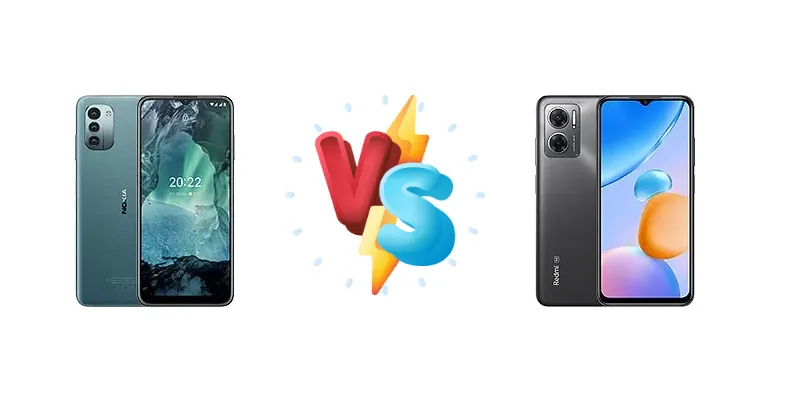
The sub-$200 5G smartphone market is heating up, and the Nokia G11 and Xiaomi Redmi 10 5G are two key players. Both aim to deliver 5G connectivity without breaking the bank, but they take different approaches to achieving this. This comparison dissects their core components to determine which phone offers the best balance of performance, features, and value.
🏆 Quick Verdict
For most users, the Xiaomi Redmi 10 5G emerges as the stronger choice. Its Mediatek Dimensity 700 chipset, built on a more efficient 7nm process, provides a noticeable performance advantage over the Nokia G11’s Unisoc T606, making it better suited for demanding tasks and gaming. While both offer 18W charging, the Redmi 10 5G’s superior processing power justifies its slight price premium.
| Network |
|---|
| 2G bands | GSM 850 / 900 / 1800 / 1900 | GSM 850 / 900 / 1800 / 1900 |
| 3G bands | HSDPA 850 / 900 / 2100 | HSDPA 850 / 900 / 1700(AWS) / 1900 / 2100 |
| 4G bands | 1, 3, 5, 7, 8, 20, 28, 38, 40, 41 | 1, 2, 3, 4, 5, 7, 8, 20, 28, 38, 40, 41 |
| 5G bands | - | 1, 3, 5, 7, 8, 20, 28, 38, 40, 41, 77, 78 SA/NSA |
| Speed | HSPA 42.2/5.76 Mbps, LTE Cat4 150/50 Mbps | HSPA, LTE, 5G |
| Technology | GSM / HSPA / LTE | GSM / HSPA / LTE / 5G |
| | eMMC 5.1 | - |
| Launch |
|---|
| Announced | 2022, February 15 | 2022, March 29 |
| Status | Available. Released 2022, March 24 | Available. Released 2022, September 23 |
| Body |
|---|
| Build | Glass front, plastic frame, plastic back | - |
| Dimensions | 164.6 x 75.9 x 8.5 mm (6.48 x 2.99 x 0.33 in) | 164 x 76.1 x 8.9 mm (6.46 x 3.00 x 0.35 in) |
| SIM | · Nano-SIM· Nano-SIM + Nano-SIM | Nano-SIM + Nano-SIM |
| Weight | 189 g (6.67 oz) | 200 g (7.05 oz) |
| Display |
|---|
| Protection | - | Corning Gorilla Glass 3 |
| Resolution | 720 x 1600 pixels, 20:9 ratio (~270 ppi density) | 1080 x 2408 pixels, 20:9 ratio (~401 ppi density) |
| Size | 6.5 inches, 102.0 cm2 (~81.6% screen-to-body ratio) | 6.58 inches, 104.3 cm2 (~83.6% screen-to-body ratio) |
| Type | IPS LCD, 90Hz | IPS LCD, 90Hz |
| Platform |
|---|
| CPU | Octa-core (2x1.6 GHz Cortex-A75 & 6x1.6 GHz Cortex-A55) | Octa-core (2x2.2 GHz Cortex-A76 & 6x2.0 GHz Cortex-A55) |
| Chipset | Unisoc T606 (12 nm) | Mediatek Dimensity 700 (7 nm) |
| GPU | Mali-G57 MP1 | Mali-G57 MC2 |
| OS | Android 11 | Android 12, MIUI 13 |
| Memory |
|---|
| Card slot | microSDXC (dedicated slot) | microSDXC (dedicated slot) |
| Internal | 32GB 3GB RAM, 64GB 3GB RAM, 64GB 4GB RAM | 64GB 4GB RAM, 128GB 4GB RAM, 128GB 6GB RAM |
| | - | UFS 2.2 |
| Main Camera |
|---|
| Dual | - | 50 MP, f/1.8, (wide), PDAF
Auxiliary lens |
| Features | LED flash | LED flash, HDR, panorama |
| Single | 8 MP, (wide) | 5 MP, f/2.2 |
| Triple | 13 MP, PDAF
2 MP (macro)
Auxiliary lens | - |
| Video | 1080p@30fps | 1080p@30fps |
| Selfie camera |
|---|
| Features | - | HDR |
| Single | 8 MP, (wide) | 5 MP, f/2.2 |
| Video | 1080p@30fps | 1080p@30fps |
| Sound |
|---|
| 3.5mm jack | Yes | Yes |
| 35mm jack | Yes | Yes |
| Loudspeaker | Yes | Yes |
| | - | 24-bit/192kHz audio |
| Comms |
|---|
| Bluetooth | 5.0, A2DP, LE | 5.1, A2DP, LE |
| Infrared port | - | Yes |
| NFC | Yes (market/region dependent) | Yes (market/region dependent) |
| Positioning | GPS, GLONASS, GALILEO | GPS, GLONASS, BDS, GALILEO |
| Radio | FM radio | FM radio |
| USB | USB Type-C 2.0, OTG | USB Type-C 2.0, OTG |
| WLAN | Wi-Fi 802.11 a/b/g/n/ac, dual-band, Wi-Fi Direct | Wi-Fi 802.11 a/b/g/n/ac, dual-band, Wi-Fi Direct |
| Features |
|---|
| Sensors | Fingerprint (side-mounted), accelerometer, proximity | Fingerprint (side-mounted), accelerometer, proximity, compass |
| Battery |
|---|
| Charging | 18W wired, PD3.0 | 18W wired |
| Type | Li-Po 5050 mAh | Li-Po 5000 mAh |
| Misc |
|---|
| Colors | Charcoal, Ice | Graphite Gray, Chrome Silver, Aurora Green |
| Models | TA-1401 | 22041219G, 22041219NY |
| Price | About 100 EUR | About 100 EUR |
| SAR | - | 1.09 W/kg (head) 1.09 W/kg (body) |
| SAR EU | 0.47 W/kg (head) 1.10 W/kg (body) | 0.60 W/kg (head) 0.99 W/kg (body) |
Nokia G11
- Potential for longer software support from Nokia.
- Clean, near-stock Android experience.
- Competitive price point.
- Less powerful Unisoc T606 chipset.
- 12nm process leads to lower efficiency.
- Likely inferior gaming performance.
Xiaomi Redmi 10 5G
- More powerful Mediatek Dimensity 700 chipset.
- 7nm process for improved efficiency.
- Better performance for gaming and multitasking.
- Xiaomi’s MIUI software can be resource-intensive.
- Potentially shorter software support lifecycle.
- May be slightly more expensive.
Display Comparison
Neither phone boasts a standout display. Both likely utilize LCD panels, a common cost-saving measure in this segment. However, the lack of detailed display specs (resolution, brightness) necessitates a focus on the chipset’s ability to drive the UI smoothly. The Redmi 10 5G’s more powerful GPU will likely translate to a more fluid experience when scrolling and navigating the interface, even if the panel itself is similar in quality to the Nokia G11’s.
Camera Comparison
Without detailed camera specs beyond the presence of cameras, a direct comparison is difficult. However, the Redmi 10 5G likely benefits from Mediatek’s image signal processor (ISP) integrated within the Dimensity 700, potentially offering better image processing capabilities. The Nokia G11 relies on the Unisoc T606’s ISP, which is generally considered less sophisticated. It’s reasonable to assume the Redmi 10 5G will deliver more detailed and vibrant photos, especially in challenging lighting conditions. The prevalence of 2MP macro lenses on both devices suggests they are largely marketing features with limited practical utility.
Performance
The core difference lies in the chipsets. The Xiaomi Redmi 10 5G’s Mediatek Dimensity 700, fabricated on a 7nm process, is significantly more efficient and powerful than the Nokia G11’s Unisoc T606 (12nm). The Dimensity 700’s Cortex-A76 cores, clocked at 2.2 GHz, offer a substantial performance uplift over the G11’s Cortex-A75 cores at 1.6 GHz. This translates to faster app loading times, smoother multitasking, and a better gaming experience on the Redmi 10 5G. The 7nm process also contributes to better thermal management, reducing the likelihood of performance throttling during sustained workloads.
Battery Life
Both phones feature 18W wired charging, suggesting similar charging speeds. The actual 0-100% charge time will depend on battery capacity (not specified) and charging implementation. However, the Redmi 10 5G’s more efficient Dimensity 700 chipset will likely result in better battery life overall. A more efficient processor consumes less power during everyday tasks, allowing the Redmi 10 5G to potentially last longer on a single charge, even with a similar battery capacity to the Nokia G11.
Buying Guide
Buy the Nokia G11 if you prioritize a potentially longer software support commitment from Nokia and a slightly more conservative, stock-Android-like experience. It’s a good option for users who primarily need a reliable phone for basic communication and light tasks. Buy the Xiaomi Redmi 10 5G if you value performance and 5G responsiveness. It’s ideal for users who stream videos, play mobile games, or frequently use data-intensive applications, and want a more powerful processor for the price.
Frequently Asked Questions
❓ Will the Redmi 10 5G’s Dimensity 700 overheat during prolonged gaming sessions?
The Dimensity 700’s 7nm process is designed for efficiency and thermal management. While some heat generation is inevitable during gaming, it’s unlikely to overheat significantly, and the phone should maintain stable performance for extended periods. The Nokia G11’s 12nm Unisoc T606 is more prone to throttling under sustained load.
❓ How does Xiaomi’s MIUI software affect the Redmi 10 5G’s performance compared to the Nokia G11’s cleaner Android build?
MIUI is a feature-rich but often resource-intensive skin. While it offers customization options, it can consume more RAM and processing power than the near-stock Android experience on the Nokia G11. However, the Redmi 10 5G’s significantly more powerful chipset can largely offset this overhead, still delivering a smoother overall experience.
❓ Is the 5G connectivity on both phones equally reliable?
Both phones support 5G, but the actual 5G performance will depend on network availability and signal strength in your area. The Dimensity 700 in the Redmi 10 5G generally has a more robust 5G modem, potentially offering slightly faster and more stable connections in fringe areas.