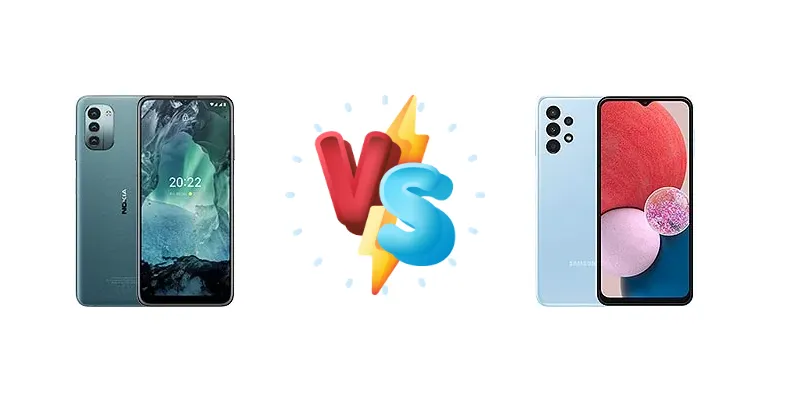
The Nokia G11 and Samsung Galaxy A13 (SM-A137) represent two compelling options in the ultra-budget smartphone space. Both aim to deliver essential smartphone functionality at a price point that won't break the bank, but they achieve this with different approaches to chipset selection and feature prioritization. This comparison dissects the core differences to help you determine which device best suits your needs.
🏆 Quick Verdict
For the average user prioritizing sustained performance and faster charging, the Samsung Galaxy A13 emerges as the better choice. Its Helio G80 chipset, with slightly higher clocked Cortex-A75 cores, provides a noticeable edge in application loading and multitasking, while the 15W charging, though slower than the Nokia's PD3.0 capability, is more readily supported by common chargers.
| Network |
|---|
| 2G bands | GSM 850 / 900 / 1800 / 1900 | GSM 850 / 900 / 1800 / 1900 |
| 3G bands | HSDPA 850 / 900 / 2100 | HSDPA 850 / 900 / 2100 |
| 4G bands | 1, 3, 5, 7, 8, 20, 28, 38, 40, 41 | 1, 3, 5, 7, 8, 20, 28, 38, 40, 41 |
| Speed | HSPA 42.2/5.76 Mbps, LTE Cat4 150/50 Mbps | HSPA, LTE |
| Technology | GSM / HSPA / LTE | GSM / HSPA / LTE |
| | eMMC 5.1 | - |
| Launch |
|---|
| Announced | 2022, February 15 | 2022, June |
| Status | Available. Released 2022, March 24 | Available. Released 2022, July |
| Body |
|---|
| Build | Glass front, plastic frame, plastic back | Glass front (Gorilla Glass 5), plastic frame, plastic back |
| Dimensions | 164.6 x 75.9 x 8.5 mm (6.48 x 2.99 x 0.33 in) | 165.1 x 76.4 x 8.8 mm (6.5 x 3.01 x 0.35 in) |
| SIM | · Nano-SIM· Nano-SIM + Nano-SIM | · Nano-SIM· Nano-SIM + Nano-SIM |
| Weight | 189 g (6.67 oz) | 195 g (6.88 oz) |
| Display |
|---|
| Protection | - | Corning Gorilla Glass 5 |
| Resolution | 720 x 1600 pixels, 20:9 ratio (~270 ppi density) | 1080 x 2408 pixels, 20:9 ratio (~400 ppi density) |
| Size | 6.5 inches, 102.0 cm2 (~81.6% screen-to-body ratio) | 6.6 inches, 104.9 cm2 (~83.2% screen-to-body ratio) |
| Type | IPS LCD, 90Hz | PLS LCD |
| Platform |
|---|
| CPU | Octa-core (2x1.6 GHz Cortex-A75 & 6x1.6 GHz Cortex-A55) | Octa-core (2x2.0 GHz Cortex-A75 & 6x1.8 GHz Cortex-A55) |
| Chipset | Unisoc T606 (12 nm) | Mediatek MT6769V/CU Helio G80 (12 nm) |
| GPU | Mali-G57 MP1 | Mali-G52 MC2 |
| OS | Android 11 | Android 12, upgradable to Android 14, One UI 6.1 |
| Memory |
|---|
| Card slot | microSDXC (dedicated slot) | microSDXC (dedicated slot) |
| Internal | 32GB 3GB RAM, 64GB 3GB RAM, 64GB 4GB RAM | 32GB 3GB RAM, 32GB 4GB RAM, 64GB 4GB RAM, 128GB 4GB RAM |
| | - | eMMC 5.1 |
| Main Camera |
|---|
| Features | LED flash | LED flash, panorama, HDR |
| Quad | - | 50 MP, f/1.8, (wide), PDAF
5 MP, f/2.2, 123˚ (ultrawide), 1/5.0", 1.12µm
2 MP (macro)
Auxiliary lens |
| Single | 8 MP, (wide) | 8 MP, f/2.2, (wide) |
| Triple | 13 MP, PDAF
2 MP (macro)
Auxiliary lens | - |
| Video | 1080p@30fps | 1080p@30fps |
| Selfie camera |
|---|
| Single | 8 MP, (wide) | 8 MP, f/2.2, (wide) |
| Video | 1080p@30fps | 1080p@30fps |
| Sound |
|---|
| 3.5mm jack | Yes | Yes |
| 35mm jack | Yes | Yes |
| Loudspeaker | Yes | Yes |
| Comms |
|---|
| Bluetooth | 5.0, A2DP, LE | 5.2, A2DP, LE |
| NFC | Yes (market/region dependent) | Yes |
| Positioning | GPS, GLONASS, GALILEO | GPS, GLONASS, GALILEO, BDS |
| Radio | FM radio | No |
| USB | USB Type-C 2.0, OTG | USB Type-C 2.0, OTG |
| WLAN | Wi-Fi 802.11 a/b/g/n/ac, dual-band, Wi-Fi Direct | Wi-Fi 802.11 a/b/g/n/ac, dual-band, Wi-Fi Direct |
| Features |
|---|
| Sensors | Fingerprint (side-mounted), accelerometer, proximity | Fingerprint (side-mounted), accelerometer, compass |
| | - | Virtual proximity sensing |
| Battery |
|---|
| Charging | 18W wired, PD3.0 | 15W wired |
| Type | Li-Po 5050 mAh | Li-Po 5000 mAh |
| Misc |
|---|
| Colors | Charcoal, Ice | Black, White, Blue |
| Models | TA-1401 | SM-A137F, SM-A137F/DSN, SM-A137F/DS |
| Price | About 100 EUR | About 180 EUR |
| SAR EU | 0.47 W/kg (head) 1.10 W/kg (body) | 0.35 W/kg (head) 1.22 W/kg (body) |
Nokia G11
- Potential for faster charging with PD3.0
- Nokia's commitment to software updates (potentially)
- More environmentally conscious brand image
- Slightly slower CPU performance compared to the Galaxy A13
- Unisoc chipset may have less optimized software support
Samsung Galaxy A13 (SM-A137)
- Slightly better CPU performance with the Helio G80
- Wider availability of accessories and support
- Samsung's established software ecosystem
- Slower charging speed (15W)
- Samsung's software can be bloated with pre-installed apps
Display Comparison
Neither device boasts a standout display. Both likely utilize LCD panels, typical for this price bracket. Detailed specs like resolution and peak brightness are missing, but we can infer similar performance. The focus here isn't on visual fidelity, but rather basic usability. Bezels are likely comparable, and color accuracy will be standard for budget phones – adequate for everyday use but not ideal for color-critical work.
Camera Comparison
Camera performance will be largely dependent on software processing, but the hardware provides clues. Detailed sensor information is absent, but both phones likely feature a primary camera accompanied by auxiliary lenses of limited utility (often 2MP macro or depth sensors). The image signal processor (ISP) within the Helio G80 may offer slightly better noise reduction and dynamic range compared to the Unisoc T606, but the difference will be marginal. Expect acceptable results in good lighting conditions, but struggles in low-light scenarios on both devices.
Performance
The core difference lies in the chipsets. The Samsung Galaxy A13’s MediaTek Helio G80 (12nm) features 2x2.0 GHz Cortex-A75 cores and 6x1.8 GHz Cortex-A55 cores, while the Nokia G11 utilizes the Unisoc T606 (12nm) with 2x1.6 GHz Cortex-A75 cores and 6x1.6 GHz Cortex-A55 cores. The higher clock speeds on the A75 cores in the Helio G80 translate to a tangible performance advantage in CPU-intensive tasks. While both use the same core architecture, the G80’s slight edge will be noticeable in app launch times and smoother multitasking. Both devices likely pair their chipsets with 3-4GB of RAM, further limiting performance headroom. Thermal management is unlikely to be a significant concern on either device given the modest processing power.
Battery Life
Both devices aim for all-day battery life. The Nokia G11 supports 18W wired charging with PD3.0, offering the *potential* for faster charging if paired with a compatible charger. However, the Samsung Galaxy A13 ships with a 15W charger. While slower, 15W is a more common standard, making it easier to find compatible chargers. The actual 0-100% charge time will depend on the charger used, but the Nokia G11 has the theoretical advantage with PD3.0, assuming you have the right adapter.
Buying Guide
Buy the Nokia G11 if you value the potential for faster charging speeds with a PD3.0 compatible charger and prefer a more environmentally conscious brand. Buy the Samsung Galaxy A13 (SM-A137) if you prioritize slightly better overall performance for everyday tasks and light gaming, and appreciate the wider availability of Samsung's ecosystem and support network.
Frequently Asked Questions
❓ Will the Unisoc T606 in the Nokia G11 struggle with popular apps like TikTok or Instagram?
While the Unisoc T606 can handle basic social media apps, you may experience occasional lag or slowdowns when multitasking or using more demanding features within those apps. The Helio G80 in the Galaxy A13 offers a smoother experience for these types of applications.
❓ Does the Samsung Galaxy A13 support any form of fast charging beyond the included 15W adapter?
The Samsung Galaxy A13 supports up to 15W charging. While it doesn't officially support higher wattage charging protocols, some users have reported success with compatible PD chargers, but results may vary and are not guaranteed. Using a higher wattage charger won't necessarily damage the phone, but it may not charge significantly faster.
❓ Is the difference in CPU clock speed between the two phones noticeable in real-world use?
Yes, the 2.0 GHz Cortex-A75 cores in the Helio G80 (Galaxy A13) provide a noticeable advantage over the 1.6 GHz cores in the Unisoc T606 (Nokia G11) when launching apps, switching between tasks, and general responsiveness. It won't be a massive difference, but it's perceptible.