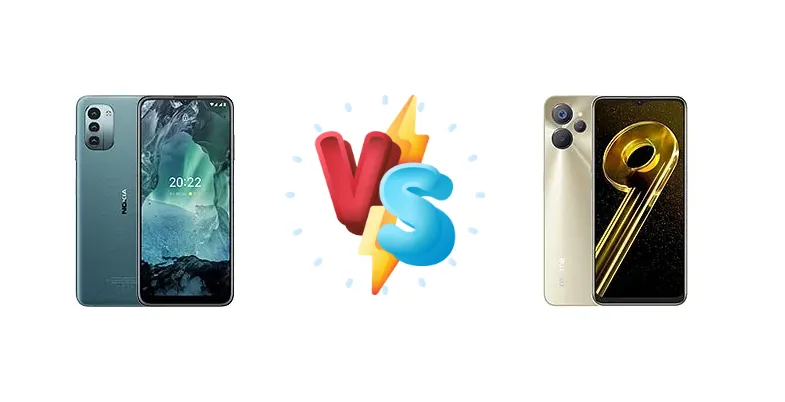
The sub-$200 smartphone market is fiercely competitive, and the Nokia G11 and Realme 9i 5G represent two compelling options. While both aim to deliver affordability, they take distinctly different approaches to achieving it. The Nokia G11 prioritizes software longevity and a familiar brand, while the Realme 9i 5G focuses on delivering the fastest possible performance within the price bracket, leveraging 5G connectivity.
🏆 Quick Verdict
For the average user prioritizing responsiveness and future-proofing with 5G, the Realme 9i 5G is the clear winner. Its Mediatek Dimensity 810 chipset offers a significant performance uplift over the Nokia G11’s Unisoc T606, making it better suited for gaming and demanding applications. However, the Nokia G11 remains a viable option for those seeking a simple, reliable experience.
| Network |
|---|
| 2G bands | GSM 850 / 900 / 1800 / 1900 | GSM 850 / 900 / 1800 / 1900 |
| 3G bands | HSDPA 850 / 900 / 2100 | HSDPA 850 / 900 / 1700(AWS) / 1900 / 2100 |
| 4G bands | 1, 3, 5, 7, 8, 20, 28, 38, 40, 41 | 1, 2, 3, 4, 5, 7, 8, 19, 20, 28, 34, 38, 39, 40, 41 |
| 5G bands | - | 1, 5, 7, 8, 28, 41, 77, 78 SA/NSA |
| Speed | HSPA 42.2/5.76 Mbps, LTE Cat4 150/50 Mbps | HSPA, LTE, 5G |
| Technology | GSM / HSPA / LTE | GSM / HSPA / LTE / 5G |
| | eMMC 5.1 | - |
| Launch |
|---|
| Announced | 2022, February 15 | 2022, August 18 |
| Status | Available. Released 2022, March 24 | Available. Released 2022, August 24 |
| Body |
|---|
| Build | Glass front, plastic frame, plastic back | - |
| Dimensions | 164.6 x 75.9 x 8.5 mm (6.48 x 2.99 x 0.33 in) | 164.4 x 75.1 x 8.1 mm (6.47 x 2.96 x 0.32 in) |
| SIM | · Nano-SIM· Nano-SIM + Nano-SIM | Nano-SIM + Nano-SIM |
| Weight | 189 g (6.67 oz) | 187 g (6.60 oz) |
| Display |
|---|
| Protection | - | Panda Glass |
| Resolution | 720 x 1600 pixels, 20:9 ratio (~270 ppi density) | 1080 x 2408 pixels, 20:9 ratio (~400 ppi density) |
| Size | 6.5 inches, 102.0 cm2 (~81.6% screen-to-body ratio) | 6.6 inches, 104.9 cm2 (~85.0% screen-to-body ratio) |
| Type | IPS LCD, 90Hz | IPS LCD, 90Hz, 400 nits (typ) |
| Platform |
|---|
| CPU | Octa-core (2x1.6 GHz Cortex-A75 & 6x1.6 GHz Cortex-A55) | Octa-core (2x2.4 GHz Cortex-A76 & 6x2.0 GHz Cortex-A55) |
| Chipset | Unisoc T606 (12 nm) | Mediatek Dimensity 810 (6 nm) |
| GPU | Mali-G57 MP1 | Mali-G57 MC2 |
| OS | Android 11 | Android 12, upgradable to Android 13, Realme UI 4.0 |
| Memory |
|---|
| Card slot | microSDXC (dedicated slot) | microSDXC (dedicated slot) |
| Internal | 32GB 3GB RAM, 64GB 3GB RAM, 64GB 4GB RAM | 64GB 4GB RAM, 128GB 4GB RAM, 128GB 6GB RAM |
| | - | UFS 2.2 |
| Main Camera |
|---|
| Features | LED flash | LED flash, HDR, panorama |
| Single | 8 MP, (wide) | 8 MP, f/2.0, 27mm (wide) |
| Triple | 13 MP, PDAF
2 MP (macro)
Auxiliary lens | 50 MP, f/1.8, 26mm (wide), 1/2.76", 0.64µm, PDAF
Unspecified MP, 46mm (telephoto)
2 MP (macro) |
| Video | 1080p@30fps | 1080p@30fps |
| Selfie camera |
|---|
| Features | - | HDR, panorama |
| Single | 8 MP, (wide) | 8 MP, f/2.0, 27mm (wide) |
| Video | 1080p@30fps | 1080p@30fps |
| Sound |
|---|
| 3.5mm jack | Yes | Yes |
| 35mm jack | Yes | Yes |
| Loudspeaker | Yes | Yes |
| Comms |
|---|
| Bluetooth | 5.0, A2DP, LE | 5.2, A2DP, LE |
| NFC | Yes (market/region dependent) | No |
| Positioning | GPS, GLONASS, GALILEO | GPS, GLONASS, GALILEO, BDS |
| Radio | FM radio | No |
| USB | USB Type-C 2.0, OTG | USB Type-C 2.0, OTG |
| WLAN | Wi-Fi 802.11 a/b/g/n/ac, dual-band, Wi-Fi Direct | Wi-Fi 802.11 a/b/g/n/ac, dual-band |
| Features |
|---|
| Sensors | Fingerprint (side-mounted), accelerometer, proximity | Fingerprint (side-mounted), accelerometer, proximity, compass |
| Battery |
|---|
| Charging | 18W wired, PD3.0 | 18W wired |
| Type | Li-Po 5050 mAh | 5000 mAh |
| Misc |
|---|
| Colors | Charcoal, Ice | Soulful Blue, Rocking Black, Gold |
| Models | TA-1401 | RMX3612 |
| Price | About 100 EUR | About 180 EUR |
| SAR EU | 0.47 W/kg (head) 1.10 W/kg (body) | - |
Nokia G11
- Potential for longer software support (Nokia's reputation)
- Clean Android experience (likely)
- Reliable brand reputation
- Significantly weaker performance
- Less efficient chipset
- Limited 5G capabilities
Realme 9i 5G
- Superior performance with Dimensity 810
- 5G connectivity for faster data speeds
- More efficient chipset for longer battery life
- Realme UI may not appeal to all users
- Potentially shorter software support lifecycle
- Build quality may be less premium
Display Comparison
Neither device boasts a standout display. Both likely utilize LCD panels, a common cost-saving measure in this segment. However, the Realme 9i 5G’s performance advantage extends to its display driver, potentially resulting in smoother scrolling and animations. Detailed display specs (resolution, brightness) are missing, but the Realme’s chipset is more capable of driving a higher refresh rate panel if one were present, offering a more fluid visual experience.
Camera Comparison
Without detailed camera specifications, a direct comparison is difficult. However, the chipset plays a role here. The Dimensity 810 includes a more powerful image signal processor (ISP) than the Unisoc T606, enabling faster image processing and potentially better low-light performance. It’s reasonable to assume the Realme 9i 5G will deliver superior image quality, particularly in challenging conditions. The presence of a dedicated ISP on the Dimensity 810 also allows for more advanced camera features.
Performance
The core difference lies in the chipsets. The Realme 9i 5G’s Mediatek Dimensity 810 (6nm) is a substantial upgrade over the Nokia G11’s Unisoc T606 (12nm). The 6nm process node allows for greater transistor density and improved power efficiency, translating to better sustained performance and less heat generation. The Dimensity 810’s Cortex-A76 cores, clocked at 2.4 GHz, are significantly faster than the G11’s Cortex-A75 cores at 1.6 GHz. This difference will be most noticeable in demanding tasks like gaming and video editing. The Realme 9i 5G will offer a smoother, more responsive experience overall.
Battery Life
Both phones feature 18W wired charging, suggesting similar charging speeds. While battery capacity isn’t specified, the Realme 9i 5G’s more efficient chipset will likely result in longer battery life despite potentially having a similar capacity. The 6nm process node of the Dimensity 810 consumes less power than the 12nm Unisoc T606, meaning more usage time between charges. The Realme 9i 5G’s power efficiency will be particularly noticeable during prolonged gaming or video streaming sessions.
Buying Guide
Buy the Nokia G11 if you need a phone with a focus on software updates and a clean Android experience, and if your usage is primarily limited to basic tasks like calling, texting, and light social media. Buy the Realme 9i 5G if you prioritize performance for gaming, streaming, and utilizing 5G networks, and are comfortable with Realme’s UI customizations.
Frequently Asked Questions
❓ Will the Realme 9i 5G overheat during extended gaming sessions?
The Mediatek Dimensity 810’s 6nm process node is more efficient than the Unisoc T606, meaning it generates less heat under load. While some throttling is inevitable, the 9i 5G is better equipped to handle prolonged gaming sessions without significant performance drops compared to the Nokia G11.
❓ Is the 5G connectivity on the Realme 9i 5G actually useful?
The usefulness of 5G depends on your location and carrier coverage. However, even in areas with limited 5G availability, the 9i 5G’s modem supports 4G LTE, and its faster processor will improve overall network performance and responsiveness compared to the Nokia G11.
❓ Does the Nokia G11 receive regular software updates?
Nokia has a generally good track record for providing software updates, even on their budget devices. While the update frequency may not match flagship phones, the G11 is likely to receive security patches and potentially Android version upgrades for a reasonable period.
❓ How does the Unisoc T606 perform with multitasking?
The Unisoc T606 is adequate for basic multitasking, such as switching between messaging apps and web browsing. However, it will struggle with more demanding tasks like running multiple apps simultaneously or editing large files. The Realme 9i 5G’s Dimensity 810 offers a significantly smoother multitasking experience.