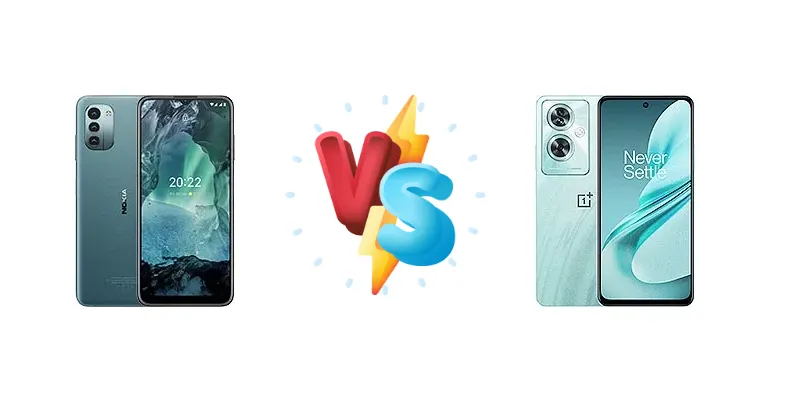
The sub-$200 smartphone market is fiercely competitive. The Nokia G11, known for its durability and software experience, faces off against the newer OnePlus Nord N30 SE, which prioritizes performance and charging speed. This comparison dissects the key differences to help you choose the right device for your needs.
🏆 Quick Verdict
For most users, the OnePlus Nord N30 SE is the better buy. Its Mediatek Dimensity 6020 chipset, built on a more efficient 7nm process, delivers significantly improved performance over the Nokia G11’s Unisoc T606. The faster 33W charging is a substantial advantage, offsetting the slightly smaller battery.
| Network |
|---|
| 2G bands | GSM 850 / 900 / 1800 / 1900 | GSM 850 / 900 / 1800 / 1900 |
| 3G bands | HSDPA 850 / 900 / 2100 | HSDPA 850 / 900 / 1700(AWS) / 1900 / 2100 |
| 4G bands | 1, 3, 5, 7, 8, 20, 28, 38, 40, 41 | 1, 2, 3, 4, 5, 7, 8, 12, 13, 17, 18, 19, 20, 26, 28, 38, 39, 40, 41, 66 |
| 5G bands | - | 1, 3, 5, 7, 8, 20, 28, 38, 40, 41, 66, 77, 78 SA/NSA |
| Speed | HSPA 42.2/5.76 Mbps, LTE Cat4 150/50 Mbps | HSPA, LTE, 5G |
| Technology | GSM / HSPA / LTE | GSM / HSPA / LTE / 5G |
| | eMMC 5.1 | - |
| Launch |
|---|
| Announced | 2022, February 15 | 2024, January 29 |
| Status | Available. Released 2022, March 24 | Available. Released 2024, January 31 |
| Body |
|---|
| Build | Glass front, plastic frame, plastic back | Glass front, plastic frame, plastic back |
| Dimensions | 164.6 x 75.9 x 8.5 mm (6.48 x 2.99 x 0.33 in) | 165.6 x 76 x 8 mm (6.52 x 2.99 x 0.31 in) |
| SIM | · Nano-SIM· Nano-SIM + Nano-SIM | Nano-SIM + Nano-SIM |
| Weight | 189 g (6.67 oz) | 193 g (6.81 oz) |
| Display |
|---|
| Resolution | 720 x 1600 pixels, 20:9 ratio (~270 ppi density) | 1080 x 2400 pixels, 20:9 ratio (~392 ppi density) |
| Size | 6.5 inches, 102.0 cm2 (~81.6% screen-to-body ratio) | 6.72 inches, 109.0 cm2 (~86.6% screen-to-body ratio) |
| Type | IPS LCD, 90Hz | IPS LCD |
| Platform |
|---|
| CPU | Octa-core (2x1.6 GHz Cortex-A75 & 6x1.6 GHz Cortex-A55) | Octa-core (2x2.2 GHz Cortex-A76 & 6x2.0 GHz Cortex-A55) |
| Chipset | Unisoc T606 (12 nm) | Mediatek Dimensity 6020 (7 nm) |
| GPU | Mali-G57 MP1 | Mali-G57 MC2 |
| OS | Android 11 | Android 13, OxygenOS 13.1 |
| Memory |
|---|
| Card slot | microSDXC (dedicated slot) | No |
| Internal | 32GB 3GB RAM, 64GB 3GB RAM, 64GB 4GB RAM | 128GB 4GB RAM |
| Main Camera |
|---|
| Dual | - | 50 MP, f/1.8, (wide), 1/2.76", 0.64µm, PDAF
Auxiliary lens |
| Features | LED flash | LED flash, HDR, panorama |
| Single | 8 MP, (wide) | - |
| Triple | 13 MP, PDAF
2 MP (macro)
Auxiliary lens | - |
| Video | 1080p@30fps | 1080p@30fps |
| Selfie camera |
|---|
| Single | 8 MP, (wide) | 8 MP, f/2.0, (wide), 1/4.0", 1.12µm |
| Video | 1080p@30fps | 1080p@30fps |
| Sound |
|---|
| 3.5mm jack | Yes | - |
| 35mm jack | Yes | Yes |
| Loudspeaker | Yes | Yes, with stereo speakers |
| Comms |
|---|
| Bluetooth | 5.0, A2DP, LE | 5.3, A2DP, LE |
| NFC | Yes (market/region dependent) | Yes |
| Positioning | GPS, GLONASS, GALILEO | GPS, GALILEO, GLONASS, BDS |
| Radio | FM radio | No |
| USB | USB Type-C 2.0, OTG | USB Type-C 2.0, OTG |
| WLAN | Wi-Fi 802.11 a/b/g/n/ac, dual-band, Wi-Fi Direct | Wi-Fi 802.11 a/b/g/n/ac, dual-band |
| Features |
|---|
| Sensors | Fingerprint (side-mounted), accelerometer, proximity | Fingerprint (side-mounted), accelerometer, gyro, proximity, compass |
| Battery |
|---|
| Charging | 18W wired, PD3.0 | 33W wired, 51% in 30 min |
| Type | Li-Po 5050 mAh | 5000 mAh |
| Misc |
|---|
| Colors | Charcoal, Ice | Black Satin, Cyan |
| Models | TA-1401 | CPH2605 |
| Price | About 100 EUR | About 510 EUR |
| SAR EU | 0.47 W/kg (head) 1.10 W/kg (body) | - |
Nokia G11
- Potentially longer software support from Nokia.
- Reliable brand reputation for durability.
- PD3.0 charging compatibility.
- Significantly slower performance due to the Unisoc T606 chipset.
- Slower 18W charging.
- Likely less efficient power consumption.
OnePlus Nord N30 SE
- Faster and more efficient Mediatek Dimensity 6020 chipset.
- 33W fast charging (51% in 30 minutes).
- Improved multitasking and gaming performance.
- OnePlus’s software update policy is less predictable than Nokia’s.
- Potentially shorter lifespan due to faster charging cycles.
- Build quality may not be as robust as the Nokia G11.
Display Comparison
Neither device boasts a standout display. Both likely utilize LCD panels, common in this price bracket. However, the focus here isn't display quality, but the underlying performance impact. Display specs are not provided, so we can only assume similar resolutions and refresh rates. The lack of high refresh rate panels on either device suggests a focus on battery conservation rather than visual fluidity.
Camera Comparison
Without detailed camera specifications, a direct comparison is difficult. However, the market segment suggests both phones will feature basic camera setups. The Nokia G11 likely emphasizes computational photography to enhance image quality, while the Nord N30 SE may lean towards a more natural look. The presence of a 2MP macro lens on either device is largely a marketing gimmick, offering limited practical benefit due to the small sensor size and lack of optical image stabilization (OIS).
Performance
The core difference lies in the chipsets. The OnePlus Nord N30 SE’s Mediatek Dimensity 6020 (7nm) is a clear upgrade over the Nokia G11’s Unisoc T606 (12nm). The 7nm fabrication process inherently offers better power efficiency and thermal performance, allowing the Dimensity 6020 to sustain higher clock speeds for longer. The CPU configuration – 2x2.2 GHz Cortex-A76 vs 2x1.6 GHz Cortex-A75 – further favors the Nord N30 SE, offering a noticeable boost in single-core and multi-core performance. This translates to snappier app launches, smoother multitasking, and a more enjoyable gaming experience.
Battery Life
The Nokia G11’s 18W charging, while supporting PD3.0, is significantly slower than the OnePlus Nord N30 SE’s 33W charging, which OnePlus claims reaches 51% in 30 minutes. This faster charging is a major convenience factor. While the G11 may have a slightly larger battery capacity (spec not provided), the Dimensity 6020’s superior power efficiency could negate that advantage, resulting in comparable real-world battery life despite the charging speed difference.
Buying Guide
Buy the Nokia G11 if you prioritize a proven, reliable brand with a focus on software updates and a longer-lasting device, and are willing to sacrifice performance. Buy the OnePlus Nord N30 SE if you value faster performance for gaming and multitasking, and appreciate the convenience of significantly quicker charging times, even if it means a potentially shorter software support lifespan.
Frequently Asked Questions
❓ Is the Mediatek Dimensity 6020 in the Nord N30 SE powerful enough for demanding games like PUBG Mobile?
Yes, the Dimensity 6020 is a significant step up from the Unisoc T606. While it won't deliver flagship-level performance, it should comfortably handle PUBG Mobile at medium settings with stable frame rates. The 7nm process also helps mitigate thermal throttling during extended gaming sessions.
❓ How long will it take to fully charge the Nokia G11 from 0% to 100%?
With its 18W charging, the Nokia G11 will likely take over 2 hours to fully charge from 0% to 100%. This is considerably slower than the OnePlus Nord N30 SE’s 33W charging, which can reach 51% in just 30 minutes.
❓ Does the OnePlus Nord N30 SE support 5G connectivity?
The name 'N30 SE' suggests 5G capability, as OnePlus typically reserves the 'SE' designation for their more affordable 5G models. However, this needs to be verified with official specifications, as it's not explicitly stated in the provided data.
❓ Which phone is likely to receive more software updates and security patches?
Nokia generally has a better track record for providing consistent software updates and security patches, even for their budget devices. OnePlus’s update policy can be less predictable, particularly for their 'SE' models.