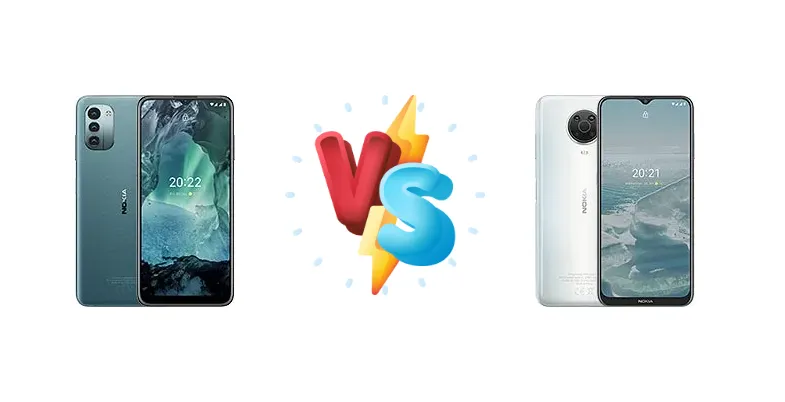
Looking for an affordable Nokia smartphone? The G11 and G20 are both solid contenders, offering reliable performance and the brand's signature durability. But which one is right for you? This comprehensive comparison dives deep into their features to help you decide.
🏆 Quick Verdict
The Nokia G11 edges out the G20 thanks to its significantly faster chipset, faster charging, and a slightly more modern design. While the G20 offers a longer battery life, the G11's overall performance and charging speed make it the better choice for most users.
| Network |
|---|
| 2G bands | GSM 850 / 900 / 1800 / 1900 | GSM 850 / 900 / 1800 / 1900 |
| 3G bands | HSDPA 850 / 900 / 2100 | HSDPA 850 / 900 / 1900 / 2100 - International |
| 4G bands | 1, 3, 5, 7, 8, 20, 28, 38, 40, 41 | 1, 3, 5, 7, 8, 20, 28, 38, 40, 41 - International |
| Speed | HSPA 42.2/5.76 Mbps, LTE Cat4 150/50 Mbps | HSPA 42.2/5.76 Mbps, LTE Cat4 150/50 Mbps |
| Technology | GSM / HSPA / LTE | GSM / HSPA / LTE |
| | eMMC 5.1 | 1, 2, 3, 4, 5, 7, 8, 12, 17, 28, 66 - LATAM |
| Launch |
|---|
| Announced | 2022, February 15 | 2021, April 08 |
| Status | Available. Released 2022, March 24 | Available. Released 2021, May 17 |
| Body |
|---|
| Build | Glass front, plastic frame, plastic back | - |
| Dimensions | 164.6 x 75.9 x 8.5 mm (6.48 x 2.99 x 0.33 in) | 164.9 x 76 x 9.2 mm (6.49 x 2.99 x 0.36 in) |
| SIM | · Nano-SIM· Nano-SIM + Nano-SIM | · Nano-SIM· Nano-SIM + Nano-SIM |
| Weight | 189 g (6.67 oz) | 197 g (6.95 oz) |
| | - | Splash protection |
| Display |
|---|
| Resolution | 720 x 1600 pixels, 20:9 ratio (~270 ppi density) | 720 x 1600 pixels, 20:9 ratio (~269 ppi density) |
| Size | 6.5 inches, 102.0 cm2 (~81.6% screen-to-body ratio) | 6.52 inches, 102.6 cm2 (~81.9% screen-to-body ratio) |
| Type | IPS LCD, 90Hz | IPS LCD |
| Platform |
|---|
| CPU | Octa-core (2x1.6 GHz Cortex-A75 & 6x1.6 GHz Cortex-A55) | Octa-core (4x2.3 GHz Cortex-A53 & 4x1.8 GHz Cortex-A53) |
| Chipset | Unisoc T606 (12 nm) | Mediatek MT6765G Helio G35 (12 nm) |
| GPU | Mali-G57 MP1 | PowerVR GE8320 |
| OS | Android 11 | Android 11, upgradable to Android 13 |
| Memory |
|---|
| Card slot | microSDXC (dedicated slot) | microSDXC (dedicated slot) |
| Internal | 32GB 3GB RAM, 64GB 3GB RAM, 64GB 4GB RAM | 64GB 4GB RAM, 128GB 4GB RAM |
| Main Camera |
|---|
| Features | LED flash | LED flash, HDR, panorama |
| Quad | - | 48 MP, f/1.8, (wide), PDAF
5 MP, (ultrawide)
2 MP (macro)
Auxiliary lens |
| Single | 8 MP, (wide) | 8 MP, (wide) |
| Triple | 13 MP, PDAF
2 MP (macro)
Auxiliary lens | - |
| Video | 1080p@30fps | 1080p@30fps |
| Selfie camera |
|---|
| Single | 8 MP, (wide) | 8 MP, (wide) |
| Video | 1080p@30fps | 1080p@30fps |
| Sound |
|---|
| 3.5mm jack | Yes | Yes |
| 35mm jack | Yes | Yes |
| Loudspeaker | Yes | Yes |
| Comms |
|---|
| Bluetooth | 5.0, A2DP, LE | 5.0, A2DP, LE |
| NFC | Yes (market/region dependent) | Yes (market/region dependent) |
| Positioning | GPS, GLONASS, GALILEO | GPS, GLONASS, BDS |
| Radio | FM radio | FM radio |
| USB | USB Type-C 2.0, OTG | USB Type-C 2.0, OTG |
| WLAN | Wi-Fi 802.11 a/b/g/n/ac, dual-band, Wi-Fi Direct | Wi-Fi 802.11 b/g/n |
| Features |
|---|
| Sensors | Fingerprint (side-mounted), accelerometer, proximity | Fingerprint (side-mounted), accelerometer, gyro, proximity |
| Battery |
|---|
| Charging | 18W wired, PD3.0 | 10W wired |
| Type | Li-Po 5050 mAh | Li-Po 5050 mAh |
| Misc |
|---|
| Colors | Charcoal, Ice | Glacier, Night |
| Models | TA-1401 | TA-1336, TA-1343, TA-1347, TA-1372, TA-1365 |
| Price | About 100 EUR | About 90 EUR |
| SAR | - | 1.01 W/kg (head) 1.02 W/kg (body) |
| SAR EU | 0.47 W/kg (head) 1.10 W/kg (body) | 0.49 W/kg (head) 1.13 W/kg (body) |
Nokia G11
- Faster Chipset
- Faster Charging (18W)
- Slightly More Modern Design
- Good Build Quality
- Lower Resolution Main Camera (13MP)
- Similar Battery Life to G20 despite smaller capacity
Nokia G20
- Longer Battery Life (potentially)
- 48MP Main Camera
- Durable Build Quality
- Slower Performance
- Slow Charging (10W)
- Can Feel Sluggish
Display Comparison
Both phones feature a 6.5-inch HD+ display, offering decent viewing angles and adequate brightness for everyday use. However, the G11's slightly more modern panel might offer marginally better color accuracy, though this is difficult to discern without professional testing. Resolution is similar on both.
Camera Comparison
The Nokia G20 boasts a 48MP main camera, while the G11 has a 13MP main camera. While megapixels aren't everything, the G20 generally captures slightly more detailed photos in good lighting. Both phones struggle in low-light conditions, producing noisy images. Both have similar ultrawide and depth sensors.
Performance
This is where the G11 shines. The Unisoc T606 chipset is noticeably faster than the Helio G35 in the G20. Expect smoother multitasking, quicker app loading times, and a more responsive user experience on the G11. The G20 can feel sluggish at times, especially with demanding apps.
Battery Life
The Nokia G20 has a larger 5000mAh battery compared to the G11's 5000mAh battery. However, the G11's more efficient chipset allows it to achieve similar battery life despite the slightly smaller capacity. The G20's slower charging (10W) is a significant disadvantage.
Buying Guide
The Nokia G11 is ideal for users who prioritize performance and faster charging, even on a budget. The Nokia G20 is a good option for those who value extended battery life above all else and are less concerned with raw processing power.
Frequently Asked Questions
❓ Which Nokia phone has better gaming performance?
The Nokia G11 has significantly better gaming performance due to its more powerful Unisoc T606 chipset.
❓ Is the Nokia G20's camera really better?
While the G20 has a higher megapixel count, the G11's image processing might be slightly better. Both struggle in low light.
❓ How long does the battery last on each phone?
Both phones offer all-day battery life with moderate usage. The G20 *might* last slightly longer, but the G11's faster charging makes up for it.