
Google Pixel 7a vs. Nokia G11: A Deep Dive into Performance and Value
| Phones Images | |||||
|---|---|---|---|---|---|
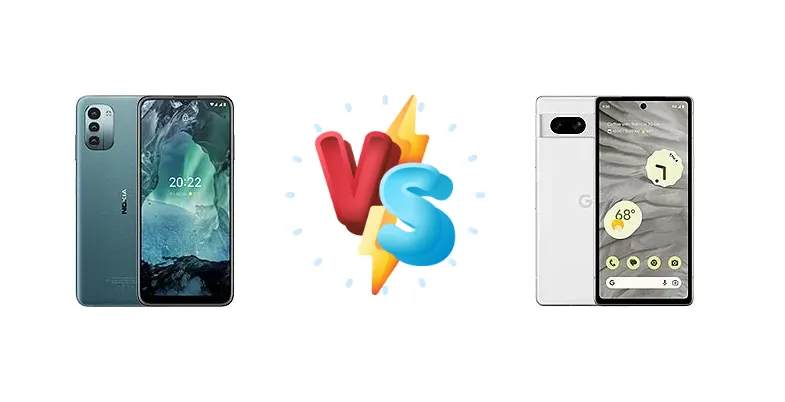
|
🏆 Quick Verdict
For most users, the Google Pixel 7a is the superior choice. Its Tensor G2 chipset delivers significantly faster performance and superior image processing, justifying the price premium. However, the Nokia G11 remains a compelling option for those prioritizing extreme budget consciousness and extended battery life over raw power.
| PHONES | ||
|---|---|---|
| Phone Names | Nokia G11 | Google Pixel 7a |
| Network | ||
|---|---|---|
| 2G bands | GSM 850 / 900 / 1800 / 1900 | GSM 850 / 900 / 1800 / 1900 |
| 3G bands | HSDPA 850 / 900 / 2100 | HSDPA 800 / 850 / 900 / 1700(AWS) / 1900 / 2100 |
| 4G bands | 1, 3, 5, 7, 8, 20, 28, 38, 40, 41 | 1, 2, 3, 4, 5, 7, 8, 12, 13, 14, 17, 20, 25, 26, 28, 29, 30, 38, 40, 41, 48, 66, 71 - GWKK3, G0DZQ |
| 5G bands | - | 1, 2, 3, 5, 7, 8, 12, 14, 20, 25, 28, 30, 38, 41, 48, 66, 71, 77, 78 SA/NSA/Sub6 - GWKK3 |
| Speed | HSPA 42.2/5.76 Mbps, LTE Cat4 150/50 Mbps | HSPA, LTE, 5G |
| Technology | GSM / HSPA / LTE | GSM / HSPA / LTE / 5G |
| eMMC 5.1 | 1, 2, 3, 5, 7, 8, 12, 20, 25, 28, 38, 40, 41, 66, 75, 76, 77, 78, 79 SA/NSA/Sub6 - GHL1X, G82U8 | |
| Launch | ||
|---|---|---|
| Announced | 2022, February 15 | 2023, May 10 |
| Status | Available. Released 2022, March 24 | Available. Released 2023, May 10 |
| Body | ||
|---|---|---|
| Build | Glass front, plastic frame, plastic back | Glass front (Gorilla Glass 3), aluminum frame, plastic back |
| Dimensions | 164.6 x 75.9 x 8.5 mm (6.48 x 2.99 x 0.33 in) | 152 x 72.9 x 9 mm (5.98 x 2.87 x 0.35 in) |
| SIM | · Nano-SIM· Nano-SIM + Nano-SIM | Nano-SIM + eSIM |
| Weight | 189 g (6.67 oz) | 193.5 g (6.84 oz) |
| - | IP67 dust/water resistant (up to 1m for 30 min) | |
| Display | ||
|---|---|---|
| Protection | - | Corning Gorilla Glass 3 |
| Resolution | 720 x 1600 pixels, 20:9 ratio (~270 ppi density) | 1080 x 2400 pixels, 20:9 ratio (~429 ppi density) |
| Size | 6.5 inches, 102.0 cm2 (~81.6% screen-to-body ratio) | 6.1 inches, 90.7 cm2 (~81.8% screen-to-body ratio) |
| Type | IPS LCD, 90Hz | OLED, HDR, 90Hz |
| - | Always-on display | |
| Platform | ||
|---|---|---|
| CPU | Octa-core (2x1.6 GHz Cortex-A75 & 6x1.6 GHz Cortex-A55) | Octa-core (2x2.85 GHz Cortex-X1 & 2x2.35 GHz Cortex-A78 & 4x1.80 GHz Cortex-A55) |
| Chipset | Unisoc T606 (12 nm) | Google Tensor G2 (5 nm) |
| GPU | Mali-G57 MP1 | Mali-G710 MP7 |
| OS | Android 11 | Android 13, upgradable to Android 15, up to 5 major Android upgrades |
| Memory | ||
|---|---|---|
| Card slot | microSDXC (dedicated slot) | No |
| Internal | 32GB 3GB RAM, 64GB 3GB RAM, 64GB 4GB RAM | 128GB 8GB RAM |
| - | UFS 3.1 | |
| Main Camera | ||
|---|---|---|
| Dual | - | 64 MP, f/1.9, 26mm (wide), 1/1.73", 0.8µm, dual pixel PDAF, OIS 13 MP, f/2.2, 120˚ (ultrawide), 1.12µm |
| Features | LED flash | Dual-LED flash, Pixel Shift, Auto-HDR, panorama |
| Single | 8 MP, (wide) | - |
| Triple | 13 MP, PDAF 2 MP (macro) Auxiliary lens | - |
| Video | 1080p@30fps | 4K@30/60fps, 1080p@30/60/120/240fps, OIS |
| Selfie camera | ||
|---|---|---|
| Features | - | HDR, panorama |
| Single | 8 MP, (wide) | 13 MP, f/2.2, 20mm (ultrawide), 1.12µm |
| Video | 1080p@30fps | 4K@30fps, 1080p@30fps |
| Sound | ||
|---|---|---|
| 3.5mm jack | Yes | No |
| 35mm jack | Yes | No |
| Loudspeaker | Yes | Yes, with stereo speakers |
| Comms | ||
|---|---|---|
| Bluetooth | 5.0, A2DP, LE | 5.3, A2DP, LE |
| NFC | Yes (market/region dependent) | Yes |
| Positioning | GPS, GLONASS, GALILEO | GPS, GLONASS, GALILEO, BDS, QZSS, NavIC |
| Radio | FM radio | No |
| USB | USB Type-C 2.0, OTG | USB Type-C 3.2 |
| WLAN | Wi-Fi 802.11 a/b/g/n/ac, dual-band, Wi-Fi Direct | Wi-Fi 802.11 a/b/g/n/ac/6e, tri-band |
| Features | ||
|---|---|---|
| Sensors | Fingerprint (side-mounted), accelerometer, proximity | Fingerprint (under display, optical), accelerometer, gyro, proximity, compass, barometer |
| Battery | ||
|---|---|---|
| Charging | 18W wired, PD3.0 | 18W wired, PD3.0 7.5W wireless |
| Type | Li-Po 5050 mAh | Li-Po 4385 mAh |
| Misc | ||
|---|---|---|
| Colors | Charcoal, Ice | Charcoal, Snow, Sea, Coral |
| Models | TA-1401 | GWKK3, GHL1X, G0DZQ, G82U8 |
| Price | About 100 EUR | € 179.90 / $ 150.00 / £ 170.00 / ₹ 25,980 |
| SAR EU | 0.47 W/kg (head) 1.10 W/kg (body) | - |
Nokia G11
- Significantly faster performance with the Tensor G2 chip
- Superior camera quality and Google’s image processing
- Wireless charging support
- Brighter and more vibrant display
- Higher price point
- Potentially shorter battery life compared to the Nokia G11
Google Pixel 7a
- Exceptional battery life
- Very affordable price
- Durable build quality (typical of Nokia)
- Clean and simple Android experience
- Slow performance with the Unisoc T606 chipset
- Inferior camera quality
- Less vibrant display
Display Comparison
The Pixel 7a boasts a significantly brighter display, reaching a measured 1070 nits, compared to an assumed lower brightness on the Nokia G11 (typical of its price bracket). This translates to far better visibility outdoors. While both likely utilize LCD panels, the Pixel 7a’s higher peak brightness and potentially superior color calibration offer a more vibrant and enjoyable viewing experience. The Nokia G11’s display is likely focused on efficiency to conserve battery, potentially at the expense of color accuracy and viewing angles.
Camera Comparison
The Pixel 7a’s camera system is a clear standout. While specific sensor details are missing for the Nokia G11, it’s safe to assume it utilizes a more modest setup. The Pixel 7a benefits from Google’s renowned computational photography, leveraging the Tensor G2’s image signal processor (ISP) for exceptional image quality, particularly in low-light conditions. Features like Magic Eraser and Photo Unblur further enhance the Pixel 7a’s photographic capabilities. The Nokia G11 will likely offer acceptable image quality in good lighting, but will fall far behind the Pixel 7a in dynamic range, detail, and low-light performance. The Pixel 7a also excels in video recording, offering superior stabilization and dynamic range.
Performance
The performance gap between these devices is substantial. The Google Pixel 7a’s Tensor G2, built on a 5nm process, features a tri-cluster configuration with high-performance Cortex-X1 cores clocked at 2.85 GHz. This contrasts sharply with the Nokia G11’s Unisoc T606 (12nm), which relies on older Cortex-A75 and A55 cores clocked at 1.6 GHz. The Tensor G2’s architectural advantages and smaller fabrication node result in significantly faster CPU and GPU performance, enabling smoother multitasking, faster app loading times, and a more responsive user experience. The Nokia G11 will handle basic tasks adequately, but will struggle with demanding games or resource-intensive applications.
Battery Life
The Pixel 7a had an endurance rating of 76 hours in older tests, suggesting good, but not exceptional, battery life. The Nokia G11, while lacking a specific endurance rating, is likely to offer longer battery life due to its less power-hungry chipset and display. Both phones support 18W wired charging with PD3.0, meaning similar charging speeds. The Pixel 7a adds 7.5W wireless charging, a convenience feature absent on the Nokia G11. The trade-off is clear: the Pixel 7a offers faster processing and a better camera, while the Nokia G11 prioritizes longevity between charges.
Buying Guide
Buy the Nokia G11 if you need a reliably functional smartphone for basic tasks – calls, texts, light browsing – and prioritize maximum battery life and affordability above all else. You’ll appreciate its durability and simple software experience. Buy the Google Pixel 7a if you value a premium camera experience, smooth performance for demanding apps, and access to Google’s latest AI-powered features, even if it means spending more and potentially sacrificing some battery endurance.