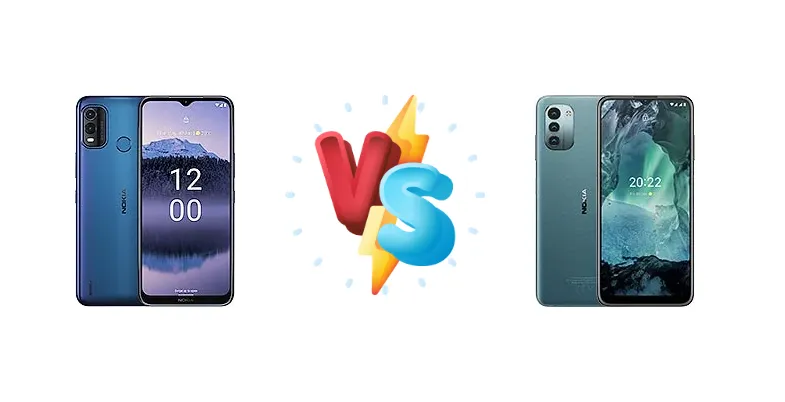
The Nokia G11 and G11 Plus are both budget-friendly smartphones aiming to deliver reliable performance and essential features. But with subtle differences, choosing between them can be tricky. This comprehensive comparison will dissect their strengths and weaknesses to help you make the right decision.
🏆 Quick Verdict
The Nokia G11 edges out the G11 Plus thanks to its significantly faster 18W charging. While both share the same Unisoc T606 chipset, the G11's quicker charging speeds provide a noticeable advantage in daily use, making it the better value proposition.
| Network |
|---|
| 2G bands | GSM 850 / 900 / 1800 / 1900 | GSM 850 / 900 / 1800 / 1900 |
| 3G bands | HSDPA 850 / 900 / 2100 - International | HSDPA 850 / 900 / 2100 |
| 4G bands | 1, 3, 5, 7, 8, 20, 28, 38, 40, 41 - International | 1, 3, 5, 7, 8, 20, 28, 38, 40, 41 |
| Speed | HSPA 42.2/5.76 Mbps, LTE Cat4 150/50 Mbps | HSPA 42.2/5.76 Mbps, LTE Cat4 150/50 Mbps |
| Technology | GSM / HSPA / LTE | GSM / HSPA / LTE |
| | 1, 3, 5, 8, 40, 41 - India | eMMC 5.1 |
| Launch |
|---|
| Announced | 2022, June 29 | 2022, February 15 |
| Status | Available. Released 2022, July 20 | Available. Released 2022, March 24 |
| Body |
|---|
| Build | Glass front, plastic frame, plastic back | Glass front, plastic frame, plastic back |
| Dimensions | 164.8 x 75.9 x 8.6 mm (6.49 x 2.99 x 0.34 in) | 164.6 x 75.9 x 8.5 mm (6.48 x 2.99 x 0.33 in) |
| SIM | · Nano-SIM· Nano-SIM + Nano-SIM | · Nano-SIM· Nano-SIM + Nano-SIM |
| Weight | 192 g (6.77 oz) | 189 g (6.67 oz) |
| | Splash protection | - |
| Display |
|---|
| Resolution | 720 x 1600 pixels, 20:9 ratio (~269 ppi density) | 720 x 1600 pixels, 20:9 ratio (~270 ppi density) |
| Size | 6.52 inches, 102.6 cm2 (~82.1% screen-to-body ratio) | 6.5 inches, 102.0 cm2 (~81.6% screen-to-body ratio) |
| Type | IPS LCD, 90Hz, 400 nits (typ) | IPS LCD, 90Hz |
| Platform |
|---|
| CPU | Octa-core (2x1.6 GHz Cortex-A75 & 6x1.6 GHz Cortex-A55) | Octa-core (2x1.6 GHz Cortex-A75 & 6x1.6 GHz Cortex-A55) |
| Chipset | Unisoc T606 (12 nm) | Unisoc T606 (12 nm) |
| GPU | Mali-G57 MP1 | Mali-G57 MP1 |
| OS | Android 12, upgradable to Android 13 | Android 11 |
| Memory |
|---|
| Card slot | microSDXC (dedicated slot) | microSDXC (dedicated slot) |
| Internal | 32GB 3GB RAM, 64GB 3GB RAM, 64GB 4GB RAM, 128GB 3GB RAM | 32GB 3GB RAM, 64GB 3GB RAM, 64GB 4GB RAM |
| | eMMC 5.1 | - |
| Main Camera |
|---|
| Dual | 50 MP, f/1.8, (wide), 1/2.67", PDAF
Auxiliary lens | - |
| Features | LED flash | LED flash |
| Single | 8 MP, f/2.0, (wide), 1/4.0" | 8 MP, (wide) |
| Triple | - | 13 MP, PDAF
2 MP (macro)
Auxiliary lens |
| Video | 1080p@30fps | 1080p@30fps |
| Selfie camera |
|---|
| Single | 8 MP, f/2.0, (wide), 1/4.0" | 8 MP, (wide) |
| Video | 1080p@30fps | 1080p@30fps |
| Sound |
|---|
| 3.5mm jack | Yes | Yes |
| 35mm jack | Yes | Yes |
| Loudspeaker | Yes | Yes |
| Comms |
|---|
| Bluetooth | 5.0, A2DP, LE | 5.0, A2DP, LE |
| NFC | No | Yes (market/region dependent) |
| Positioning | GPS | GPS, GLONASS, GALILEO |
| Radio | FM radio | FM radio |
| USB | USB Type-C 2.0, OTG | USB Type-C 2.0, OTG |
| WLAN | Wi-Fi 802.11 a/b/g/n/ac, dual-band, Wi-Fi Direct | Wi-Fi 802.11 a/b/g/n/ac, dual-band, Wi-Fi Direct |
| Features |
|---|
| Sensors | Fingerprint (rear-mounted), accelerometer, proximity | Fingerprint (side-mounted), accelerometer, proximity |
| Battery |
|---|
| Charging | 10W wired | 18W wired, PD3.0 |
| Type | Li-Ion 5000 mAh | Li-Po 5050 mAh |
| Misc |
|---|
| Colors | Lake Blue, Charcoal Grey | Charcoal, Ice |
| Models | - | TA-1401 |
| Price | About 130 EUR | About 100 EUR |
| SAR EU | - | 0.47 W/kg (head) 1.10 W/kg (body) |
Nokia G11 Plus
- Potentially lower price
- Large 6.53-inch display
- Reliable Nokia build quality
- Slow 10W charging
- Unisoc T606 chipset (limited performance)
- Basic camera system
Nokia G11
- Faster 18W charging with PD3.0
- Reliable Nokia build quality
- Large 6.53-inch display
- Unisoc T606 chipset (limited performance)
- Basic camera system
- May be slightly more expensive
Display Comparison
Both phones feature a 6.53-inch FHD+ display, likely with similar color accuracy and brightness. The G11 Plus might have a slightly different panel, but the difference is unlikely to be substantial. Expect decent viewing angles and sharpness for everyday use.
Camera Comparison
Both devices likely feature a similar camera setup, typically a 50MP main sensor, a 2MP depth sensor, and a 2MP macro lens. Image quality will be adequate in good lighting conditions, but low-light performance will be limited. Video recording capabilities will likely be capped at 1080p.
Performance
Powered by the same Unisoc T606 chipset, expect comparable performance in everyday tasks like browsing, social media, and light gaming. Don't expect flagship-level speeds; these phones are designed for efficiency rather than raw power. Multitasking will be adequate but may show some slowdown with many apps open.
Battery Life
The Nokia G11 boasts a 5000mAh battery, while the G11 Plus also has a 5000mAh battery. However, the charging speed is the key differentiator. The G11's 18W charging is significantly faster than the G11 Plus's 10W, meaning quicker top-ups and less time tethered to a charger.
Buying Guide
Who should buy the Nokia G11 Plus? Those prioritizing a slightly larger screen and potentially a lower price (if available at a discount) might consider it. Who should buy the Nokia G11? Users who value faster charging and a more modern charging standard (PD3.0) will find the G11 a more compelling choice.
Frequently Asked Questions
❓ Is the Unisoc T606 a good chipset for gaming?
No, the Unisoc T606 is not ideal for demanding games. It's suitable for casual games and basic tasks but will struggle with graphically intensive titles.
❓ What does PD3.0 charging mean?
PD3.0 (Power Delivery 3.0) is a fast-charging standard that allows for quicker charging speeds and more efficient power transfer. It's a more modern standard than the G11 Plus's 10W charging.