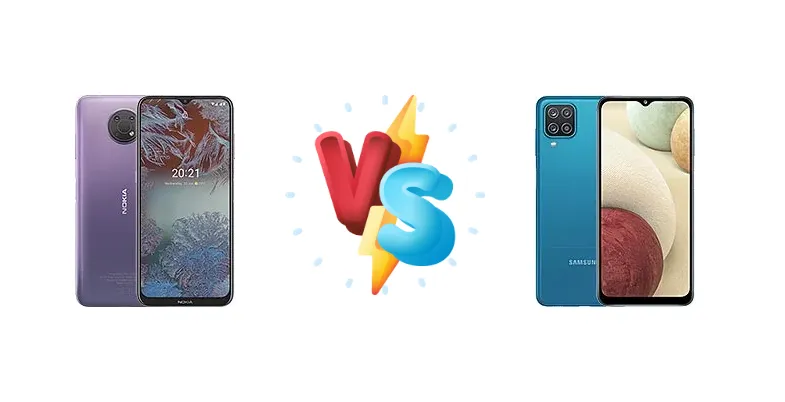
The sub-₹15,000 (approximately $180 USD) smartphone market in India is fiercely competitive. Both the Nokia G10 and the Samsung Galaxy A12 (India variant) aim to deliver essential smartphone functionality at an accessible price. However, they take different approaches to achieving this, primarily through their chipset choices. This comparison dives deep into the architectural differences and real-world implications of the Mediatek Helio G25 versus the Samsung Exynos 850.
🏆 Quick Verdict
For the average user prioritizing consistent performance and slightly faster charging, the Samsung Galaxy A12 (India) is the better choice. Its Exynos 850, built on an 8nm process, offers a noticeable advantage over the Nokia G10’s 12nm Helio G25, translating to smoother multitasking and a more responsive user experience.
| Network |
|---|
| 2G bands | GSM 850 / 900 / 1800 / 1900 | GSM 850 / 900 / 1800 / 1900 |
| 3G bands | HSDPA 850 / 900 / 2100 - ROW | HSDPA 850 / 900 / 2100 |
| 4G bands | 1, 3, 5, 7, 8, 20, 28, 38, 40, 41 - ROW | 1, 3, 5, 7, 8, 20, 28, 38, 40, 41 |
| Speed | HSPA 42.2/5.76 Mbps, LTE Cat4 150/50 Mbps | HSPA 42.2/5.76 Mbps, LTE Cat4 150/50 Mbps |
| Technology | GSM / HSPA / LTE | GSM / HSPA / LTE |
| | 1, 2, 3, 4, 5, 7, 8, 12, 17, 28, 66 - LATAM | - |
| Launch |
|---|
| Announced | 2021, April 08 | 2021, August 12 |
| Status | Available. Released 2021, April 26 | Available. Released 2021, August 12 |
| Body |
|---|
| Build | - | Glass front, plastic back, plastic frame |
| Dimensions | 164.9 x 76 x 9.2 mm (6.49 x 2.99 x 0.36 in) | 164 x 75.8 x 8.9 mm (6.46 x 2.98 x 0.35 in) |
| SIM | · Nano-SIM· Nano-SIM + Nano-SIM | · Nano-SIM· Nano-SIM + Nano-SIM |
| Weight | 194 g (6.84 oz) | 205 g (7.23 oz) |
| | Splash protection | - |
| Display |
|---|
| Resolution | 720 x 1600 pixels, 20:9 ratio (~269 ppi density) | 720 x 1600 pixels, 20:9 ratio (~270 ppi density) |
| Size | 6.52 inches, 102.6 cm2 (~81.9% screen-to-body ratio) | 6.5 inches, 102.0 cm2 (~82.1% screen-to-body ratio) |
| Type | IPS LCD | PLS LCD |
| Platform |
|---|
| CPU | Octa-core (4x2.0 GHz Cortex-A53 & 4x1.5 GHz Cortex-A53) | Octa-core (4x2.0 GHz Cortex-A55 & 4x2.0 GHz Cortex-A55) |
| Chipset | Mediatek MT6762G Helio G25 (12 nm) | Exynos 850 (8 nm) |
| GPU | PowerVR GE8320 | Mali-G52 |
| OS | Android 11, upgradable to Android 13 | Android 11, upgradable to Android 13, One UI 5.1 |
| Memory |
|---|
| Card slot | microSDXC (dedicated slot) | microSDXC (dedicated slot) |
| Internal | 32GB 3GB RAM, 32GB 4GB RAM, 64GB 3GB RAM, 64GB 4GB RAM | 64GB 4GB RAM, 128GB 4GB RAM, 128GB 6GB RAM |
| | eMMC 5.1 | eMMC 5.1 |
| Main Camera |
|---|
| Features | LED flash, HDR, panorama | LED flash, panorama, HDR |
| Quad | - | 48 MP, f/2.0, 26mm (wide), AF
5 MP, f/2.2, 123˚ (ultrawide)
2 MP (macro)
Auxiliary lens |
| Single | 8 MP, (wide) | - |
| Triple | 13 MP, (wide), AF
2 MP (macro)
Auxiliary lens | - |
| Video | 1080p@30fps | 1080p@30fps |
| Selfie camera |
|---|
| Single | 8 MP, (wide) | 8 MP, f/2.2 |
| Video | 1080p@30fps | 1080p@30fps |
| Sound |
|---|
| 3.5mm jack | Yes | Yes |
| 35mm jack | Yes | Yes |
| Loudspeaker | Yes | Yes |
| Comms |
|---|
| Bluetooth | 5.0, A2DP, LE | 5.0, A2DP, LE |
| NFC | No | No |
| Positioning | GPS, GLONASS, BDS | GPS, GLONASS, GALILEO, BDS |
| Radio | FM radio | FM radio, RDS, recording |
| USB | USB Type-C 2.0, OTG | USB Type-C 2.0 |
| WLAN | Wi-Fi 802.11 b/g/n | Wi-Fi 802.11 b/g/n, Wi-Fi Direct |
| Features |
|---|
| Sensors | Fingerprint (side-mounted), accelerometer, proximity | Fingerprint (side-mounted), accelerometer |
| | - | Virtual proximity sensing |
| Battery |
|---|
| Charging | 10W wired | 15W wired |
| Type | Li-Po 5050 mAh | Li-Po 5000 mAh |
| Misc |
|---|
| Colors | Dusk, Night | Black, Blue, White |
| Models | TA-1334, TA-1351, TA-1346, TA-1338 | SM-A127F, SM-A127F/DS |
| Price | About 110 EUR | About 160 EUR |
| SAR | 1.06 W/kg (head) 1.51 W/kg (body) | 0.79 W/kg (head) |
| SAR EU | 0.46 W/kg (head) 1.51 W/kg (body) | - |
Nokia G10
- Clean Android experience with guaranteed updates
- Potentially longer software support
- Lower price point (potentially)
- Less powerful processor (Helio G25)
- Slower charging (10W)
- Potentially less responsive UI
Samsung Galaxy A12 (India)
- More powerful processor (Exynos 850)
- Faster charging (15W)
- Established brand ecosystem
- Samsung’s One UI can be resource intensive
- Potentially shorter software support compared to Nokia
- May be slightly more expensive
Display Comparison
Neither device boasts a particularly impressive display. Both likely utilize LCD panels, a common cost-saving measure in this segment. However, the lack of detailed display specs (resolution, brightness) necessitates focusing on the chipset's ability to drive the UI smoothly. The Exynos 850’s more efficient architecture may contribute to a slightly more fluid scrolling experience, even if the panels themselves are similar. Bezels are expected to be substantial on both devices, reflecting their budget positioning.
Camera Comparison
Camera performance is likely to be similar, with both phones relying on budget sensors and image processing. Without specific sensor details, it’s difficult to make definitive claims. However, the Exynos 850’s image signal processor (ISP) is likely more capable than the Helio G25’s, potentially leading to slightly better dynamic range and noise reduction in photos. The prevalence of 2MP macro and depth sensors on both devices suggests these are largely marketing features and offer limited practical benefit. Focusing on the main sensor’s quality (which is unspecified) is crucial for assessing real-world image quality.
Performance
The core difference lies in the chipsets. The Samsung Galaxy A12’s Exynos 850, fabricated on an 8nm process, is a significant step up from the Nokia G10’s 12nm Mediatek Helio G25. While both are octa-core CPUs, the Exynos 850 utilizes newer Cortex-A55 cores across all eight cores, compared to the G25’s mix of A53 cores. This architectural improvement, coupled with the smaller fabrication node, results in better power efficiency and sustained performance. The G25’s older A53 cores will likely struggle with demanding multitasking or graphically intensive applications. Users intending to play PUBG Mobile or similar titles will find the A12 a more playable experience, even if settings need to be reduced.
Battery Life
Both phones offer adequate battery capacity for all-day use with moderate usage. The Nokia G10’s 10W charging is significantly slower than the Samsung Galaxy A12’s 15W charging. This translates to a longer time to fully recharge the device. While the Helio G25’s lower power consumption might slightly offset the slower charging, the A12’s faster charging is a tangible benefit for users who frequently need to top up their battery.
Buying Guide
Buy the Nokia G10 if you prioritize a clean Android experience with guaranteed software updates and are willing to trade some performance for potentially longer software support. Buy the Samsung Galaxy A12 (India) if you prefer a more established brand ecosystem, need slightly better performance for everyday tasks and light gaming, and value the faster 15W charging.
Frequently Asked Questions
❓ Does the Exynos 850 in the Galaxy A12 (India) overheat during prolonged gaming sessions?
While the Exynos 850 isn't a flagship processor, its 8nm fabrication process and efficient design mitigate thermal throttling. Expect some warming during extended gaming, but it's unlikely to reach critical temperatures that cause significant performance drops. The Nokia G10’s Helio G25, while less powerful, may also throttle under sustained load due to its less efficient architecture.
❓ Are the 2MP macro and depth cameras on either phone actually useful for taking good photos?
Generally, no. 2MP macro cameras typically lack the detail and clarity needed for truly impressive macro shots. Depth sensors assist with portrait mode effects, but software algorithms have largely replaced the need for dedicated depth sensors. Don't base your purchasing decision on these cameras.
❓ Can the Samsung Galaxy A12 (India) run PUBG Mobile smoothly?
Yes, but with caveats. The Exynos 850 can run PUBG Mobile, but you'll likely need to use lower graphics settings (Balanced or Low) and frame rate settings to maintain a stable experience. Expect frame drops during intense firefights. The Nokia G10 will struggle significantly with PUBG Mobile, even on the lowest settings.
❓ How long will it take to fully charge each phone from 0%?
With the 15W charger, the Samsung Galaxy A12 (India) should fully charge in approximately 2.5 - 3 hours. The Nokia G10, with its 10W charging, will take considerably longer, likely around 4-5 hours to reach 100%.