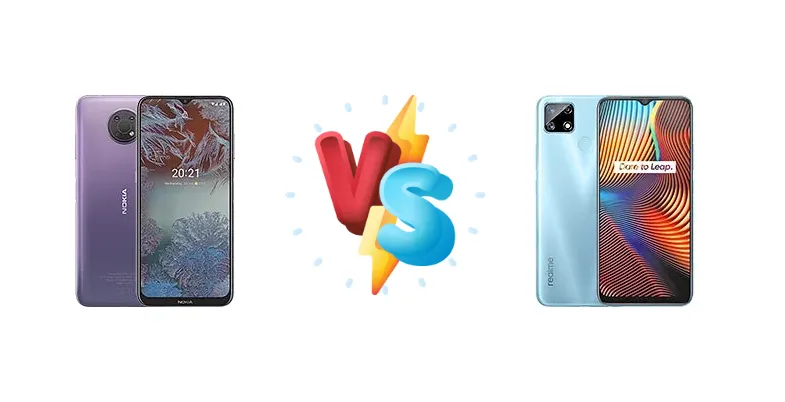
The Nokia G10 and Realme 7i (Global) represent two compelling options in the ultra-budget smartphone space. While both aim to deliver essential smartphone functionality at a low price point, they diverge significantly in their internal hardware, particularly in chipset and charging capabilities. This comparison will dissect these differences to determine which device offers the best value for your money.
🏆 Quick Verdict
For most users, the Realme 7i is the superior choice. Its Helio G85 chipset, featuring more powerful Cortex-A75 cores, delivers noticeably better performance for gaming and multitasking. The 18W charging also significantly reduces downtime compared to the Nokia G10’s sluggish 10W charging.
| Network |
|---|
| 2G bands | GSM 850 / 900 / 1800 / 1900 | GSM 850 / 900 / 1800 / 1900 |
| 3G bands | HSDPA 850 / 900 / 2100 - ROW | HSDPA 850 / 900 / 1700(AWS) / 1900 / 2100 |
| 4G bands | 1, 3, 5, 7, 8, 20, 28, 38, 40, 41 - ROW | 1, 2, 3, 4, 5, 7, 8, 20, 28, 38, 40, 41 |
| Speed | HSPA 42.2/5.76 Mbps, LTE Cat4 150/50 Mbps | HSPA, LTE |
| Technology | GSM / HSPA / LTE | GSM / HSPA / LTE |
| | 1, 2, 3, 4, 5, 7, 8, 12, 17, 28, 66 - LATAM | - |
| Launch |
|---|
| Announced | 2021, April 08 | 2020, December 22. Released 2020, December 23 |
| Status | Available. Released 2021, April 26 | Discontinued |
| Body |
|---|
| Dimensions | 164.9 x 76 x 9.2 mm (6.49 x 2.99 x 0.36 in) | 164.5 x 75.9 x 9.8 mm (6.48 x 2.99 x 0.39 in) |
| SIM | · Nano-SIM· Nano-SIM + Nano-SIM | Nano-SIM + Nano-SIM |
| Weight | 194 g (6.84 oz) | 208 g (7.34 oz) |
| | Splash protection | - |
| Display |
|---|
| Resolution | 720 x 1600 pixels, 20:9 ratio (~269 ppi density) | 720 x 1600 pixels, 20:9 ratio (~270 ppi density) |
| Size | 6.52 inches, 102.6 cm2 (~81.9% screen-to-body ratio) | 6.5 inches, 102.0 cm2 (~81.7% screen-to-body ratio) |
| Type | IPS LCD | IPS LCD, 450 nits (typ), 560 nits (peak) |
| Platform |
|---|
| CPU | Octa-core (4x2.0 GHz Cortex-A53 & 4x1.5 GHz Cortex-A53) | Octa-core (2x2.0 GHz Cortex-A75 & 6x1.8 GHz Cortex-A55) |
| Chipset | Mediatek MT6762G Helio G25 (12 nm) | Mediatek MT6769Z Helio G85 (12 nm) |
| GPU | PowerVR GE8320 | Mali-G52 MC2 |
| OS | Android 11, upgradable to Android 13 | Android 10, Realme UI |
| Memory |
|---|
| Card slot | microSDXC (dedicated slot) | microSDXC (dedicated slot) |
| Internal | 32GB 3GB RAM, 32GB 4GB RAM, 64GB 3GB RAM, 64GB 4GB RAM | 64GB 4GB RAM |
| | eMMC 5.1 | eMMC 5.1 |
| Main Camera |
|---|
| Features | LED flash, HDR, panorama | LED flash, HDR, panorama |
| Single | 8 MP, (wide) | - |
| Triple | 13 MP, (wide), AF
2 MP (macro)
Auxiliary lens | 48 MP, f/1.8, 26mm (wide), 1/2.0", 0.8µm, PDAF
8 MP, f/2.3, 16mm, 119˚ (ultrawide), 1/4.0", 1.12µm
2 MP (macro) |
| Video | 1080p@30fps | 1080p@30/60fps |
| Selfie camera |
|---|
| Features | - | HDR, panorama |
| Single | 8 MP, (wide) | 8 MP, f/2.0, 26mm (wide), 1/4.0", 1.12µm |
| Video | 1080p@30fps | 1080p@30fps |
| Sound |
|---|
| 3.5mm jack | Yes | Yes |
| 35mm jack | Yes | Yes |
| Loudspeaker | Yes | Yes |
| Comms |
|---|
| Bluetooth | 5.0, A2DP, LE | 5.0, A2DP, LE, aptX HD |
| NFC | No | No |
| Positioning | GPS, GLONASS, BDS | GPS, GLONASS, BDS |
| Radio | FM radio | FM radio |
| USB | USB Type-C 2.0, OTG | USB Type-C 2.0, OTG |
| WLAN | Wi-Fi 802.11 b/g/n | Wi-Fi 802.11 a/b/g/n/ac, dual-band, Wi-Fi Direct |
| Features |
|---|
| Sensors | Fingerprint (side-mounted), accelerometer, proximity | Fingerprint (rear-mounted), accelerometer, proximity, compass |
| Battery |
|---|
| Charging | 10W wired | 18W wired
5W reverse wired |
| Type | Li-Po 5050 mAh | 6000 mAh |
| Misc |
|---|
| Colors | Dusk, Night | Glory Silver, Victory Blue |
| Models | TA-1334, TA-1351, TA-1346, TA-1338 | - |
| Price | About 110 EUR | About 190 EUR |
| SAR | 1.06 W/kg (head) 1.51 W/kg (body) | - |
| SAR EU | 0.46 W/kg (head) 1.51 W/kg (body) | - |
Nokia G10
- Potentially cleaner Android experience (Nokia's strength)
- Likely longer software support from Nokia
- May prioritize battery efficiency over performance
- Significantly weaker processor (Helio G25)
- Slow 10W charging
- Less responsive user experience
Realme 7i (Global)
- More powerful processor (Helio G85)
- Faster 18W charging with reverse charging
- Better performance for gaming and multitasking
- Realme's UI may include bloatware
- Potentially shorter software support compared to Nokia
Display Comparison
Neither device boasts a standout display. Both utilize 12nm chipsets, suggesting similar power constraints impacting display capabilities. While specific display specs (resolution, brightness) are not provided, the Realme 7i’s focus on performance suggests a potentially more responsive panel. The Nokia G10 likely prioritizes power efficiency over display quality, potentially resulting in lower peak brightness and less vibrant colors. Bezels are likely comparable given the price bracket.
Camera Comparison
Without detailed camera sensor information, a direct comparison is difficult. However, the Realme 7i’s overall performance focus suggests a more capable image signal processor (ISP) within the Helio G85. This could translate to faster image processing and potentially better low-light performance. The Nokia G10, prioritizing cost savings, likely employs a more basic ISP. The presence of a 2MP macro lens on both devices is largely a marketing gimmick; image quality from these sensors is typically poor. Focus should be on the main sensor's capabilities, which are not specified in the provided data.
Performance
The core difference lies in the chipsets. The Realme 7i’s Mediatek Helio G85 utilizes two Cortex-A75 cores clocked at 2.0 GHz alongside six Cortex-A55 cores, offering a substantial performance advantage over the Nokia G10’s Helio G25. The G25 relies on four Cortex-A53 cores at 2.0 GHz and another four at 1.5 GHz. The A75 cores in the G85 provide significantly improved single-core performance, crucial for app launch speeds and general responsiveness. The G85 also benefits from a more modern CPU architecture (A75 vs A53), translating to better efficiency and sustained performance. This difference will be most noticeable in demanding applications and games.
Battery Life
Both devices likely feature similar battery capacities given their market segment, but the Realme 7i’s 18W charging is a game-changer. The Nokia G10’s 10W charging is significantly slower, meaning longer periods tethered to a power outlet. While a larger battery capacity on the Nokia G10 might offer slightly longer overall runtime, the convenience of faster charging on the Realme 7i is a significant advantage for users who are frequently on the go. The Realme 7i also supports 5W reverse wired charging, a feature absent on the Nokia G10, allowing it to top up accessories like earbuds.
Buying Guide
Buy the Nokia G10 if your priority is a clean Android experience and long-term software support, and you primarily use your phone for basic tasks like calls, messaging, and light social media. Buy the Realme 7i (Global) if you prioritize performance for gaming, streaming, or multitasking, and value faster charging to minimize downtime. The Realme 7i is the better option for users who demand more from their smartphone.
Frequently Asked Questions
❓ Will the Realme 7i overheat during extended gaming sessions?
The Helio G85 is designed for gaming, but sustained high performance can generate heat. Realme typically implements thermal management solutions, but prolonged gaming at maximum settings may lead to some throttling. The Nokia G10's weaker processor is less likely to overheat, but also offers a significantly less enjoyable gaming experience.
❓ Is the 5W reverse charging on the Realme 7i useful for everyday use?
The 5W reverse charging is primarily useful for topping up accessories like wireless earbuds or a smartwatch. It's not designed to quickly charge another phone, but it provides a convenient way to share a small amount of power in a pinch. The Nokia G10 lacks this feature entirely.
❓ How does the software experience differ between the Nokia G10 and Realme 7i?
The Nokia G10 runs a near-stock version of Android, offering a clean and uncluttered user experience with a focus on timely updates. The Realme 7i utilizes Realme UI, which is based on Android but includes customizations and pre-installed apps (bloatware). While Realme UI offers additional features, some users may prefer the simplicity of Nokia's approach.