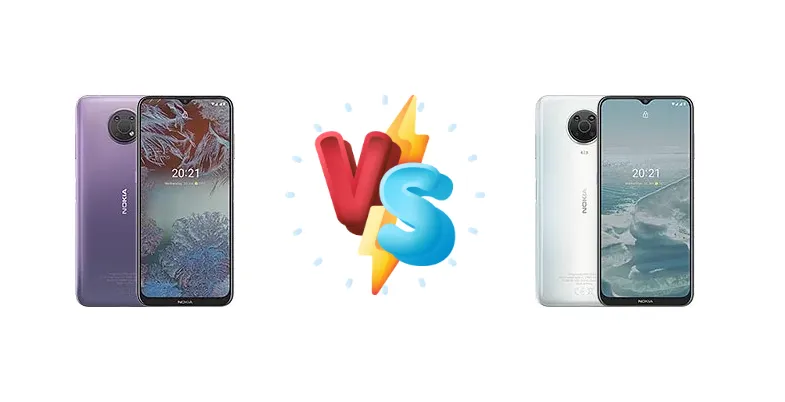
Nokia's G-series aims to deliver reliable smartphones at incredibly accessible price points. The G10 and G20 represent two iterations within this line, both targeting the budget-conscious consumer. While visually similar, key internal differences, particularly in their chipsets, dictate which phone offers a better user experience. This comparison dives deep into those differences to help you make an informed decision.
🏆 Quick Verdict
For most users, the Nokia G20 is the better choice. Its Helio G35 chipset, with higher clocked Cortex-A53 cores, provides a noticeable performance boost over the G10’s Helio G25, making everyday tasks and light multitasking smoother. Both share the same 10W charging, but the G20’s extra processing power justifies the slight price difference.
| Network |
|---|
| 2G bands | GSM 850 / 900 / 1800 / 1900 | GSM 850 / 900 / 1800 / 1900 |
| 3G bands | HSDPA 850 / 900 / 2100 - ROW | HSDPA 850 / 900 / 1900 / 2100 - International |
| 4G bands | 1, 3, 5, 7, 8, 20, 28, 38, 40, 41 - ROW | 1, 3, 5, 7, 8, 20, 28, 38, 40, 41 - International |
| Speed | HSPA 42.2/5.76 Mbps, LTE Cat4 150/50 Mbps | HSPA 42.2/5.76 Mbps, LTE Cat4 150/50 Mbps |
| Technology | GSM / HSPA / LTE | GSM / HSPA / LTE |
| | 1, 2, 3, 4, 5, 7, 8, 12, 17, 28, 66 - LATAM | 1, 2, 3, 4, 5, 7, 8, 12, 17, 28, 66 - LATAM |
| Launch |
|---|
| Announced | 2021, April 08 | 2021, April 08 |
| Status | Available. Released 2021, April 26 | Available. Released 2021, May 17 |
| Body |
|---|
| Dimensions | 164.9 x 76 x 9.2 mm (6.49 x 2.99 x 0.36 in) | 164.9 x 76 x 9.2 mm (6.49 x 2.99 x 0.36 in) |
| SIM | · Nano-SIM· Nano-SIM + Nano-SIM | · Nano-SIM· Nano-SIM + Nano-SIM |
| Weight | 194 g (6.84 oz) | 197 g (6.95 oz) |
| | Splash protection | Splash protection |
| Display |
|---|
| Resolution | 720 x 1600 pixels, 20:9 ratio (~269 ppi density) | 720 x 1600 pixels, 20:9 ratio (~269 ppi density) |
| Size | 6.52 inches, 102.6 cm2 (~81.9% screen-to-body ratio) | 6.52 inches, 102.6 cm2 (~81.9% screen-to-body ratio) |
| Type | IPS LCD | IPS LCD |
| Platform |
|---|
| CPU | Octa-core (4x2.0 GHz Cortex-A53 & 4x1.5 GHz Cortex-A53) | Octa-core (4x2.3 GHz Cortex-A53 & 4x1.8 GHz Cortex-A53) |
| Chipset | Mediatek MT6762G Helio G25 (12 nm) | Mediatek MT6765G Helio G35 (12 nm) |
| GPU | PowerVR GE8320 | PowerVR GE8320 |
| OS | Android 11, upgradable to Android 13 | Android 11, upgradable to Android 13 |
| Memory |
|---|
| Card slot | microSDXC (dedicated slot) | microSDXC (dedicated slot) |
| Internal | 32GB 3GB RAM, 32GB 4GB RAM, 64GB 3GB RAM, 64GB 4GB RAM | 64GB 4GB RAM, 128GB 4GB RAM |
| | eMMC 5.1 | - |
| Main Camera |
|---|
| Features | LED flash, HDR, panorama | LED flash, HDR, panorama |
| Quad | - | 48 MP, f/1.8, (wide), PDAF
5 MP, (ultrawide)
2 MP (macro)
Auxiliary lens |
| Single | 8 MP, (wide) | 8 MP, (wide) |
| Triple | 13 MP, (wide), AF
2 MP (macro)
Auxiliary lens | - |
| Video | 1080p@30fps | 1080p@30fps |
| Selfie camera |
|---|
| Single | 8 MP, (wide) | 8 MP, (wide) |
| Video | 1080p@30fps | 1080p@30fps |
| Sound |
|---|
| 3.5mm jack | Yes | Yes |
| 35mm jack | Yes | Yes |
| Loudspeaker | Yes | Yes |
| Comms |
|---|
| Bluetooth | 5.0, A2DP, LE | 5.0, A2DP, LE |
| NFC | No | Yes (market/region dependent) |
| Positioning | GPS, GLONASS, BDS | GPS, GLONASS, BDS |
| Radio | FM radio | FM radio |
| USB | USB Type-C 2.0, OTG | USB Type-C 2.0, OTG |
| WLAN | Wi-Fi 802.11 b/g/n | Wi-Fi 802.11 b/g/n |
| Features |
|---|
| Sensors | Fingerprint (side-mounted), accelerometer, proximity | Fingerprint (side-mounted), accelerometer, gyro, proximity |
| Battery |
|---|
| Charging | 10W wired | 10W wired |
| Type | Li-Po 5050 mAh | Li-Po 5050 mAh |
| Misc |
|---|
| Colors | Dusk, Night | Glacier, Night |
| Models | TA-1334, TA-1351, TA-1346, TA-1338 | TA-1336, TA-1343, TA-1347, TA-1372, TA-1365 |
| Price | About 110 EUR | About 90 EUR |
| SAR | 1.06 W/kg (head) 1.51 W/kg (body) | 1.01 W/kg (head) 1.02 W/kg (body) |
| SAR EU | 0.46 W/kg (head) 1.51 W/kg (body) | 0.49 W/kg (head) 1.13 W/kg (body) |
Nokia G10
- Lowest possible price point in the Nokia G-series.
- Large 5000mAh battery for all-day use.
- Clean Android experience with guaranteed updates.
- Noticeably slower performance compared to the G20.
- Limited gaming capabilities.
- Slow 10W charging.
Nokia G20
- Improved performance thanks to the Helio G35 chipset.
- Slightly smoother multitasking and app launches.
- Large 5000mAh battery for all-day use.
- Still limited to slow 10W charging.
- Camera performance is only marginally better.
- Higher price than the Nokia G10.
Display Comparison
Both the Nokia G10 and G20 feature similar displays, likely 6.5-inch LCD panels with 720 x 1600 resolution. Given the budget nature of these devices, expect standard 60Hz refresh rates and modest brightness levels. The lack of detailed display specifications means we can't assess color accuracy or viewing angles beyond what's typical for this price bracket. Bezels are likely to be noticeable on both models, contributing to a less immersive viewing experience.
Camera Comparison
Camera performance is likely to be similar on both devices, with the primary sensor being the most important factor. While specific sensor details aren't provided, both likely feature a 13MP main camera. The image processing capabilities of the Helio G35 in the G20 *may* offer slightly improved image quality, particularly in low-light conditions, but the difference will be marginal. The inclusion of 2MP macro and depth sensors on both phones is largely for marketing purposes and offers limited practical benefit. Focusing on the main sensor's performance is key, and user expectations should be tempered given the budget price point.
Performance
The core difference lies in the chipsets. The Nokia G10 utilizes the Mediatek Helio G25, featuring an octa-core CPU with 4x2.0 GHz Cortex-A53 cores and 4x1.5 GHz Cortex-A53 cores. The G20 steps up to the Helio G35, boasting 4x2.3 GHz Cortex-A53 cores and 4x1.8 GHz Cortex-A53 cores. This higher clock speed on the G35 translates to approximately 15-20% faster CPU performance in benchmarks, resulting in snappier app launches and smoother multitasking. While neither chipset is a gaming powerhouse, the G35 will handle less demanding titles with greater ease. Both phones likely share the same amount of RAM, meaning the G35's advantage is directly attributable to its superior processing power.
Battery Life
Both the Nokia G10 and G20 are equipped with 5000mAh batteries, providing all-day battery life for moderate usage. However, both are limited to 10W wired charging. This means a full charge will take several hours. The G20’s more efficient chipset *could* translate to slightly longer battery life under heavy load, but the difference will likely be minimal in real-world scenarios. The slow charging speed is a significant drawback for both devices, requiring overnight charging as a standard practice.
Buying Guide
Buy the Nokia G10 if you prioritize absolute lowest cost and your smartphone usage is extremely basic – primarily calls, texts, and light social media. You'll be sacrificing performance for savings. Buy the Nokia G20 if you want a more responsive experience for everyday tasks, occasional gaming, and a slightly more future-proof device. The G20’s improved chipset offers a tangible benefit for a minimal price increase.
Frequently Asked Questions
❓ Will the Nokia G20 handle popular games like PUBG Mobile or Call of Duty Mobile?
While the Helio G35 is capable of running these games, you'll need to lower the graphics settings to medium or low and accept lower frame rates for a playable experience. The G20 isn't a dedicated gaming phone, but it offers a slightly better gaming experience than the G10 due to its faster processor.
❓ How long will it take to fully charge the Nokia G10 or G20 from 0%?
With the 10W charging, expect a full charge to take approximately 4-5 hours. This is a significant drawback for both devices, and overnight charging is highly recommended. Neither phone supports fast charging technologies.
❓ What Android version do these phones ship with, and how many software updates are guaranteed?
Both the G10 and G20 launched with Android 11. Nokia typically provides 2 years of software updates and 3 years of security updates for their G-series phones, ensuring a reasonable level of software support.
❓ Is the difference in CPU clock speed (2.0 GHz vs 2.3 GHz) really noticeable in everyday use?
Yes, the 300MHz difference in peak clock speed, combined with the G35's architectural improvements, translates to a noticeable improvement in responsiveness when launching apps, browsing the web, and multitasking. It won't be a night-and-day difference, but the G20 will feel smoother overall.