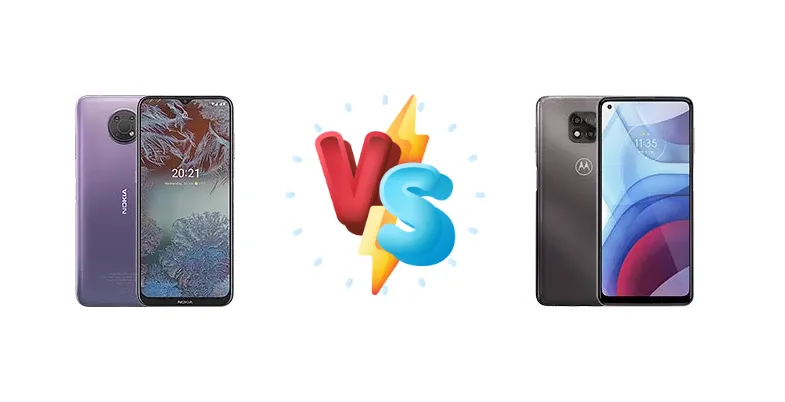
The sub-$200 smartphone market is fiercely competitive. Both the Nokia G10 and Motorola Moto G Power (2021) aim to deliver essential features at an accessible price. However, they take different approaches to achieving this, primarily diverging in their chipset choices and charging capabilities. This comparison dissects those differences to determine which phone offers the best value for your money.
🏆 Quick Verdict
For the average user prioritizing consistent performance and faster charging, the Motorola Moto G Power (2021) is the better choice. Its Snapdragon 662 chipset, built on an 11nm process, provides a noticeable efficiency advantage over the Nokia G10’s Helio G25, translating to smoother multitasking and slightly better gaming. While the Nokia G10 is a viable option, the Moto G Power offers a more refined experience.
| Network |
|---|
| 2G bands | GSM 850 / 900 / 1800 / 1900 | GSM 850 / 900 / 1800 / 1900 |
| 3G bands | HSDPA 850 / 900 / 2100 - ROW | HSDPA 850 / 900 / 1700(AWS) / 1900 / 2100 |
| 4G bands | 1, 3, 5, 7, 8, 20, 28, 38, 40, 41 - ROW | 1, 2, 3, 4, 5, 7, 8, 12, 13, 14, 17, 25, 26, 29, 30, 38, 41, 66, 71 |
| Speed | HSPA 42.2/5.76 Mbps, LTE Cat4 150/50 Mbps | HSPA, LTE |
| Technology | GSM / HSPA / LTE | GSM / CDMA / HSPA / EVDO / LTE |
| | 1, 2, 3, 4, 5, 7, 8, 12, 17, 28, 66 - LATAM | CDMA2000 1xEV-DO |
| Launch |
|---|
| Announced | 2021, April 08 | 2021, January 08 |
| Status | Available. Released 2021, April 26 | Available. Released 2021, January 14 |
| Body |
|---|
| Build | - | Glass front, plastic back, plastic frame |
| Dimensions | 164.9 x 76 x 9.2 mm (6.49 x 2.99 x 0.36 in) | 165.3 x 75.9 x 9.5 mm (6.51 x 2.99 x 0.37 in) |
| SIM | · Nano-SIM· Nano-SIM + Nano-SIM | Nano-SIM |
| Weight | 194 g (6.84 oz) | 206.5 g (7.30 oz) |
| | Splash protection | Water-repellent coating |
| Display |
|---|
| Resolution | 720 x 1600 pixels, 20:9 ratio (~269 ppi density) | 720 x 1600 pixels, 20:9 ratio (~266 ppi density) |
| Size | 6.52 inches, 102.6 cm2 (~81.9% screen-to-body ratio) | 6.6 inches, 105.2 cm2 (~83.8% screen-to-body ratio) |
| Type | IPS LCD | IPS LCD |
| Platform |
|---|
| CPU | Octa-core (4x2.0 GHz Cortex-A53 & 4x1.5 GHz Cortex-A53) | Octa-core (4x2.0 GHz Kryo 260 Gold & 4x1.8 GHz Kryo 260 Silver) |
| Chipset | Mediatek MT6762G Helio G25 (12 nm) | Qualcomm SM6115 Snapdragon 662 (11 nm) |
| GPU | PowerVR GE8320 | Adreno 610 |
| OS | Android 11, upgradable to Android 13 | Android 10 |
| Memory |
|---|
| Card slot | microSDXC (dedicated slot) | microSDXC (dedicated slot) |
| Internal | 32GB 3GB RAM, 32GB 4GB RAM, 64GB 3GB RAM, 64GB 4GB RAM | 32GB 3GB RAM, 64GB 4GB RAM |
| | eMMC 5.1 | eMMC 5.1 |
| Main Camera |
|---|
| Features | LED flash, HDR, panorama | LED flash, HDR, panorama |
| Single | 8 MP, (wide) | - |
| Triple | 13 MP, (wide), AF
2 MP (macro)
Auxiliary lens | 48 MP, f/1.7, (wide), 1/2.0", 0.8µm, PDAF
2 MP (macro)
Auxiliary lens |
| Video | 1080p@30fps | 1080p@30/60fps, gyro-EIS |
| Selfie camera |
|---|
| Features | - | HDR |
| Single | 8 MP, (wide) | 8 MP, f/2.0, 1.12µm |
| Video | 1080p@30fps | 1080p@30fps, gyro-EIS |
| Sound |
|---|
| 3.5mm jack | Yes | Yes |
| 35mm jack | Yes | Yes |
| Loudspeaker | Yes | Yes |
| Comms |
|---|
| Bluetooth | 5.0, A2DP, LE | 5.0, A2DP, LE |
| NFC | No | No |
| Positioning | GPS, GLONASS, BDS | GPS, GLONASS, GALILEO |
| Radio | FM radio | FM radio |
| USB | USB Type-C 2.0, OTG | USB Type-C 2.0 |
| WLAN | Wi-Fi 802.11 b/g/n | Wi-Fi 802.11 a/b/g/n/ac, dual-band, Wi-Fi Direct |
| Features |
|---|
| Sensors | Fingerprint (side-mounted), accelerometer, proximity | Fingerprint (side-mounted), accelerometer, gyro, proximity, compass, barometer |
| Battery |
|---|
| Charging | 10W wired | 15W wired |
| Type | Li-Po 5050 mAh | Li-Po 5000 mAh |
| Misc |
|---|
| Colors | Dusk, Night | Flash Gray, Polar Silver |
| Models | TA-1334, TA-1351, TA-1346, TA-1338 | - |
| Price | About 110 EUR | About 60 EUR |
| SAR | 1.06 W/kg (head) 1.51 W/kg (body) | - |
| SAR EU | 0.46 W/kg (head) 1.51 W/kg (body) | - |
Nokia G10
- Clean Android experience (typically)
- Potentially lower price point
- Acceptable performance for basic tasks
- Slower charging (10W)
- Less efficient chipset (Helio G25)
- Potentially more noticeable performance slowdowns under load
Motorola Moto G Power (2021)
- More efficient chipset (Snapdragon 662)
- Faster charging (15W)
- Smoother multitasking and gaming
- Motorola’s software can include bloatware
- May be slightly more expensive than the Nokia G10
Display Comparison
Neither device boasts a standout display. Both likely utilize LCD panels, a common cost-saving measure in this segment. The focus here isn't on visual fidelity, but rather on basic usability. Without specific brightness data, it's reasonable to assume both offer adequate outdoor visibility under moderate sunlight. The absence of high refresh rates or advanced panel technologies like LTPO is expected at this price point, meaning users should anticipate standard 60Hz refresh rates.
Camera Comparison
Both phones likely feature modest camera setups geared towards casual photography. Without detailed sensor information, it’s safe to assume the Moto G Power’s image processing will be more refined, leveraging Qualcomm’s ISP capabilities. The focus should be on daylight photography, as low-light performance will likely be limited on both devices. Any 2MP macro or depth sensors present on either phone should be considered supplementary features with limited practical value.
Performance
The core difference lies in the chipsets. The Motorola Moto G Power (2021) features the Qualcomm Snapdragon 662 (11nm), while the Nokia G10 uses the MediaTek Helio G25 (12nm). While both are octa-core CPUs, the Snapdragon 662 benefits from Qualcomm’s Kryo CPU architecture, offering a more efficient and powerful core configuration (4x2.0 GHz Kryo 260 Gold & 4x1.8 GHz Kryo 260 Silver) compared to the Nokia’s Cortex-A53 arrangement (4x2.0 GHz & 4x1.5 GHz). The 11nm process node of the Snapdragon 662 further contributes to better thermal management and power efficiency, meaning less throttling during sustained workloads. This translates to a smoother experience when switching between apps and a slight advantage in mobile gaming.
Battery Life
The Motorola Moto G Power (2021) has a clear advantage in charging speed, supporting 15W wired charging compared to the Nokia G10’s 10W. While both likely pack batteries in the 5000mAh range (based on market segment), the faster charging of the Moto G Power significantly reduces downtime. A full charge on the Nokia G10 will take considerably longer, making it less convenient for users who need to quickly top up their battery.
Buying Guide
Buy the Nokia G10 if you prioritize a clean Android experience and are comfortable with slower charging speeds and potentially less demanding tasks. It’s a good fit for users who primarily use their phone for calls, texts, and light social media. Buy the Motorola Moto G Power (2021) if you value a more responsive user experience, faster charging, and a chipset capable of handling moderate gaming and multitasking without significant slowdowns. This is the better option for users who want a phone that can keep up with a more active digital lifestyle.
Frequently Asked Questions
❓ Will the Helio G25 in the Nokia G10 struggle with popular apps like TikTok or Instagram?
While the Helio G25 can handle these apps, you may experience occasional stutters or slowdowns, especially when multitasking. The Snapdragon 662 in the Moto G Power offers a smoother experience for these types of social media applications due to its more efficient architecture.
❓ How long will it take to fully charge the Nokia G10 with its 10W charger?
Expect a full charge from 0% to 100% to take approximately 3-4 hours with the Nokia G10’s 10W charger. The Moto G Power (2021) with its 15W charger will charge significantly faster, likely in around 2-2.5 hours.
❓ Is the Motorola Moto G Power (2021) a good choice for playing mobile games?
The Moto G Power (2021) is capable of playing many popular mobile games at medium settings. The Snapdragon 662 provides a noticeable performance boost over the Helio G25, resulting in fewer frame drops and a more enjoyable gaming experience. However, don't expect to max out graphics settings on demanding titles.
❓ Does either phone have NFC for contactless payments?
Neither the Nokia G10 nor the Motorola Moto G Power (2021) consistently include NFC across all regional variants. It's crucial to check the specific model number and specifications for your region before purchasing if NFC is a requirement.