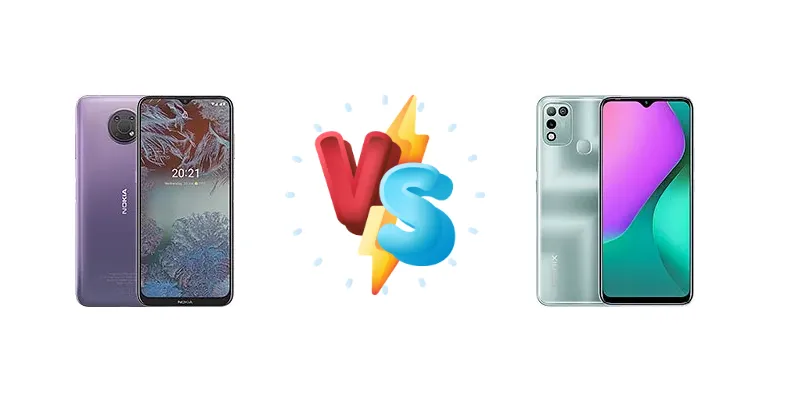
The Nokia G10 and Infinix Hot 10 Play represent the extreme end of the smartphone price spectrum. Both devices target first-time smartphone buyers or those needing a reliable secondary device. This comparison dissects their similarities and subtle differences to determine which offers the best value for essential smartphone tasks.
🏆 Quick Verdict
For the average user prioritizing software reliability and a potentially longer software support lifecycle, the Nokia G10 is the better choice. However, the Infinix Hot 10 Play offers more RAM options for a slightly lower starting price, potentially improving multitasking performance.
| Network |
|---|
| 2G bands | GSM 850 / 900 / 1800 / 1900 | GSM 850 / 900 / 1800 / 1900 |
| 3G bands | HSDPA 850 / 900 / 2100 - ROW | HSDPA 850 / 900 / 2100 |
| 4G bands | 1, 3, 5, 7, 8, 20, 28, 38, 40, 41 - ROW | 1, 3, 5, 8, 38, 40, 41 |
| Speed | HSPA 42.2/5.76 Mbps, LTE Cat4 150/50 Mbps | HSPA, LTE |
| Technology | GSM / HSPA / LTE | GSM / HSPA / LTE |
| | 1, 2, 3, 4, 5, 7, 8, 12, 17, 28, 66 - LATAM | 1, 2, 3, 4, 5, 7, 8, 20, 28, 38, 40, 41 |
| Launch |
|---|
| Announced | 2021, April 08 | 2021, January 21 |
| Status | Available. Released 2021, April 26 | Available. Released 2021, January 21 |
| Body |
|---|
| Build | - | Glass front, plastic back, plastic frame |
| Dimensions | 164.9 x 76 x 9.2 mm (6.49 x 2.99 x 0.36 in) | 171.8 x 78 x 8.9 mm (6.76 x 3.07 x 0.35 in) |
| SIM | · Nano-SIM· Nano-SIM + Nano-SIM | Nano-SIM + Nano-SIM |
| Weight | 194 g (6.84 oz) | 207 g (7.30 oz) |
| | Splash protection | - |
| Display |
|---|
| Resolution | 720 x 1600 pixels, 20:9 ratio (~269 ppi density) | 720 x 1640 pixels (~263 ppi density) |
| Size | 6.52 inches, 102.6 cm2 (~81.9% screen-to-body ratio) | 6.82 inches, 110.5 cm2 (~82.4% screen-to-body ratio) |
| Type | IPS LCD | IPS LCD, 440 nits (typ) |
| Platform |
|---|
| CPU | Octa-core (4x2.0 GHz Cortex-A53 & 4x1.5 GHz Cortex-A53) | Octa-core (4x2.0 GHz Cortex-A53 & 4x1.5 GHz Cortex-A53) |
| Chipset | Mediatek MT6762G Helio G25 (12 nm) | Mediatek MT6762G Helio G25 (12 nm) |
| GPU | PowerVR GE8320 | PowerVR GE8320 |
| OS | Android 11, upgradable to Android 13 | Android 10 (Go edition), XOS 7 |
| Memory |
|---|
| Card slot | microSDXC (dedicated slot) | microSDXC (dedicated slot) |
| Internal | 32GB 3GB RAM, 32GB 4GB RAM, 64GB 3GB RAM, 64GB 4GB RAM | 32GB 2GB RAM, 64GB 4GB RAM |
| | eMMC 5.1 | eMMC 5.1 |
| Main Camera |
|---|
| Dual | - | 13 MP, f/1.8, (wide), 1/3.1", 1.12µm, AF
Auxiliary lens |
| Features | LED flash, HDR, panorama | Quad-LED flash, panorama, HDR |
| Single | 8 MP, (wide) | - |
| Triple | 13 MP, (wide), AF
2 MP (macro)
Auxiliary lens | - |
| Video | 1080p@30fps | 1080p@30fps |
| Selfie camera |
|---|
| Features | - | LED flash |
| Single | 8 MP, (wide) | 8 MP, f/2.0, (wide) |
| Video | 1080p@30fps | 1080p@30fps |
| Sound |
|---|
| 3.5mm jack | Yes | Yes |
| 35mm jack | Yes | Yes |
| Loudspeaker | Yes | Yes |
| Comms |
|---|
| Bluetooth | 5.0, A2DP, LE | 5.0, A2DP, LE |
| NFC | No | No |
| Positioning | GPS, GLONASS, BDS | GPS |
| Radio | FM radio | FM radio |
| USB | USB Type-C 2.0, OTG | microUSB 2.0 |
| WLAN | Wi-Fi 802.11 b/g/n | Wi-Fi 802.11 a/b/g/n/ac, dual-band, Wi-Fi Direct |
| Features |
|---|
| Sensors | Fingerprint (side-mounted), accelerometer, proximity | Fingerprint (rear-mounted), accelerometer, proximity, compass |
| Battery |
|---|
| Charging | 10W wired | 10W wired |
| Type | Li-Po 5050 mAh | 6000 mAh |
| Misc |
|---|
| Colors | Dusk, Night | Aegean Blue, Morandi Green, Obsidian Black, Purple |
| Models | TA-1334, TA-1351, TA-1346, TA-1338 | X688C, X688B, MZ-Infinix X688C |
| Price | About 110 EUR | About 80 EUR |
| SAR | 1.06 W/kg (head) 1.51 W/kg (body) | - |
| SAR EU | 0.46 W/kg (head) 1.51 W/kg (body) | - |
| Pricing |
|---|
| 32GB 2GB RAM | - | ₹ 8,709 |
| 64GB 4GB RAM | - | Rp 1,570,000 |
Nokia G10
- Potentially longer software support from Nokia.
- Cleaner Android experience (likely closer to stock).
- Established brand reputation for reliability.
- RAM configuration is unknown, potentially limiting performance.
- Slow 10W charging.
Infinix Hot 10 Play
- Available with 4GB of RAM for improved multitasking.
- Lower starting price (₹8,709 for 32GB/2GB variant).
- More storage options available.
- Android experience may be heavily customized.
- Slow 10W charging.
Display Comparison
Both the Nokia G10 and Infinix Hot 10 Play lack detailed display specifications in the provided data. Given their price point, it's safe to assume both utilize LCD panels with 720p+ resolution. The absence of information regarding peak brightness, color gamut coverage, or PWM dimming rates suggests neither device will excel in outdoor visibility or color accuracy. Bezels are likely to be substantial on both, maximizing screen real estate within a compact form factor.
Camera Comparison
Camera details are sparse for both devices. The lack of information regarding sensor size, aperture, or image stabilization suggests both will struggle in low-light conditions. While both likely feature a multi-camera setup, the provided data doesn't allow for a meaningful comparison beyond acknowledging their existence. The focus should be on basic photography for social media sharing, rather than expecting high-quality images.
Performance
Both devices are powered by the Mediatek MT6762G Helio G25 (12 nm) chipset, featuring an identical CPU configuration: an octa-core setup with 4x2.0 GHz Cortex-A53 and 4x1.5 GHz Cortex-A53 cores. This means raw processing power will be virtually indistinguishable between the two. However, the Infinix Hot 10 Play offers a 64GB/4GB RAM variant, while the Nokia G10’s RAM configuration is unspecified. The additional RAM on the Infinix model will demonstrably improve multitasking capabilities and reduce app reload times, especially with the resource-intensive Android operating system. Thermal management is unlikely to be a concern given the low-power chipset.
Battery Life
Both the Nokia G10 and Infinix Hot 10 Play utilize 10W wired charging. This slow charging speed means a full charge will take a significant amount of time – likely exceeding 3 hours. Battery capacity is not specified, but given the low-power chipset and basic display technology, both devices should achieve all-day battery life with moderate usage. The 10W charging rate is a significant limitation for users accustomed to faster charging solutions.
Buying Guide
Buy the Nokia G10 if you value a cleaner Android experience, potentially longer software updates, and brand reputation for durability. This phone suits users who primarily need calling, messaging, and basic app usage. Buy the Infinix Hot 10 Play if you prioritize maximizing RAM within a tight budget and are comfortable with a more customized Android experience. This is ideal for users who frequently switch between apps or enjoy a more visually altered interface.
Frequently Asked Questions
❓ Will the Helio G25 chipset struggle with popular games like PUBG Mobile?
The Mediatek Helio G25 is an entry-level chipset. While it can run PUBG Mobile, expect to play at the lowest graphics settings and potentially experience frame rate drops, especially during intense action. It's not designed for demanding gaming experiences.
❓ How long will software updates be supported on the Nokia G10?
Nokia typically provides a guaranteed number of software updates and security patches for its devices. While the exact duration for the G10 isn't explicitly stated, Nokia generally offers better software support than many other brands in this price segment, potentially extending the device's usability.
❓ Is the 2GB of RAM on the base Infinix Hot 10 Play sufficient for everyday use?
2GB of RAM is the bare minimum for running Android smoothly. While it can handle basic tasks like calling, messaging, and browsing, you may experience noticeable lag when switching between apps or running multiple applications simultaneously. Upgrading to the 4GB RAM variant is highly recommended.
❓ What type of charging port do these phones use?
Given the price point and target market, both the Nokia G10 and Infinix Hot 10 Play almost certainly use a micro-USB port for charging and data transfer. This is a legacy standard, but remains common in ultra-budget smartphones.