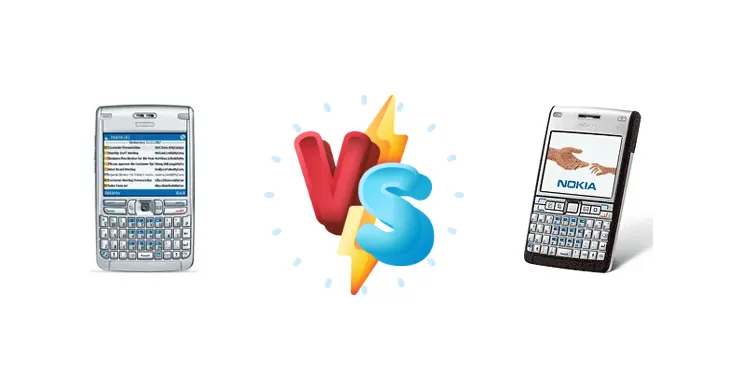
The Nokia E62 and E61i represent a fascinating period in mobile technology – the dawn of the smartphone era. Both devices offered a blend of business features, QWERTY keyboards, and early smartphone capabilities. But which one truly reigned supreme? Let's dive into a detailed comparison to find out.
🏆 Quick Verdict
The Nokia E61i edges out the E62 thanks to its dual-core processor, offering a noticeable performance boost. While both are relics of the past, the E61i's slightly faster processing and similar feature set make it the marginally better choice for those seeking a nostalgic smartphone experience.
| Network |
|---|
| 2G bands | GSM 850 / 900 / 1800 / 1900 | GSM 850 / 900 / 1800 / 1900 |
| 3G bands | - | UMTS 2100 |
| EDGE | Class 10 | - |
| GPRS | Class 11 | - |
| Speed | - | Yes, 384 kbps |
| Technology | GSM | GSM / UMTS |
| Launch |
|---|
| Announced | 2006, September | 2007, February |
| Status | Discontinued | Discontinued |
| Body |
|---|
| Dimensions | 117 x 69.7 x 14 mm, 108 cc (4.61 x 2.74 x 0.55 in) | 117 x 70 x 13.9 mm, 97 cc (4.61 x 2.76 x 0.55 in) |
| Keyboard | QWERTY | QWERTY |
| SIM | Mini-SIM | Mini-SIM |
| Weight | 144 g (5.08 oz) | 150 g (5.29 oz) |
| Display |
|---|
| Resolution | 320 x 240 pixels, 4:3 ratio (~138 ppi density) | 320 x 240 pixels, 4:3 ratio (~143 ppi density) |
| Size | 2.9 inches, 58 x 45 mm, 26.0 cm2 (~31.9% screen-to-body ratio) | 2.8 inches, 24.3 cm2 (~29.6% screen-to-body ratio) |
| Type | TFT, 16M colors | TFT, 16M colors |
| | Five-way scroll key
| Five-way scroll key
|
| Platform |
|---|
| CPU | 235 MHz ARM 9 | 220 MHz Dual ARM 9 |
| OS | Symbian OS 9.1, Series 60 UI | Symbian OS 9.1, Series 60 v3.0 UI |
| Memory |
|---|
| Card slot | miniSD | microSD (dedicated slot) |
| Internal | 80MB 32MB RAM | 60MB 64MB RAM |
| Main Camera |
|---|
| Single | - | 2 MP |
| Video | - | CIF |
| Sound |
|---|
| 3.5mm jack | No | No |
| 35mm jack | No | No |
| Alert types | Vibration; Downloadable polyphonic, monophonic, MP3 ringtones | Vibration; Downloadable polyphonic, monophonic, MP3 ringtones |
| Loudspeaker | Yes | Yes |
| Comms |
|---|
| Bluetooth | 2.0 | 1.2 |
| Infrared port | Yes | Yes |
| Positioning | No | No |
| Radio | No | No |
| USB | miniUSB | Pop-Port 2.0 |
| WLAN | No | Wi-Fi 802.11b/g |
| Features |
|---|
| Browser | WAP 2.0/xHTML, HTML | WAP 2.0/xHTML, HTML |
| | WMV/RV/MP4/3GP player
MP3/WMA/WAV/RA/AAC/M4A player
Document viewer (Word, Excel, PowerPoint, PDF)
Predictive text input
Voice command/memo
Organizer
Printing | MP3/AAC/MP4 player
Document viewer (Word, Excel, PowerPoint, PDF)
Blackberry connectivity
Push to talk
Voice command/dial
Organizer
Printing |
| Battery |
|---|
| Stand-by | Up to 330 h | Up to 400 h (2G) / 456 h (3G) |
| Talk time | Up to 6 h | Up to 9 h (2G) / 5 h (3G) |
| Type | Removable Li-Po 1500 mAh battery (BP-5L) | Removable Li-Po 1500 mAh battery (BP-4L) |
| Misc |
|---|
| Colors | Silver | Silver, Mocca |
| Price | About 200 EUR | About 200 EUR |
| SAR | 0.95 W/kg (head) 0.81 W/kg (body) | 1.12 W/kg (head) 0.81 W/kg (body) |
| SAR EU | 0.51 W/kg (head) | 0.57 W/kg (head) |
Nokia E62
- Sleek design
- QWERTY keyboard
- Symbian OS
- Slower performance
- Limited camera quality
- Outdated display
Nokia E61i
- Dual-core processor (slightly faster)
- QWERTY keyboard
- Symbian OS
- Potentially better battery life
- Limited camera quality
- Outdated display
- Can be harder to find in good condition
Display Comparison
Both the Nokia E62 and E61i feature 2.8-inch QVGA (320x240) displays. Image quality is typical for the era – functional but not visually stunning. The E62's display might have a slightly better viewing angle, but the difference is minimal. Both suffer from limited brightness and color reproduction by modern standards.
Camera Comparison
Both phones feature a 2-megapixel camera. Image quality is, predictably, quite poor by today's standards. Expect grainy photos with limited dynamic range. Low-light performance is virtually nonexistent. Neither phone is a serious contender for photography.
Performance
This is where the E61i gains a significant advantage. Its 220 MHz Dual ARM 9 processor provides a noticeable performance boost over the E62's 235 MHz single-core ARM 9. Apps load faster, and multitasking feels slightly smoother on the E61i. However, both devices will struggle with modern applications.
Battery Life
The Nokia E62 typically offered around 300 hours of standby time and 9 hours of talk time. The E61i, with its slightly more efficient dual-core processor, often achieved slightly better battery life, potentially extending standby to around 330 hours and talk time to 9-10 hours. Both rely on a BL-5C battery.
Buying Guide
The Nokia E62 is ideal for collectors seeking a specific model or those who appreciate its design. The Nokia E61i is better suited for users wanting the slightly improved performance and a more robust overall experience, even within the constraints of these older devices.
Frequently Asked Questions
❓ What operating system did these phones use?
Both the Nokia E62 and E61i ran Symbian OS, specifically Symbian 9.3. It was a popular mobile operating system at the time, but is now outdated.
❓ Are these phones still usable today?
While technically usable, these phones are severely limited by their outdated hardware and software. They can't run modern apps and have limited internet connectivity options. They are primarily of interest to collectors and enthusiasts.