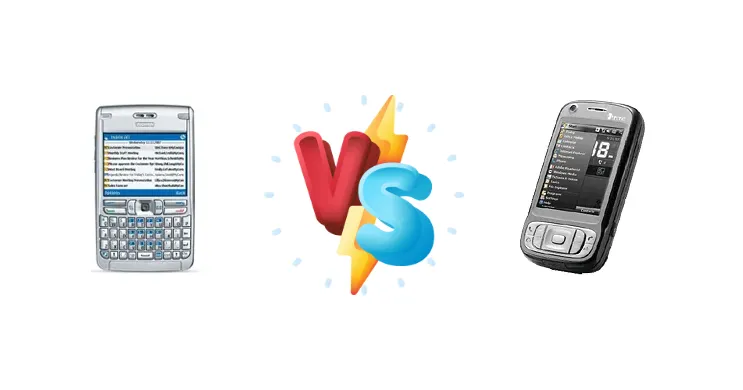
The Nokia E62 and HTC TyTN II represent a pivotal moment in early smartphone development, both running Windows Mobile but targeting slightly different user needs. The E62 prioritized business functionality and a classic Nokia aesthetic, while the TyTN II aimed for a more feature-rich, multimedia-focused experience. This comparison dissects their core differences, focusing on the impact of their contrasting processors.
🏆 Quick Verdict
For the average user seeking a responsive experience, the HTC TyTN II is the clear winner. Its 400 MHz ARM 11 processor and Qualcomm MSM7200 chipset deliver significantly better performance than the Nokia E62’s 235 MHz ARM 9, making multitasking and application loading noticeably faster.
| Network |
|---|
| 2G bands | GSM 850 / 900 / 1800 / 1900 | GSM 850 / 900 / 1800 / 1900 |
| 3G bands | - | HSDPA 850 / 1900 / 2100 |
| EDGE | Class 10 | - |
| GPRS | Class 11 | - |
| Speed | - | HSPA 3.6/0.384 Mbps |
| Technology | GSM | GSM / HSPA |
| Launch |
|---|
| Announced | 2006, September | 2007, July |
| Status | Discontinued | Discontinued |
| Body |
|---|
| Dimensions | 117 x 69.7 x 14 mm, 108 cc (4.61 x 2.74 x 0.55 in) | 112 x 59 x 19 mm (4.41 x 2.32 x 0.75 in) |
| Keyboard | QWERTY | QWERTY |
| SIM | Mini-SIM | Mini-SIM |
| Weight | 144 g (5.08 oz) | 190 g (6.70 oz) |
| Display |
|---|
| Resolution | 320 x 240 pixels, 4:3 ratio (~138 ppi density) | 240 x 320 pixels, 4:3 ratio (~143 ppi density) |
| Size | 2.9 inches, 58 x 45 mm, 26.0 cm2 (~31.9% screen-to-body ratio) | 2.8 inches, 24.3 cm2 (~36.7% screen-to-body ratio) |
| Type | TFT, 16M colors | TFT resistive touchscreen, 65K colors |
| | Five-way scroll key
| Handwriting recognition
|
| Platform |
|---|
| CPU | 235 MHz ARM 9 | 400 MHz ARM 11 |
| Chipset | - | Qualcomm MSM7200 |
| GPU | - | Adreno 130 |
| OS | Symbian OS 9.1, Series 60 UI | Microsoft Windows Mobile 6.0 Professional |
| Memory |
|---|
| Card slot | miniSD | microSD (dedicated slot) |
| Internal | 80MB 32MB RAM | 128MB RAM, 256MB ROM |
| Main Camera |
|---|
| Single | - | 3.15 MP, AF |
| Video | - | Yes |
| Selfie camera |
|---|
| Single | - | VGA videocall camera |
| Sound |
|---|
| 3.5mm jack | No | No |
| 35mm jack | No | No |
| Alert types | Vibration; Downloadable polyphonic, monophonic, MP3 ringtones | Vibration; Downloadable polyphonic, MP3 ringtones |
| Loudspeaker | Yes | Yes |
| Comms |
|---|
| Bluetooth | 2.0 | 2.0 |
| Infrared port | Yes | - |
| Positioning | No | GPS, A-GPS |
| Radio | No | No |
| USB | miniUSB | 2.0 |
| WLAN | No | Wi-Fi 802.11b/g |
| Features |
|---|
| Browser | WAP 2.0/xHTML, HTML | WAP 2.0/xHTML, HTML (PocketIE) |
| | WMV/RV/MP4/3GP player
MP3/WMA/WAV/RA/AAC/M4A player
Document viewer (Word, Excel, PowerPoint, PDF)
Predictive text input
Voice command/memo
Organizer
Printing | Pocket Office
Voice memo
Media Player 10 |
| Battery |
|---|
| Stand-by | Up to 330 h | Up to 400 h |
| Talk time | Up to 6 h | Up to 6 h |
| Type | Removable Li-Po 1500 mAh battery (BP-5L) | Removable Li-Po 1350 mAh battery |
| Misc |
|---|
| Colors | Silver | Silver |
| Price | About 200 EUR | About 140 EUR |
| SAR | 0.95 W/kg (head) 0.81 W/kg (body) | 0.39 W/kg (head) 1.66 W/kg (body) |
| SAR EU | 0.51 W/kg (head) | - |
| Tests |
|---|
| Loudspeaker | - |
Voice 76dB / Noise 75dB / Ring 82dB
|
Nokia E62
- Classic Nokia build quality and reliability
- Simple and straightforward user interface
- Focus on core business functionality
- Significantly slower processor
- Limited multimedia capabilities
- Smaller screen size (likely)
HTC TyTN II
- Faster ARM 11 processor and Qualcomm chipset
- Improved graphics performance
- Larger screen size (likely)
- Potentially shorter battery life due to more powerful processor
- More complex user interface
- May be less durable than the Nokia E62
Display Comparison
Information regarding display specifications (resolution, size, panel type) is unavailable. However, given the era, both likely utilized resistive touchscreen technology. The TyTN II’s larger form factor suggests a potentially larger display, offering more screen real estate for viewing documents or multimedia. The E62, with its focus on business, likely prioritized a more compact size over screen size.
Camera Comparison
Details regarding camera specifications are unavailable. However, cameras on devices of this era were generally low-resolution and of limited quality. Both devices likely featured cameras primarily for basic photo capture and video calls, rather than high-quality photography. The TyTN II, being more multimedia-focused, might have included slightly better camera software or features.
Performance
The core difference lies in the processors. The HTC TyTN II’s 400 MHz ARM 11, coupled with the Qualcomm MSM7200 chipset, represents a substantial leap in processing power over the Nokia E62’s 235 MHz ARM 9. The ARM 11 architecture introduced improvements in instruction set efficiency, allowing for faster execution of tasks. The MSM7200 also integrated a GPU, enabling better graphics performance for basic 3D applications and games, a capability the E62 likely lacked. This translates to snappier application loading, smoother multitasking, and a more responsive user interface on the TyTN II.
Battery Life
Battery capacity details are unavailable for both devices. However, the more powerful processor and chipset in the HTC TyTN II would likely result in faster battery drain during intensive use. The Nokia E62, with its less demanding processor, might offer slightly longer battery life under similar usage conditions. Real-world battery performance would heavily depend on network conditions and user habits.
Buying Guide
Buy the Nokia E62 if you prioritize a simple, reliable business tool with a focus on call quality and a classic Nokia user experience. Its strength lies in its durability and straightforward functionality. Buy the HTC TyTN II if you need a more versatile device capable of handling more demanding applications and multimedia tasks, and if you value a larger screen and a more modern (for the time) feature set.
Frequently Asked Questions
❓ Will the HTC TyTN II struggle with modern apps, even emulated?
Yes, the HTC TyTN II, despite its faster processor, is severely limited by its operating system (Windows Mobile) and available RAM. Running modern apps, even through emulation, is unlikely to be a smooth experience. It's designed for the software of its time.
❓ Is the Nokia E62 a good choice for someone looking for a retro business phone?
Absolutely. The Nokia E62 excels as a retro business phone. Its durable build, simple interface, and focus on call quality make it a reliable tool for basic communication. However, its limited processing power means it's not suitable for demanding tasks.
❓ Can either of these phones be upgraded to a more modern operating system?
Upgrading either device to a modern operating system like Android is extremely difficult and generally not feasible. The hardware is not designed to support modern OS requirements, and the process requires significant technical expertise and carries a high risk of bricking the device.