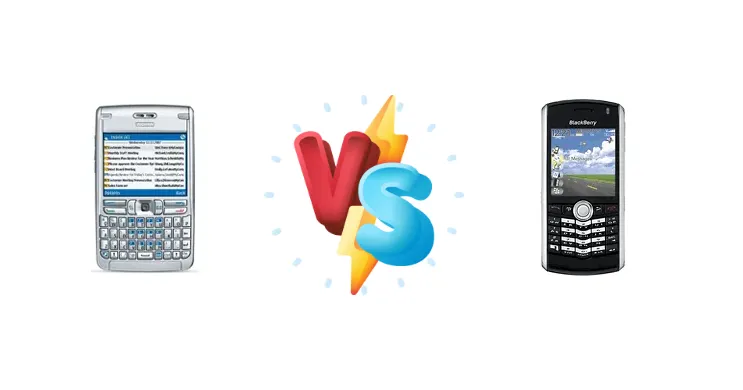
In the mid-2000s, the smartphone landscape was being defined. The Nokia E62 and BlackBerry Pearl 8100 represented two distinct approaches to mobile productivity. The E62, with its focus on Symbian and a traditional keyboard, aimed for broad functionality. The Pearl 8100, leveraging BlackBerry’s push email and signature trackball, targeted the corporate user. This comparison dissects their core differences to determine which device better served its intended audience.
🏆 Quick Verdict
For the average user seeking a balance of features and usability, the BlackBerry Pearl 8100 emerges as the stronger choice. Its 312 MHz Intel XScale processor provided a noticeable performance advantage over the E62’s 235 MHz ARM 9, and the optimized BlackBerry OS delivered a superior email experience, crucial for its target demographic.
| Network |
|---|
| 2G bands | GSM 850 / 900 / 1800 / 1900 | GSM 850 / 900 / 1800 / 1900 |
| EDGE | Class 10 | Yes |
| GPRS | Class 11 | Yes |
| Technology | GSM | GSM |
| Launch |
|---|
| Announced | 2006, September | 2006, September |
| Status | Discontinued | Discontinued |
| Body |
|---|
| Dimensions | 117 x 69.7 x 14 mm, 108 cc (4.61 x 2.74 x 0.55 in) | 107 x 50 x 14.5 mm (4.21 x 1.97 x 0.57 in) |
| Keyboard | QWERTY | QWERTY |
| SIM | Mini-SIM | Mini-SIM |
| Weight | 144 g (5.08 oz) | 89.5 g (3.14 oz) |
| Display |
|---|
| Resolution | 320 x 240 pixels, 4:3 ratio (~138 ppi density) | 240 x 260 pixels (~161 ppi density) |
| Size | 2.9 inches, 58 x 45 mm, 26.0 cm2 (~31.9% screen-to-body ratio) | 2.2 inches, 15.6 cm2 (~29.1% screen-to-body ratio) |
| Type | TFT, 16M colors | 65K colors |
| | Five-way scroll key
| Wallpapers |
| Platform |
|---|
| CPU | 235 MHz ARM 9 | 32-bit Intel XScale PXA272 312 MHz |
| OS | Symbian OS 9.1, Series 60 UI | BlackBerry OS |
| Memory |
|---|
| Card slot | miniSD | microSD (dedicated slot) |
| Internal | 80MB 32MB RAM | 64MB |
| Main Camera |
|---|
| Features | - | LED flash |
| Single | - | 1.3 MP |
| Video | - | No |
| Sound |
|---|
| 3.5mm jack | No | No |
| 35mm jack | No | No |
| Alert types | Vibration; Downloadable polyphonic, monophonic, MP3 ringtones | Vibration; Downloadable polyphonic, MP3 ringtones |
| Loudspeaker | Yes | Yes |
| Comms |
|---|
| Bluetooth | 2.0 | 2.0 |
| Infrared port | Yes | - |
| Positioning | No | No |
| Radio | No | No |
| USB | miniUSB | Proprietary |
| WLAN | No | No |
| Features |
|---|
| Browser | WAP 2.0/xHTML, HTML | HTML |
| | WMV/RV/MP4/3GP player
MP3/WMA/WAV/RA/AAC/M4A player
Document viewer (Word, Excel, PowerPoint, PDF)
Predictive text input
Voice command/memo
Organizer
Printing | Document viewer (Word, Excel, PowerPoint, PDF)
Media player
SureType keyboard software
Organizer |
| Battery |
|---|
| Stand-by | Up to 330 h | Up to 360 h |
| Talk time | Up to 6 h | Up to 3 h 30 min |
| Type | Removable Li-Po 1500 mAh battery (BP-5L) | Removable Li-Ion 900 mAh battery |
| Misc |
|---|
| Colors | Silver | Black, White, Red |
| Price | About 200 EUR | About 200 EUR |
| SAR | 0.95 W/kg (head) 0.81 W/kg (body) | - |
| SAR EU | 0.51 W/kg (head) | - |
Nokia E62
- More open operating system (Symbian)
- Larger form factor for easier typing
- Greater file management capabilities
- Slower processor (235 MHz ARM 9)
- Less optimized for email
- Potentially shorter battery life
BlackBerry Pearl 8100
- Faster processor (312 MHz Intel XScale)
- Superior email experience (BlackBerry push)
- Compact and pocketable design
- Closed operating system (BlackBerry OS)
- Smaller keyboard
- Limited application ecosystem
Display Comparison
Neither device boasted a particularly impressive display by modern standards. Specifications for screen resolution and panel type are not provided, but both likely utilized reflective LCDs common at the time. The Pearl 8100’s smaller form factor likely resulted in a more compact display, potentially impacting readability for document viewing, a key use case for the E62. The E62’s larger size afforded more screen real estate, beneficial for multitasking within Symbian.
Camera Comparison
Camera capabilities were rudimentary on both devices. Details regarding sensor size and resolution are unavailable, but both likely featured low-resolution cameras primarily intended for basic snapshots. Image quality would have been limited by the technology of the time, and neither device was positioned as a photography powerhouse. The focus was clearly on communication and productivity, not mobile photography.
Performance
The core difference lies in the processors. The BlackBerry Pearl 8100’s 312 MHz Intel XScale PXA272 significantly outpaced the Nokia E62’s 235 MHz ARM 9. While both were 32-bit architectures, the XScale was designed for mobile applications and offered superior performance in tasks like web browsing and application loading. This difference was particularly noticeable when handling complex email attachments or running multiple applications simultaneously. The E62’s ARM 9, while efficient, struggled to keep pace with the demands of a modern smartphone experience, even by 2006 standards.
Battery Life
Battery life is difficult to assess without specific mAh ratings. However, the more powerful Intel XScale processor in the Pearl 8100 likely consumed more power than the E62’s ARM 9. The E62, with its less demanding processor, likely offered slightly longer battery life under typical usage. However, the Pearl 8100’s optimized OS and focus on efficient email delivery may have mitigated some of the power consumption difference.
Buying Guide
Buy the Nokia E62 if you needed a more open and customizable smartphone experience with broader application support through Symbian. It suited users who valued file management and multimedia capabilities alongside basic communication. Buy the BlackBerry Pearl 8100 if you prioritized secure, reliable email and efficient communication, particularly within a corporate environment. Its focus on push email and the iconic trackball made it the ideal choice for professionals constantly on the move.
Frequently Asked Questions
❓ Was the BlackBerry Pearl 8100’s trackball prone to failure?
The BlackBerry trackball was a defining feature, but it was also a known point of failure. Over time, the trackball could become sticky or unresponsive due to dust and wear. Replacement was possible, but required technical expertise.
❓ Could the Nokia E62 run third-party applications?
Yes, the Nokia E62, running Symbian OS, supported a wide range of third-party applications. However, the application ecosystem was less curated and secure compared to BlackBerry’s environment. Users could download and install software from various sources, but compatibility and security were potential concerns.
❓ How did the email experience differ between the two devices?
The BlackBerry Pearl 8100 excelled at email thanks to BlackBerry’s push email technology. Emails were delivered instantly to the device, providing a near-real-time communication experience. The Nokia E62 relied on manual or scheduled email synchronization, which was less efficient and responsive.
❓ Was the Nokia E62 considered a good multimedia device for its time?
The Nokia E62 offered more multimedia capabilities than the Pearl 8100, supporting MP3 playback and basic video playback. Its larger screen and Symbian OS allowed for a more versatile multimedia experience, though still limited by the technology of the era.