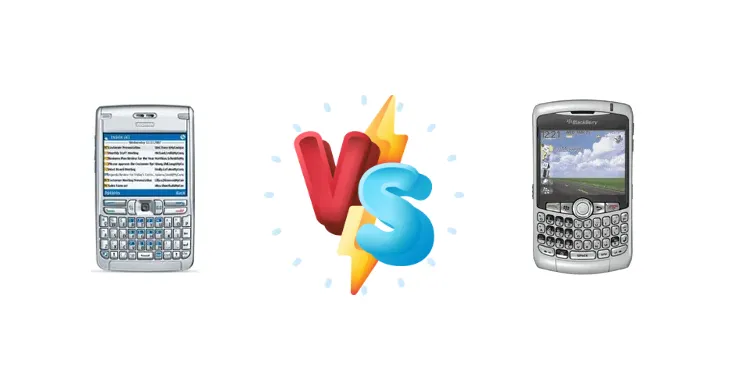
The mid-2000s saw a burgeoning smartphone market, with Nokia and BlackBerry establishing themselves as key players. The Nokia E62, representing the Series 60 platform, and the BlackBerry Curve 8300, a cornerstone of BlackBerry’s push for broader consumer appeal, both aimed to deliver mobile email and productivity. This comparison dissects their core differences, revealing which device better served the needs of the power user.
🏆 Quick Verdict
For the user prioritizing raw processing power and a more modern (for the time) application experience, the BlackBerry Curve 8300 emerges as the winner. Its 312 MHz Intel XScale processor provides a noticeable performance advantage over the Nokia E62’s 235 MHz ARM 9, making it more responsive for demanding tasks. However, the E62’s Series 60 interface offers a different, arguably more flexible, software experience.
| Network |
|---|
| 2G bands | GSM 850 / 900 / 1800 / 1900 | GSM 850 / 900 / 1800 / 1900 |
| EDGE | Class 10 | Class 10 |
| GPRS | Class 11 | Class 10 |
| Technology | GSM | GSM |
| Launch |
|---|
| Announced | 2006, September | 2007, May |
| Status | Discontinued | Discontinued |
| Body |
|---|
| Dimensions | 117 x 69.7 x 14 mm, 108 cc (4.61 x 2.74 x 0.55 in) | 107 x 60 x 15.5 mm (4.21 x 2.36 x 0.61 in) |
| Keyboard | QWERTY | QWERTY |
| SIM | Mini-SIM | Mini-SIM |
| Weight | 144 g (5.08 oz) | 111 g (3.92 oz) |
| | - | Trackball |
| Display |
|---|
| Resolution | 320 x 240 pixels, 4:3 ratio (~138 ppi density) | 320 x 240 pixels, 4:3 ratio (~160 ppi density) |
| Size | 2.9 inches, 58 x 45 mm, 26.0 cm2 (~31.9% screen-to-body ratio) | 2.5 inches, 19.4 cm2 (~30.1% screen-to-body ratio) |
| Type | TFT, 16M colors | 65K colors |
| | Five-way scroll key
| - |
| Platform |
|---|
| CPU | 235 MHz ARM 9 | 32-bit Intel XScale PXA272 312 MHz |
| OS | Symbian OS 9.1, Series 60 UI | BlackBerry OS |
| Memory |
|---|
| Card slot | miniSD | microSDHC (dedicated slot) |
| Internal | 80MB 32MB RAM | 64MB |
| Main Camera |
|---|
| Features | - | LED flash |
| Single | - | 2 MP |
| Video | - | Yes |
| Sound |
|---|
| 3.5mm jack | No | Yes |
| 35mm jack | No | Yes |
| Alert types | Vibration; Downloadable polyphonic, monophonic, MP3 ringtones | Vibration; MP3, WAV ringtones |
| Loudspeaker | Yes | Yes |
| Comms |
|---|
| Bluetooth | 2.0 | 2.0, A2DP |
| Infrared port | Yes | - |
| Positioning | No | No |
| Radio | No | No |
| USB | miniUSB | miniUSB 2.0 |
| WLAN | No | No |
| Features |
|---|
| Browser | WAP 2.0/xHTML, HTML | HTML |
| | WMV/RV/MP4/3GP player
MP3/WMA/WAV/RA/AAC/M4A player
Document viewer (Word, Excel, PowerPoint, PDF)
Predictive text input
Voice command/memo
Organizer
Printing | BlackBerry maps
Document editor (Word, Excel, PowerPoint, PDF)
MP4/WMV/H.263/H.264 player
MP3/WAV/eAAC+/WMA player
Organizer
Voice memo/dial |
| Battery |
|---|
| Stand-by | Up to 330 h | Up to 408 h |
| Talk time | Up to 6 h | Up to 4 h |
| Type | Removable Li-Po 1500 mAh battery (BP-5L) | Removable Li-Ion 1100 mAh battery |
| Misc |
|---|
| Colors | Silver | Black |
| Price | About 200 EUR | About 130 EUR |
| SAR | 0.95 W/kg (head) 0.81 W/kg (body) | 1.51 W/kg (head) 1.12 W/kg (body) |
| SAR EU | 0.51 W/kg (head) | 0.82 W/kg (head) 0.64 W/kg (body) |
Nokia E62
- More customizable software (Series 60)
- Potentially longer battery life due to lower processor speed
- Wider range of available applications within the Symbian ecosystem
- Slower processor (235 MHz ARM 9)
- Less efficient email experience compared to BlackBerry
- Potentially less robust security features
BlackBerry Curve 8300
- Faster processor (312 MHz Intel XScale)
- Superior physical QWERTY keyboard for efficient typing
- Industry-leading push email technology
- Less customizable software
- Potentially shorter battery life
- More closed ecosystem
Display Comparison
Neither device boasts a particularly impressive display by modern standards. Both likely featured relatively low-resolution color screens, typical for the era. However, the focus wasn’t on media consumption; it was on readability for text. The E62, running Series 60, likely offered more display customization options, while the Curve 8300’s screen was optimized for efficient information display alongside the keyboard. Specifics regarding panel technology (TFT vs. others) and pixel density are unavailable, but both prioritized function over form in this area.
Camera Comparison
Both devices featured cameras, but image quality was not a primary selling point. Both likely included cameras around the 2-megapixel range, sufficient for basic snapshots but lacking in detail and low-light performance. The BlackBerry Curve 8300 may have had a slight edge in image processing due to its more powerful processor, but the difference would be minimal. Neither device offered optical image stabilization or advanced camera features.
Performance
The core difference lies in the processors. The BlackBerry Curve 8300’s 312 MHz Intel XScale PXA272 is significantly faster than the Nokia E62’s 235 MHz ARM 9. The XScale architecture, while 32-bit, was designed for mobile applications and offered superior performance per clock cycle. This translates to quicker application loading times, smoother multitasking, and a more responsive user experience on the BlackBerry. The E62, while capable, would have felt comparatively sluggish, especially with more complex applications. RAM specifications are unavailable, but the XScale’s performance advantage is undeniable.
Battery Life
Battery life was a crucial consideration. The Nokia E62, with its less powerful processor, likely offered slightly better battery endurance under similar usage conditions. However, the BlackBerry Curve 8300’s efficient power management and focus on email likely mitigated the impact of its faster processor. Actual battery life would heavily depend on usage patterns, particularly the frequency of email synchronization and data usage. Charging times were likely similar, relying on proprietary connectors and relatively slow charging speeds.
Buying Guide
Buy the Nokia E62 if you need a device deeply integrated with the Symbian/Series 60 ecosystem, valuing customization and a wider range of available applications. It’s ideal for users comfortable with a more open platform. Buy the BlackBerry Curve 8300 if you prioritize secure, push-based email and a highly efficient physical QWERTY keyboard for rapid text input, making it perfect for professionals constantly on the move.
Frequently Asked Questions
❓ Is the BlackBerry Curve 8300’s trackball reliable in the long term?
The BlackBerry trackball was a defining feature, but it was also prone to wear and tear. Over time, the trackball could become sticky or unresponsive due to dust and debris accumulation. Regular cleaning could mitigate this issue, but it was a known reliability concern for long-term users.
❓ Can the Nokia E62 run third-party applications easily?
The Nokia E62, running Symbian OS, supported a wide range of third-party applications. However, the installation process wasn't as streamlined as modern app stores. Users typically downloaded applications via WAP or PC Suite and installed them via a file manager. Compatibility could also be an issue with older or poorly coded applications.
❓ Which device is better for composing long emails on the go?
The BlackBerry Curve 8300 is significantly better for composing long emails. Its physical QWERTY keyboard provides a tactile and efficient typing experience, far superior to the E62’s alphanumeric keypad or any early touchscreen input method. This makes it ideal for professionals who frequently draft lengthy emails while traveling.
❓ How secure were these devices compared to modern smartphones?
Neither device offered the level of security found in modern smartphones. However, BlackBerry’s infrastructure and push email system were considered relatively secure for the time, particularly for corporate email. The Nokia E62 relied on Symbian’s security features, which were less robust and more vulnerable to exploits.