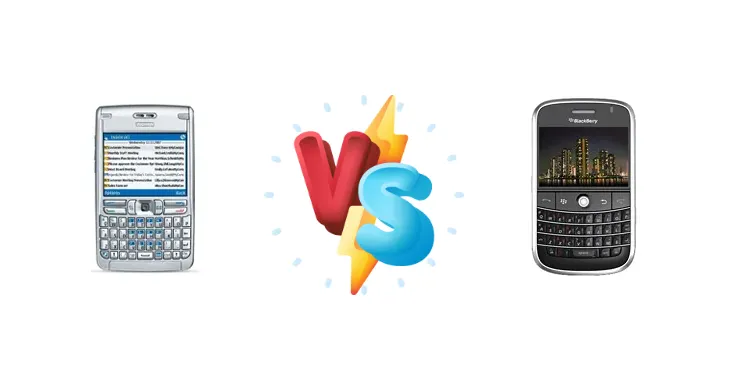
In the mid-2000s, the Nokia E62 and BlackBerry Bold 9000 represented the pinnacle of mobile productivity. Both devices targeted professionals needing robust email and communication tools, but they approached the challenge with fundamentally different hardware and software philosophies. This comparison dissects their strengths and weaknesses, revealing which device better served the needs of the power user.
🏆 Quick Verdict
For the average user seeking a balance of performance and usability, the BlackBerry Bold 9000 emerges as the stronger choice. Its significantly faster 624 MHz processor provides a noticeably smoother experience, particularly when handling complex tasks like email synchronization and document editing, outweighing the E62's more compact form factor.
| Network |
|---|
| 2G bands | GSM 850 / 900 / 1800 / 1900 | GSM 850 / 900 / 1800 / 1900 |
| 3G bands | - | HSDPA 850 / 1900 / 2100 |
| EDGE | Class 10 | - |
| GPRS | Class 11 | - |
| Speed | - | HSPA 3.6/0.384 Mbps |
| Technology | GSM | GSM / HSPA |
| Launch |
|---|
| Announced | 2006, September | 2008, May |
| Status | Discontinued | Discontinued |
| Body |
|---|
| Dimensions | 117 x 69.7 x 14 mm, 108 cc (4.61 x 2.74 x 0.55 in) | 114 x 66 x 14 mm (4.49 x 2.60 x 0.55 in) |
| Keyboard | QWERTY | QWERTY |
| SIM | Mini-SIM | Mini-SIM |
| Weight | 144 g (5.08 oz) | 133 g (4.69 oz) |
| | - | Trackball |
| Display |
|---|
| Resolution | 320 x 240 pixels, 4:3 ratio (~138 ppi density) | 480 x 320 pixels, 3:2 ratio (~222 ppi density) |
| Size | 2.9 inches, 58 x 45 mm, 26.0 cm2 (~31.9% screen-to-body ratio) | 2.6 inches, 20.1 cm2 (~26.8% screen-to-body ratio) |
| Type | TFT, 16M colors | 65K colors |
| | Five-way scroll key
| - |
| Platform |
|---|
| CPU | 235 MHz ARM 9 | 624 MHz |
| OS | Symbian OS 9.1, Series 60 UI | BlackBerry OS |
| Memory |
|---|
| Card slot | miniSD | microSDHC (dedicated slot) |
| Internal | 80MB 32MB RAM | 1GB 128MB RAM |
| Main Camera |
|---|
| Features | - | LED flash |
| Single | - | 2 MP |
| Video | - | Yes |
| Sound |
|---|
| 3.5mm jack | No | Yes |
| 35mm jack | No | Yes |
| Alert types | Vibration; Downloadable polyphonic, monophonic, MP3 ringtones | Vibration; MP3, WAV ringtones |
| Loudspeaker | Yes | Yes |
| Comms |
|---|
| Bluetooth | 2.0 | 2.0, A2DP |
| Infrared port | Yes | - |
| Positioning | No | GPS, A-GPS, BlackBerry Maps |
| Radio | No | No |
| USB | miniUSB | miniUSB 2.0 |
| WLAN | No | Wi-Fi 802.11 a/b/g |
| Features |
|---|
| Browser | WAP 2.0/xHTML, HTML | HTML |
| | WMV/RV/MP4/3GP player
MP3/WMA/WAV/RA/AAC/M4A player
Document viewer (Word, Excel, PowerPoint, PDF)
Predictive text input
Voice command/memo
Organizer
Printing | BlackBerry maps
Document editor (Word, Excel, PowerPoint, PDF)
MP4/WMV/H.264 player
MP3/eAAC+/WMA player
Organizer
Voice memo/dial |
| Battery |
|---|
| Stand-by | Up to 330 h | Up to 310 h |
| Talk time | Up to 6 h | Up to 5 h |
| Type | Removable Li-Po 1500 mAh battery (BP-5L) | Removable Li-Ion 1500 mAh battery |
| Misc |
|---|
| Colors | Silver | Black, White |
| Price | About 200 EUR | About 80 EUR |
| SAR | 0.95 W/kg (head) 0.81 W/kg (body) | 1.51 W/kg (head) 0.95 W/kg (body) |
| SAR EU | 0.51 W/kg (head) | 0.84 W/kg (head) 0.66 W/kg (body) |
| Tests |
|---|
| Audio quality | - |
Noise -87.6dB / Crosstalk -85.8dB |
| Loudspeaker | - |
Voice 70dB / Noise 66dB / Ring 68dB |
Nokia E62
- More compact and lightweight design.
- Potentially longer battery life under light usage.
- Traditional smartphone form factor.
- Significantly slower processor.
- Smaller display for reduced productivity.
- Limited multitasking capabilities.
BlackBerry Bold 9000
- Much faster processor for improved performance.
- Larger display for enhanced readability.
- Optimized for email and productivity tasks.
- Larger and heavier design.
- Potentially shorter battery life.
- Reliance on the BlackBerry ecosystem.
Display Comparison
Neither device boasts a particularly advanced display by modern standards. Both likely utilized reflective LCD technology common at the time. However, the Bold 9000’s larger screen size (exact dimensions unavailable) would offer a more comfortable viewing experience for reading emails and documents. The E62’s smaller display, while contributing to its compact size, necessitates more scrolling and zooming. Color accuracy and viewing angles were likely similar, constrained by the limitations of the technology.
Camera Comparison
Camera capabilities were not a primary focus for either device. Both likely featured basic cameras suitable for occasional snapshots. Specific sensor details are unavailable, but given the era, image quality would be limited by low resolution and poor low-light performance. The Bold 9000 may have had a slight advantage due to its more powerful processor enabling faster image processing, but the difference would be minimal. Neither device would compete with modern smartphone cameras.
Performance
The performance disparity is the most significant difference between these two devices. The BlackBerry Bold 9000’s 624 MHz processor represents a substantial leap over the Nokia E62’s 235 MHz ARM 9. This translates directly into faster application launch times, smoother multitasking, and quicker email synchronization. While both devices ran proprietary operating systems, the Bold 9000’s processor allowed for more complex background processes and a more responsive user interface. The E62, while adequate for basic tasks, would struggle with demanding applications.
Battery Life
Battery life is difficult to assess without specific mAh ratings. However, the Nokia E62’s lower-powered processor likely contributed to longer battery life under light usage. The Bold 9000’s more powerful processor would consume more energy, potentially requiring more frequent charging. Real-world battery performance would depend heavily on usage patterns, particularly the frequency of email synchronization and data usage. Charging times would also be significantly longer compared to modern fast-charging technologies.
Buying Guide
Buy the Nokia E62 if you prioritize a smaller, lighter device with a focus on basic communication and a more traditional smartphone experience. It’s ideal for users who primarily need a reliable phone for calls and simple messaging. Buy the BlackBerry Bold 9000 if you demand superior performance for multitasking, email management, and document editing. Its faster processor and optimized software make it the clear choice for professionals who rely heavily on their mobile device for productivity.
Frequently Asked Questions
❓ How does the BlackBerry Bold 9000's trackball compare to the Nokia E62's navigation?
The BlackBerry Bold 9000's trackball offered a unique and efficient method for navigating the user interface and selecting items, particularly within emails and lists. The Nokia E62 relied on a more traditional directional pad, which was less precise and required more deliberate movements. The trackball provided a faster and more intuitive experience for power users.
❓ Would the Nokia E62 be a suitable device for someone primarily using Gmail?
While the Nokia E62 could technically access Gmail through a mobile browser or a third-party application, the experience would be significantly less optimized than on the BlackBerry Bold 9000. BlackBerry’s push email technology and dedicated email client were specifically designed for efficient email management, offering features like instant notifications and seamless synchronization that the E62 would lack.
❓ Is the performance difference between the processors noticeable in everyday use?
Absolutely. The 624 MHz processor in the BlackBerry Bold 9000 provides a demonstrably smoother and more responsive experience compared to the Nokia E62’s 235 MHz processor. Tasks like opening applications, composing emails, and browsing the web are noticeably faster on the Bold 9000, reducing frustration and improving productivity.