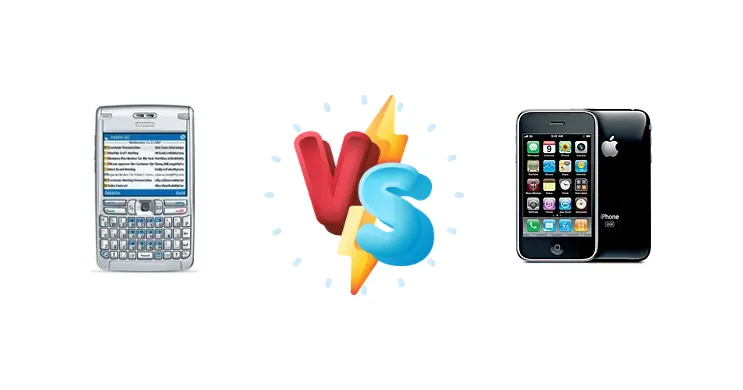
In 2009, the smartphone landscape was rapidly evolving. The Nokia E62, a business-focused device running Symbian OS, represented a continuation of established mobile traditions. Simultaneously, Apple’s iPhone 3GS was pushing boundaries with its innovative multi-touch interface and burgeoning app ecosystem. This comparison dissects these two pivotal devices, revealing their strengths and weaknesses in a historical context.
🏆 Quick Verdict
For the average user seeking a modern smartphone experience, the iPhone 3GS is the clear winner. Its faster 600 MHz Cortex-A8 processor and nascent app store offered a glimpse into the future of mobile computing. However, the Nokia E62 remains a compelling choice for users prioritizing physical keyboard input and a more traditional smartphone workflow.
| Network |
|---|
| 2G bands | GSM 850 / 900 / 1800 / 1900 | GSM 850 / 900 / 1800 / 1900 |
| 3G bands | - | HSDPA 850 / 1900 / 2100 |
| EDGE | Class 10 | - |
| GPRS | Class 11 | - |
| Speed | - | HSPA 7.2/0.384 Mbps |
| Technology | GSM | GSM / HSPA |
| Launch |
|---|
| Announced | 2006, September | 2009, June. Released 2009, June |
| Status | Discontinued | Discontinued |
| Body |
|---|
| Dimensions | 117 x 69.7 x 14 mm, 108 cc (4.61 x 2.74 x 0.55 in) | 115.5 x 62.1 x 12.3 mm (4.55 x 2.44 x 0.48 in) |
| Keyboard | QWERTY | - |
| SIM | Mini-SIM | Mini-SIM |
| Weight | 144 g (5.08 oz) | 135 g (4.76 oz) |
| Display |
|---|
| Protection | - | Corning Gorilla Glass, oleophobic coating |
| Resolution | 320 x 240 pixels, 4:3 ratio (~138 ppi density) | 320 x 480 pixels, 3:2 ratio (~165 ppi density) |
| Size | 2.9 inches, 58 x 45 mm, 26.0 cm2 (~31.9% screen-to-body ratio) | 3.5 inches, 36.5 cm2 (~50.9% screen-to-body ratio) |
| Type | TFT, 16M colors | TFT |
| | Five-way scroll key
| - |
| Platform |
|---|
| CPU | 235 MHz ARM 9 | 600 MHz Cortex-A8 |
| GPU | - | PowerVR SGX535 |
| OS | Symbian OS 9.1, Series 60 UI | iOS 3, upgradable to iOS 6.1.6 |
| Memory |
|---|
| Card slot | miniSD | No |
| Internal | 80MB 32MB RAM | 8GB 256MB RAM, 16GB 256MB RAM, 32GB 256MB RAM |
| Main Camera |
|---|
| Single | - | 3.15 MP, f/2.8, AF |
| Video | - | 480p@30fps |
| Sound |
|---|
| 3.5mm jack | No | Yes |
| 35mm jack | No | Yes |
| Alert types | Vibration; Downloadable polyphonic, monophonic, MP3 ringtones | - |
| Loudspeaker | Yes | Yes |
| Comms |
|---|
| Bluetooth | 2.0 | 2.1, A2DP (headset support only) |
| Infrared port | Yes | - |
| Positioning | No | GPS, A-GPS |
| Radio | No | No |
| USB | miniUSB | 2.0 |
| WLAN | No | Wi-Fi 802.11 b/g |
| Features |
|---|
| Browser | WAP 2.0/xHTML, HTML | HTML (Safari) |
| Sensors | - | Accelerometer, proximity, compass |
| | WMV/RV/MP4/3GP player
MP3/WMA/WAV/RA/AAC/M4A player
Document viewer (Word, Excel, PowerPoint, PDF)
Predictive text input
Voice command/memo
Organizer
Printing | iCloud cloud service
Maps
Organizer
TV-out
Audio/video player/editor
Photo viewer/editor
Voice command/dial
Predictive text input |
| Battery |
|---|
| Stand-by | Up to 330 h | - |
| Talk time | Up to 6 h | Up to 5 h (3G) |
| Type | Removable Li-Po 1500 mAh battery (BP-5L) | Li-Ion 1400 mAh, non-removable |
| Misc |
|---|
| Colors | Silver | Black, White |
| Models | - | A1325, A1303, iPhone2,1 |
| Price | About 200 EUR | About 110 EUR |
| SAR | 0.95 W/kg (head) 0.81 W/kg (body) | 0.26 W/kg (head) 0.79 W/kg (body) |
| SAR EU | 0.51 W/kg (head) | 0.45 W/kg (head) 0.40 W/kg (body) |
| Tests |
|---|
| Audio quality | - |
Noise -92.1dB / Crosstalk -95.0dB |
| Camera | - |
Photo |
| Display | - |
Contrast ratio: 201:1 (nominal) |
| Loudspeaker | - |
Voice 69dB / Noise 69dB / Ring 71dB
|
Nokia E62
- Excellent physical QWERTY keyboard for efficient typing.
- Symbian OS offers extensive customization options.
- More affordable price point at launch.
- Significantly slower processor compared to the iPhone 3GS.
- Resistive touchscreen is less responsive and accurate.
- Limited app ecosystem compared to the App Store.
Apple iPhone 3GS
- Faster 600 MHz Cortex-A8 processor delivers superior performance.
- Capacitive touchscreen provides a more intuitive user experience.
- Pioneering App Store unlocks a world of mobile applications.
- Lack of a physical keyboard may hinder productivity for some users.
- Higher price point compared to the Nokia E62.
- Limited customization options compared to Symbian OS.
Display Comparison
Both devices share a nominal contrast ratio of 201:1, indicating similar display technology limitations of the era. However, the iPhone 3GS’s 3.5-inch display benefits from a capacitive touchscreen, offering superior responsiveness compared to the E62’s resistive touchscreen. While neither device boasts high resolution by today’s standards, the iPhone’s display was generally perceived as sharper and more vibrant due to its optimized color calibration and touch input.
Camera Comparison
Both devices feature photo cameras, but details regarding sensor size and image quality are limited in the provided data. The iPhone 3GS, however, benefited from Apple’s image processing algorithms, which generally produced more pleasing and shareable photos. The E62’s camera, while functional, was likely more focused on capturing documentation than artistic photography. The iPhone’s camera was a key selling point, showcasing the potential of mobile photography.
Performance
The performance disparity is significant. The Nokia E62’s 235 MHz ARM 9 processor is demonstrably slower than the iPhone 3GS’s 600 MHz Cortex-A8. This difference translates to noticeably slower application loading times, web browsing, and overall system responsiveness on the E62. The Cortex-A8 architecture, coupled with a higher clock speed, allows the iPhone 3GS to handle more complex tasks and multitasking with greater ease. The E62’s performance, while adequate for basic tasks, feels constrained in comparison.
Battery Life
Without specific battery capacity (mAh) data for either device, a direct comparison is difficult. However, the iPhone 3GS’s more efficient Cortex-A8 processor likely contributed to comparable or slightly better battery life despite its higher processing power. The E62’s Symbian OS, while customizable, was not known for its power efficiency. Real-world usage would likely reveal similar battery performance, with both devices requiring daily charging for moderate to heavy use.
Buying Guide
Buy the Nokia E62 if you need a robust physical QWERTY keyboard for extensive email and document editing, and value the flexibility of Symbian OS for customization. Buy the Apple iPhone 3GS if you prefer a streamlined, touch-centric user experience, and are excited by the potential of mobile applications and a more responsive interface. The E62 is for the power user focused on productivity; the 3GS is for the early adopter embracing a new paradigm.
Frequently Asked Questions
❓ Was the Nokia E62 a good business phone for its time?
Absolutely. The E62’s QWERTY keyboard and Symbian OS were highly valued by business users who relied on email, document editing, and contact management. It offered a productivity-focused experience that many found superior to early touchscreen smartphones.
❓ How did the iPhone 3GS’s App Store change the mobile landscape?
The App Store fundamentally altered the mobile experience. It moved the focus from hardware features to software capabilities, allowing developers to create and distribute applications directly to users. This fostered innovation and transformed the iPhone from a phone into a versatile mobile platform.
❓ Could the Nokia E62 run third-party applications?
Yes, the Nokia E62, running Symbian OS, supported third-party applications. However, the app ecosystem was fragmented and lacked the centralized distribution and quality control of Apple’s App Store. Finding and installing apps was often more complex and less secure.