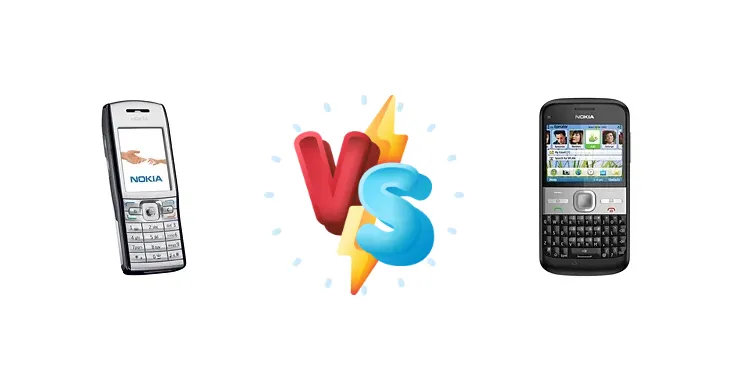
Remember the days of Symbian and durable Nokia phones? We're pitting two of them against each other: the Nokia E50 and the Nokia E5. Both offer a glimpse into a bygone era of mobile technology, but which one holds up better today?
🏆 Quick Verdict
The Nokia E5 decisively wins thanks to its significantly faster processor and improved overall performance. While the E50 has a certain nostalgic charm, the E5's speed and slightly more modern features make it the better choice for anyone seeking a usable retro experience.
| Network |
|---|
| 2G bands | GSM 850 / 900 / 1800 / 1900 | GSM 850 / 900 / 1800 / 1900 |
| 3G bands | - | HSDPA 900 / 1900 / 2100 |
| EDGE | Class 10 | - |
| GPRS | Class 10 | - |
| Speed | - | HSPA 10.2/2 Mbps |
| Technology | GSM | GSM / HSPA |
| | - | HSDPA 850 / 1900 / 2100 |
| Launch |
|---|
| Announced | 2006, May | 2010, April. Released 2010, August |
| Status | Discontinued | Discontinued |
| Body |
|---|
| Dimensions | 113 x 43.5 x 15.5 mm, 70 cc (4.45 x 1.71 x 0.61 in) | 115 x 58.9 x 12.8 mm, 75 cc (4.53 x 2.32 x 0.50 in) |
| Keyboard | - | QWERTY |
| SIM | Mini-SIM | Mini-SIM |
| Weight | 104 g (3.67 oz) | 126 g (4.44 oz) |
| Display |
|---|
| Resolution | 240 x 320 pixels, 4:3 ratio (~190 ppi density) | 320 x 240 pixels, 4:3 ratio (~169 ppi density) |
| Size | 2.1 inches, 31 x 42 mm, 13.7 cm2 (~27.8% screen-to-body ratio) | 2.36 inches, 17.2 cm2 (~25.5% screen-to-body ratio) |
| Type | TFT, 256K colors | TFT, 256K colors |
| | 5-way joystick navigation
Downloadable themes | - |
| Platform |
|---|
| CPU | 235 MHz ARM 9 | 600 MHz ARM 11 |
| OS | Symbian OS 9.1, S60 3rd edition | Symbian 9.3, Series 60 rel. 3.2 |
| Memory |
|---|
| Card slot | microSD (dedicated slot) | microSDHC (dedicated slot), 2 GB included |
| Internal | 70MB 32MB RAM | 250MB; 256MB RAM |
| Main Camera |
|---|
| Features | also available without camera | LED flash |
| Single | 1.3 MP | 5 MP |
| Video | QCIF | 480p@15fps |
| Sound |
|---|
| 3.5mm jack | No | Yes |
| 35mm jack | No | Yes |
| Alert types | Vibration; Downloadable polyphonic, monophonic, MP3, ringtones | - |
| Loudspeaker | Yes | Yes |
| Comms |
|---|
| Bluetooth | 2.0 | 2.0, A2DP |
| Infrared port | Yes | - |
| Positioning | No | GPS, A-GPS; Ovi Maps |
| Radio | No | Stereo FM radio, RDS |
| USB | Pop-Port 2.0 | microUSB 2.0 |
| WLAN | No | Wi-Fi 802.11 b/g, UPnP & DLNA technology |
| Features |
|---|
| Browser | WAP 2.0/xHTML, HTML | WAP 2.0/xHTML, HTML, Adobe Flash Lite |
| | Push to talk
WMV/RV/MP4/3GP player
MP3/WMA/WAV/RA/AAC/M4A player
Document viewer (Word, Excel, PowerPoint, PDF)
Blackberry connectivity
Predictive text input
Voice command/memo
Organizer | Document editor (Word, Excel, PowerPoint), PDF viewer
MP4/H.264/WMV player
MP3/WAV/WMA/eAAC+ player
Voice command/dial
Organizer
Predictive text input |
| Battery |
|---|
| Music play | - | Up to 38 h |
| Stand-by | Up to 240 h | Up to 635 h (2G) / Up to 670 h (3G) |
| Talk time | Up to 8 h | Up to 13 h 10 min (2G) / Up to 5 h 15 min (3G) |
| Type | Removable Li-Ion 970 mAh battery (BL-5C) | Removable Li-Ion 1200 mAh battery (BL-4D) |
| Misc |
|---|
| Colors | Silver, Black | Carbon Black, Chalk White, Sky Blue, Copper Brown, Silver Grey |
| Price | About 150 EUR | About 90 EUR |
| SAR | 0.96 W/kg (head) 1.33 W/kg (body) | 1.18 W/kg (head) 1.12 W/kg (body) |
| SAR EU | 0.97 W/kg (head) | 0.88 W/kg (head) |
| Tests |
|---|
| Audio quality | - |
Noise -90.0dB / Crosstalk -91.5dB |
| Camera | - |
Photo |
| Loudspeaker | - |
Voice 75dB / Noise 66dB / Ring 75dB |
Nokia E50
- Classic Nokia design
- Compact size
- Durable build quality
- Symbian OS (nostalgia factor)
- Slow processor
- Low-resolution display
- Poor camera
- Limited app support
Nokia E5
- Faster processor
- Improved performance
- Slightly better battery life
- More responsive user experience
- Still dated technology
- Low-resolution display
- Poor camera
- Limited app support
Display Comparison
Both phones feature relatively small, QVGA displays typical of their time. The E50's screen is slightly smaller, but both offer adequate readability for text-based tasks. Neither phone excels in display quality by modern standards.
Camera Comparison
Both phones feature basic 'photo' cameras, meaning they are very low resolution and offer limited functionality. Image quality is poor by today's standards, and neither phone is suitable for serious photography. The E5 might have a slightly better sensor, but the difference is minimal.
Performance
This is where the E5 shines. Its 600 MHz ARM 11 processor is a substantial upgrade over the E50's 235 MHz ARM 9. Expect noticeably faster app loading, smoother navigation, and a more responsive user experience on the E5.
Battery Life
The Nokia E5 generally has a slightly larger battery capacity, potentially offering a bit longer battery life than the E50. However, both phones will require frequent charging with moderate use.
Buying Guide
The Nokia E50 is best for collectors and those seeking a very specific, early 2000s Nokia experience. The Nokia E5 is suitable for users wanting a functional, albeit dated, phone for basic tasks and a taste of classic Nokia design.
Frequently Asked Questions
❓ Are apps available for these phones?
App availability is extremely limited. Both phones run older versions of Symbian, and modern app stores are not supported. You may find some legacy apps, but don't expect a wide selection.
❓ Are these phones worth buying in 2024?
They're primarily of interest to collectors or those seeking a nostalgic experience. For practical use, modern smartphones offer vastly superior features and performance.