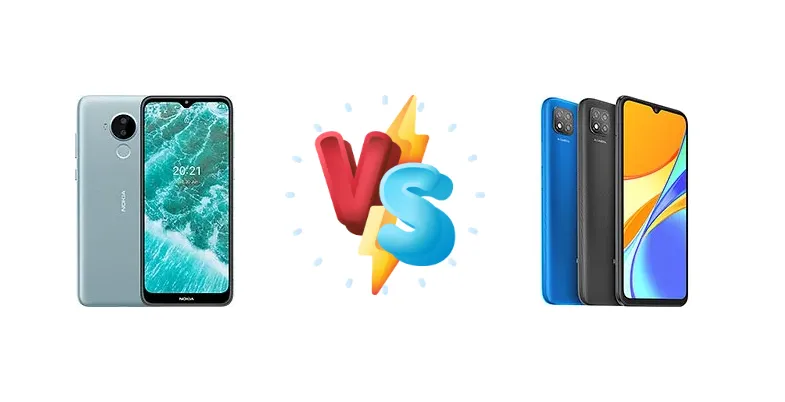
The Nokia C30 and Xiaomi Redmi 9C NFC represent the ultra-budget end of the smartphone spectrum, targeting first-time buyers or those needing a reliable secondary device. Both offer essential features like NFC, but diverge significantly in their underlying hardware, particularly in their chipsets. This comparison dissects those differences to determine which phone delivers the best value.
🏆 Quick Verdict
For the average user prioritizing responsiveness and efficiency, the Xiaomi Redmi 9C NFC is the better choice. Its MediaTek Helio G35, built on a 12nm process, offers a noticeable performance advantage over the Nokia C30’s Unisoc SC9863A, despite both being octa-core CPUs. While both charge at 10W, the Redmi 9C NFC’s processor is less likely to be bottlenecked in everyday tasks.
| Network |
|---|
| 2G bands | GSM 850 / 900 / 1800 / 1900 | GSM 850 / 900 / 1800 / 1900 |
| 3G bands | HSDPA 850 / 900 / 2100 - International | HSDPA 850 / 900 / 1700(AWS) / 1900 / 2100 |
| 4G bands | 1, 3, 5, 7, 8, 20, 28, 38, 40, 41 - International | 1, 2, 3, 4, 5, 7, 8, 20, 38, 40 |
| Speed | HSPA 42.2/5.76 Mbps, LTE Cat4 150/50 Mbps | HSPA, LTE |
| Technology | GSM / HSPA / LTE | GSM / HSPA / LTE |
| | 1, 3, 7, 20, 28 - Australia, UK, Ireland | - |
| Launch |
|---|
| Announced | 2021, July 27 | 2020, August 27. Released 2020, August 27 |
| Status | Available. Released 2021, October 12 | Discontinued |
| Body |
|---|
| Dimensions | 177.7 x 79.1 x 9.9 mm (7.00 x 3.11 x 0.39 in) | 164.9 x 77.1 x 9 mm (6.49 x 3.04 x 0.35 in) |
| SIM | Nano-SIM + Nano-SIM | Nano-SIM + Nano-SIM |
| Weight | 237 g (8.36 oz) | 196 g (6.91 oz) |
| Display |
|---|
| Resolution | 720 x 1600 pixels, 20:9 ratio (~257 ppi density) | 720 x 1600 pixels, 20:9 ratio (~269 ppi density) |
| Size | 6.82 inches, 112.3 cm2 (~79.9% screen-to-body ratio) | 6.53 inches, 102.9 cm2 (~81.0% screen-to-body ratio) |
| Type | IPS LCD | IPS LCD, 400 nits (typ) |
| Platform |
|---|
| CPU | Octa-core (4x1.6 GHz Cortex-A55 & 4x1.2 GHz Cortex-A55) | Octa-core (4x2.3 GHz Cortex-A53 & 4x1.8 GHz Cortex-A53) |
| Chipset | Unisoc SC9863A (28 nm) | Mediatek MT6765G Helio G35 (12 nm) |
| GPU | IMG8322 | PowerVR GE8320 |
| OS | Android 11 (Go edition) | Android 10, MIUI 12 |
| Memory |
|---|
| Card slot | microSDXC (dedicated slot) | microSDXC (dedicated slot) |
| Internal | 32GB 2GB RAM, 32GB 3GB RAM, 64GB 2GB RAM, 64GB 3GB RAM, 64GB 4GB RAM | 32GB 2GB RAM, 32GB 3GB RAM, 64GB 2GB RAM, 64GB 3GB RAM, 128GB 3GB RAM, 128GB 4GB RAM |
| | eMMC 5.1 | eMMC 5.1 |
| Main Camera |
|---|
| Dual | 13 MP, (wide)
Auxiliary lens | 13 MP, f/2.2, 28mm (wide), 1.0µm, PDAF
2 MP (macro) |
| Features | LED flash | LED flash, HDR |
| Single | 5 MP | - |
| Video | 1080p@30fps | 1080p@30fps |
| Selfie camera |
|---|
| Features | - | HDR |
| Single | 5 MP | 5 MP, f/2.2, (wide), 1.12µm |
| Video | Unspecified | 1080p@30fps |
| Sound |
|---|
| 3.5mm jack | Yes | Yes |
| 35mm jack | Yes | Yes |
| Loudspeaker | Yes | Yes |
| Comms |
|---|
| Bluetooth | 4.2, A2DP | 5.0, A2DP, LE |
| NFC | No | Yes |
| Positioning | GPS | GPS, GLONASS, BDS |
| Radio | FM radio | FM radio |
| USB | microUSB 2.0, OTG | microUSB 2.0, OTG |
| WLAN | Wi-Fi 802.11 b/g/n | Wi-Fi 802.11 b/g/n, Wi-Fi Direct |
| Features |
|---|
| Sensors | Fingerprint (rear-mounted), accelerometer, proximity | Fingerprint (rear-mounted), accelerometer, proximity |
| Battery |
|---|
| Charging | 10W wired | 10W wired |
| Type | Li-Po 6000 mAh | Li-Po 5000 mAh |
| Misc |
|---|
| Colors | Green, White, Dark Grey | Midnight Gray, Sunshine Yellow, Twilight Blue |
| Models | TA-1357, TA-1377, TA-1369, TA-1360, TA-1359 | M2006C3MNG |
| Price | About 100 EUR | About 100 EUR |
| SAR | 0.33 W/kg (head) 1.19 W/kg (body) | 0.57 W/kg (head) 0.90 W/kg (body) |
| SAR EU | 0.41 W/kg (head) 1.29 W/kg (body) | 0.37 W/kg (head) 1.14 W/kg (body) |
Nokia C30
- Potentially cleaner Android experience with Nokia's software.
- May receive more timely security updates (though limited).
- Larger display size (assumed, based on market positioning).
- Less powerful and less efficient Unisoc SC9863A chipset.
- Likely slower app loading times and multitasking.
- Potentially poorer gaming performance.
Xiaomi Redmi 9C NFC
- More efficient MediaTek Helio G35 chipset.
- Faster app loading and smoother multitasking.
- NFC support for contactless payments.
- Better gaming performance (relative to the C30).
- Xiaomi’s MIUI software can be more cluttered.
- Potential for more bloatware.
- Update support may be less consistent than Nokia.
Display Comparison
Neither device boasts a standout display. Both likely feature LCD panels, typical for this price point. However, detailed specs like resolution and brightness are missing. The focus here is on the internal hardware, as display quality is unlikely to be a major differentiator. Bezels are expected to be substantial on both, maximizing screen real estate within a budget.
Camera Comparison
Both phones likely feature basic camera setups. Without detailed sensor information, it’s difficult to make a definitive judgment. However, the Redmi 9C NFC’s image signal processor (ISP), integrated within the Helio G35, is likely more capable than the one in the Unisoc SC9863A. This could result in slightly better image processing, particularly in low-light conditions. The prevalence of 2MP macro/depth sensors on both devices suggests these are largely marketing features and won’t significantly impact image quality.
Performance
The core difference lies in the chipsets. The Xiaomi Redmi 9C NFC’s MediaTek Helio G35 (12nm) is demonstrably more efficient than the Nokia C30’s Unisoc SC9863A (28nm). The 12nm process allows for higher clock speeds (2.3 GHz vs 1.6 GHz) and a more modern architecture (Cortex-A53 vs A55) for the primary cores. While both are octa-core, the Helio G35’s architecture translates to better single-core and multi-core performance, resulting in smoother app launches and less lag during multitasking. The Unisoc chip, being older and on a larger node, will struggle more with demanding applications.
Battery Life
Both devices are equipped with 10W charging, indicating similar charging speeds (expect around 2.5-3 hours for a full charge). Battery capacity is not specified, but given the target market, both likely house batteries in the 4000-5000 mAh range. The Redmi 9C NFC’s more efficient Helio G35 chipset will translate to better battery life in real-world usage, allowing it to last longer on a single charge despite potentially having a similar capacity battery.
Buying Guide
Buy the Nokia C30 if you prioritize a larger display and a clean Android experience, potentially benefiting from Nokia’s software update promises (though limited). Buy the Xiaomi Redmi 9C NFC if you need a more responsive device for basic multitasking, social media, and occasional gaming, and value the added efficiency of the Helio G35 chipset. The NFC functionality is a key benefit for mobile payments on the Redmi 9C NFC.
Frequently Asked Questions
❓ Will the Redmi 9C NFC struggle with popular apps like WhatsApp and Facebook?
While not a powerhouse, the Helio G35 in the Redmi 9C NFC is sufficient for running popular apps like WhatsApp and Facebook smoothly. The more efficient processor and likely optimized RAM management will prevent significant lag during typical usage. The Nokia C30’s Unisoc chip may exhibit more noticeable slowdowns.
❓ Is the NFC on the Redmi 9C NFC compatible with all payment systems?
The Redmi 9C NFC’s NFC functionality is generally compatible with most major contactless payment systems like Google Pay and various bank-specific mobile payment solutions. However, compatibility can vary depending on your region and bank. It’s best to check with your bank to confirm support.
❓ Can I play basic games like PUBG Mobile on either of these phones?
You can *attempt* to play PUBG Mobile on both, but expect a very limited experience. The Helio G35 in the Redmi 9C NFC will offer slightly better frame rates at the lowest settings, but both phones will struggle with consistent performance. These phones are not designed for gaming.
❓ Which phone is better for someone who primarily uses their phone for calls and texts?
Both phones are perfectly adequate for calls and texts. However, the Redmi 9C NFC’s more efficient processor will contribute to slightly better standby battery life, meaning it will likely last longer between charges even with minimal usage.